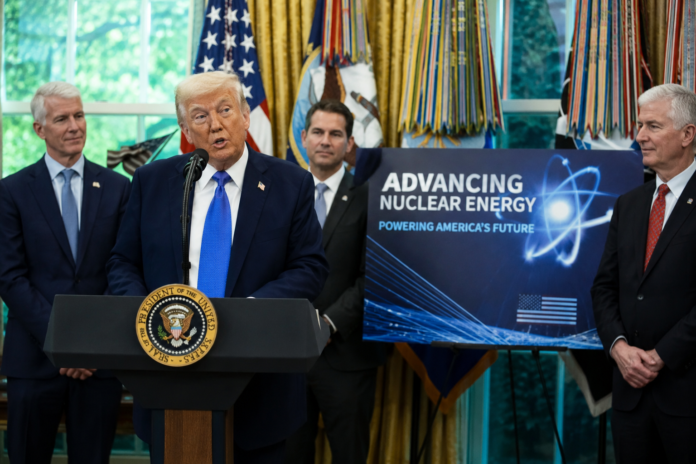
President Donald Trump announced Friday that four American nuclear energy startups have successfully brought advanced reactors to criticality, exceeding a White House goal set last year and marking what officials call the beginning of a domestic nuclear renaissance. The Oval Office event featured Energy Secretary Chris Wright and industry executives celebrating the first privately funded advanced reactor designs to come online in the United States in more than four decades. The announcement lands amid a broader administration push to quadruple U.S. nuclear capacity and meet surging electricity demand from artificial intelligence data centers.
Story Highlights
- Four nuclear startups reached reactor criticality, beating Trump’s goal of three by the July 4 deadline set in 2025 executive orders
- The milestone marks the first privately funded advanced nuclear designs operational in the U.S. in over 40 years
- The push is tied to the administration’s Genesis Mission and efforts to expand energy supply for AI data centers
What Happened
President Donald Trump convened an Oval Office event on Friday to announce that four American nuclear energy companies had successfully reached criticality, the point at which a reactor produces a self-sustaining nuclear reaction, ahead of a self-imposed deadline. “Most believed the goal was impossible, but I’m delighted to say that four companies succeeded in meeting that deadline,” Trump said, calling the achievement “pretty much a miracle.” He was joined by Energy Secretary Chris Wright, Interior Secretary Doug Burgum, and executives from the four participating companies.
The milestone traces back to four executive orders Trump signed in May 2025 aimed at accelerating nuclear licensing, cutting regulatory red tape, and establishing a Department of Energy pilot program to test advanced reactor designs outside traditional commercial regulatory timelines. The administration had set a target of three reactors reaching criticality by July 4, 2026, the nation’s 250th anniversary. Four companies cleared that bar instead, according to the Energy Department.
“America is building again, America is dreaming again, and we’re leading the world in pioneering the next generation of nuclear power,” Trump said during the event, framing the achievement as validation of his broader deregulatory approach to energy policy. The announcement followed a Wednesday Energy Department update revealing the first projects selected under the administration’s Genesis Mission, a program using artificial intelligence to accelerate scientific and engineering discovery, including nearly 300 projects touching nuclear energy, critical minerals, and related infrastructure.
The largest single project within that effort is a three-year, $60 million investment applying AI tools to speed up nuclear facility construction while lowering operating costs. Separately, the administration disclosed this week that it is evaluating placing nuclear energy projects in federal waters, part of a broader effort to identify new siting options for advanced reactors as land-based permitting remains contentious in some states.
The event also came against the backdrop of a controversial U.S.-Saudi Arabia nuclear cooperation deal announced earlier in the week, which Trump said remains conditional on Saudi Arabia normalizing relations with Israel under the Abraham Accords framework, linking domestic nuclear policy to ongoing Middle East diplomacy.
Why It Matters
The nuclear announcement matters first and foremost for America’s electricity grid, which is under mounting strain from the explosive growth of AI data centers. These facilities consume enormous and continuous amounts of power, and utilities across the country have warned that existing generation capacity, largely natural gas and aging nuclear plants, may not keep pace with demand growth over the next decade. Advanced reactors, particularly smaller modular designs, are seen by both parties as a potential solution because they can be built faster and sited more flexibly than traditional large-scale plants.
For ratepayers, the administration has tied this nuclear push to its separate Ratepayer Protection Pledge, an effort to shield ordinary electricity customers from cost increases tied to AI-driven demand. Whether nuclear expansion actually lowers costs for households depends heavily on construction timelines and financing costs, both of which have historically been the Achilles’ heel of the American nuclear industry.
The achievement also has notable industrial policy implications. If the reactors that reached criticality this month can be replicated at scale, the United States could reestablish itself as a global leader in nuclear technology exports, an area where Russia and China have made significant inroads in recent years by financing and building reactors abroad, including in parts of Africa and Asia.
For the environmental and energy policy debate more broadly, the milestone gives nuclear power renewed political momentum in Washington, potentially strengthening the case for continued federal support even as the administration has simultaneously rolled back environmental review requirements that critics argue protect surrounding communities and ecosystems.
Economic and Global Context
Nuclear power has struggled for decades in the United States due to high upfront capital costs, lengthy regulatory timelines, and public wariness following incidents like Three Mile Island. The last large-scale reactors to come online, at Georgia’s Vogtle plant, took more than a decade and ran billions of dollars over budget before completing in 2023 and 2024. The four reactors highlighted Friday represent a different model: smaller, standardized designs built by private companies under a streamlined federal pilot program rather than traditional utility-scale construction.
Globally, the nuclear race has intensified. China has been constructing reactors at a pace far exceeding the United States, while Russia has positioned itself as a nuclear technology and fuel supplier to developing nations, particularly across Africa, often bundling reactor construction with security and political influence arrangements. Analysts have noted a potential emerging arrangement in which the U.S. supplies advanced reactor technology and digital controls while Russia handles fuel supply and security in some international projects, a dynamic that would notably exclude European firms from certain markets.
Financially, the AI boom’s energy appetite has become a central storyline for utilities and investors. Data center operators including major cloud computing providers have signed long-term power purchase agreements directly with nuclear developers, betting that advanced reactors can deliver the round-the-clock, carbon-free electricity that intermittent renewables cannot easily provide at the scale AI training and inference require.
The Genesis Mission’s nearly 300 selected projects, spanning energy, critical minerals, and scientific research, represent a broader administration bet that AI itself can be used as a tool to accelerate breakthroughs in the physical sciences, shortening development timelines that have historically taken decades.
Implications
In the coming months, expect increased scrutiny of whether the four reactors that reached criticality can move toward full commercial operation and whether their construction and licensing model can be replicated across additional sites. Success would likely embolden further deregulatory action from the Nuclear Regulatory Commission and additional federal incentives for advanced reactor developers.
For utilities and grid operators, the announcement signals that federal policy will continue favoring rapid nuclear deployment, which may influence long-term planning decisions and capital allocation toward nuclear partnerships rather than exclusively natural gas or renewable buildouts.
For international partners, particularly Saudi Arabia and other nations seeking civilian nuclear cooperation with the United States, the domestic success strengthens Washington’s negotiating position, though deals like the Saudi arrangement remain entangled with unresolved regional diplomacy tied to the Abraham Accords.
For voters and ratepayers, the real test will come in whether this nuclear expansion translates into stable or lower electricity bills over the next several years, a promise the administration has made explicitly but one that will depend on execution far beyond Friday’s ceremonial announcement.
Sources

