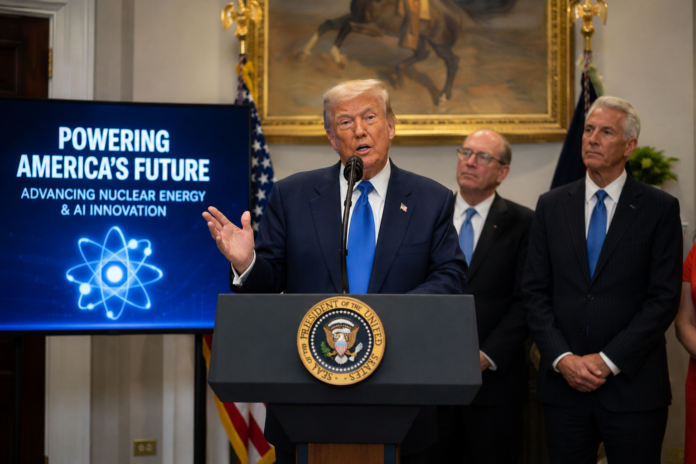
President Trump used a White House announcement Friday to advance his administration’s push to modernize American nuclear energy, building on a week of moves that included opening federal waters to potential nuclear projects and funding dozens of AI-driven nuclear research initiatives. The announcement reflects a broader Republican strategy to expand domestic energy production and reduce reliance on foreign energy sources. It also comes as the administration works to address surging electricity demand driven by the artificial intelligence boom.
Story Highlights
- Trump delivered remarks from the Oval Office at 3 p.m. Friday on American nuclear innovation
- The announcement follows a Wednesday decision to evaluate placing nuclear energy projects in federal waters
- The Department of Energy this week selected nearly 300 projects under Trump’s Genesis Mission, including a $60 million AI-driven nuclear initiative
- The Marine Minerals Administration signed a coordination agreement with the Nuclear Regulatory Commission for offshore nuclear oversight
What Happened
President Trump delivered remarks from the Oval Office on Friday afternoon focused on advancing American nuclear energy innovation, capping a week of administration actions aimed at accelerating the deployment of nuclear power nationwide. The announcement came just two days after the administration disclosed it would evaluate placing nuclear energy projects in federal waters, part of a broader effort to expand where and how quickly new nuclear facilities can be built.
According to a Reuters report cited by multiple outlets, the Marine Minerals Administration, which oversees development on the United States’ Outer Continental Shelf, signed a coordination agreement with the Nuclear Regulatory Commission this week to jointly oversee potential offshore nuclear projects. The arrangement is designed to streamline regulatory review for nuclear facilities located in federal waters, an approach officials say could speed up deployment timelines that have historically stretched a decade or longer for new reactor projects in the United States.
The nuclear push is closely tied to the administration’s Genesis Mission, a broader initiative aimed at accelerating artificial intelligence-driven scientific discovery. Earlier in the week, the Department of Energy announced the first projects selected under the Genesis Mission’s Request for Applications process, encompassing nearly 300 initiatives addressing challenges in energy, science and engineering, including nuclear energy, critical mineral extraction, chip design and commercial fusion energy. The largest single project selected under the initiative is a three-year, $60 million investment intended to use artificial intelligence to help deliver nuclear facilities faster and more safely while reducing operating costs.
The nuclear announcement also follows a separate White House event earlier in the week, where Trump unveiled a “Ratepayer Protection Pledge” during a roundtable at the Environmental Protection Agency, an initiative intended to shield everyday electricity customers from rising costs tied to surging power demand from data centers and artificial intelligence infrastructure. Together, the moves reflect an administration strategy that links energy expansion directly to broader technology and national competitiveness goals, positioning nuclear power as a central pillar of that effort. As of Friday afternoon, the White House had not released full details of the specific policy actions included in Trump’s Oval Office remarks.
Why It Matters
Nuclear energy has emerged as a rare point of growing bipartisan interest in Washington, but the Trump administration’s approach reflects a distinctly Republican emphasis on deregulation and accelerated permitting as the primary levers for expanding capacity. For a party that has long championed reducing regulatory barriers to domestic energy production, the coordination agreement between the Marine Minerals Administration and the Nuclear Regulatory Commission represents a concrete step toward removing bureaucratic friction that has historically slowed nuclear project timelines.
The push also arrives at a moment of acute strain on the American power grid, driven substantially by the exponential growth in electricity demand from data centers supporting artificial intelligence systems. Industry estimates have repeatedly flagged looming capacity shortfalls as AI infrastructure expands, and Republicans have increasingly framed nuclear energy, with its high energy density and lack of carbon emissions, as a practical solution that avoids the reliability concerns associated with intermittent renewable sources.
For American consumers, the stakes are directly tied to electricity affordability. The administration’s Ratepayer Protection Pledge underscores a political recognition that rising electricity costs, driven in part by the same AI boom the administration is otherwise promoting, could become a significant liability heading into the midterm elections if not addressed convincingly.
The emphasis on offshore nuclear siting also reflects a broader Republican energy strategy that treats federal lands and waters as underutilized assets for expanding American energy independence, echoing similar approaches taken toward offshore oil and gas leasing earlier in Trump’s term.
Economic and Global Context
The $60 million AI-driven nuclear investment announced under the Genesis Mission represents just one piece of a substantially larger push to modernize America’s nuclear fleet, which has seen limited new reactor construction in recent decades despite nuclear power providing roughly one-fifth of total U.S. electricity generation. Advocates argue that streamlined permitting, combined with new small modular reactor technologies, could meaningfully shorten the historically lengthy development timelines that have made nuclear power less competitive with natural gas and renewables in recent years.
Globally, the United States faces increasing competition from China and Russia in nuclear technology exports, with both countries aggressively building new reactors domestically and marketing nuclear infrastructure to developing nations. Administration officials have framed the push to accelerate American nuclear innovation partly in these competitive terms, arguing that a revitalized domestic nuclear sector strengthens both energy security and America’s position in global energy markets.
The surge in electricity demand tied to artificial intelligence is not unique to the United States, but the scale of American AI infrastructure investment has placed particular strain on domestic grid capacity. Analysts have estimated that data center electricity consumption could double or more within the next several years, adding urgency to efforts that pair nuclear expansion directly with AI policy, as reflected in the Genesis Mission’s structure.
Implications
For the nuclear industry, the coordination agreement between federal agencies and the new Genesis Mission funding represent tangible near-term steps that could accelerate specific projects already in development, though the full scope of Friday’s Oval Office announcement remained unclear as of publication and will likely shape how quickly these initiatives translate into new operational capacity.
For congressional Republicans, the nuclear push offers a policy area with potential for bipartisan cooperation, given growing interest among Democrats in nuclear power as a low-carbon energy source, even as the two parties continue to disagree sharply on broader energy and climate policy.
For American consumers and businesses, the ultimate test of the administration’s approach will be whether expanded nuclear capacity translates into tangible relief on electricity costs, particularly given the political sensitivity around the Ratepayer Protection Pledge and broader affordability concerns heading into the midterms.
For global energy markets, a successful acceleration of American nuclear deployment could strengthen the United States’ competitive position against state-backed nuclear exporters like Russia and China, with implications extending well beyond domestic energy policy into broader questions of technological and strategic influence.
Sources

