Story Highlights
- Some Republican senators are calling for a third reconciliation bill to fund the Pentagon and extend expiring Trump tax cuts
- Senate Appropriations Committee members oppose the move, arguing defense should be funded through regular order
- Pessimism about holding the House in November is a driving factor in senators’ calculations
What Happened
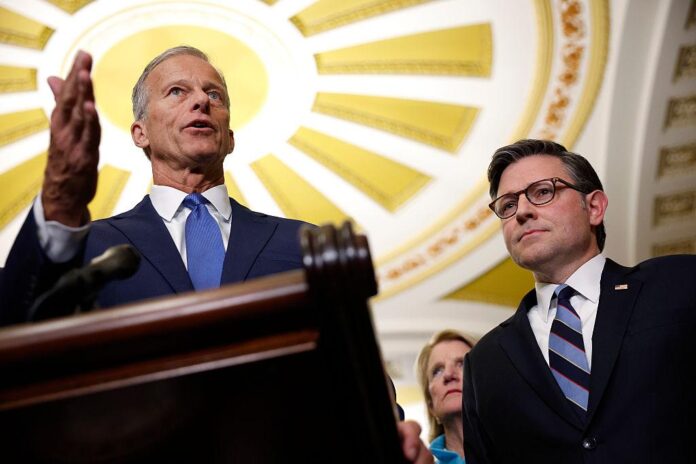
The decision to advance a narrowly focused budget reconciliation bill to fund immigration enforcement operations later this month has sparked a battle among Senate Republicans over whether to pass a third reconciliation bill before the midterm election to enact other elements of President Donald Trump‘s agenda. Some Republican senators want to advance a third budget reconciliation package this summer to allocate more money for the Department of Defense, but senior GOP colleagues on the Senate Appropriations Committee are opposing the idea. They are worried it may further diminish their power and the regular appropriations process.
There is also a push by some conservatives, including Sen. Ted Cruz (R-Texas), to enact new tax cuts or extend the working-class Trump tax cuts that are due to soon expire. But that effort is meeting resistance from Senate Majority Leader John Thune (R-S.D.), who is warning colleagues it could force Republicans to relitigate every tax and spending policy decision they already resolved in last year’s reconciliation process.
Pessimism that Republicans will lose control of the House after this fall’s elections is a big factor in the calculations, one senator acknowledged. “There are some who are saying, ‘Look, we know the House is going to flip and so this is basically our last opportunity to really do anything, and so we’ve got to go for the gold ring. We’ve got to put everything that we want into a reconciliation bill because we’re not going to be legislating anymore,'” said a GOP senator who spoke on condition of anonymity.
Thune feared that expanding the scope of the reconciliation bill would delay its passage through Congress by weeks or months — something he did not want to risk after House Republicans refused to approve a bill funding most of the Department of Homeland Security until they saw the Senate make significant progress toward passing a budget vehicle to fund immigration enforcement through 2029.
Republican senators say that with the immigration enforcement bill already drafted and moving toward a Senate vote, the question of what comes next has become unavoidable. The debate is exposing real divisions about what the party’s remaining legislative priorities should be and how aggressively leadership should pursue them.
Why It Matters
The internal Republican disagreement over a third reconciliation bill is not merely a procedural squabble — it reflects fundamental questions about what the party believes it can accomplish before November and what it is willing to risk to achieve it. Reconciliation is a powerful but finite tool, and its use triggers political consequences as well as policy outcomes.
For Trump, a third reconciliation bill would offer another vehicle for delivering on signature promises: additional tax relief, more defense spending, and potentially Iran war supplemental funding. But the president’s agenda is already competing against itself for limited legislative time and political capital. The June 1 deadline for the immigration bill leaves very little runway for anything more ambitious before the summer recess.
Republican senators say there is growing opposition within their conference to attempting a third budget reconciliation bill, especially among members of the Senate Appropriations panel, who believe it is “our job,” in the words of one lawmaker, to pass funding for the Pentagon under regular order. Passing appropriations bills under regular order would mean getting Democrats to support a supplemental defense appropriations package or a full-year defense bill.
The appropriators’ resistance is also a matter of institutional self-preservation. Every time Congress uses reconciliation to move major spending, it bypasses the committee process that appropriators control. Members of those committees have watched their influence erode with each successive reconciliation vehicle and are drawing a line at defense — one of the few areas where they retain significant bipartisan leverage.
Economic and Global Context
The dispute over a potential third reconciliation bill unfolds against an economy under significant pressure. Mark Zandi, chief economist at Moody’s Analytics, concluded that the data are “definitive”: tariffs have done significant damage to the U.S. economy. He noted that job growth has come to a standstill since Liberation Day, with only the non-traded healthcare industry adding meaningfully to payrolls, while inflation has accelerated to a 3 percent year-over-year pace, up from 2.5 percent before the tariffs — well above the Federal Reserve’s 2 percent target.
That economic environment makes the expiration of Trump’s working-class tax cuts a particularly live issue. Republicans who voted for those cuts in last year’s reconciliation bill are now facing constituents squeezed by higher prices and worried about their tax bills. Allowing those cuts to expire without action would be politically damaging — but extending them through another reconciliation bill would add substantially to the deficit.
Defense spending is the other major fiscal pressure point. The Iran war has driven supplemental spending requests, and Pentagon officials have indicated that the base defense budget requires substantial increases to sustain current operational tempo. Funding that through regular order requires Democratic votes that simply may not be available in today’s political environment.
Implications
Now that most of the Department of Homeland Security is funded through September and a budget reconciliation package funding ICE and Border Patrol has already been drafted in the Senate, there are growing questions over whether GOP leaders will attempt to move a third reconciliation package to pay for the military conflict with Iran or enact new tax cuts. GOP senators are growing increasingly pessimistic about achieving any partisan legislative accomplishments after they enact legislation to fund ICE and Border Patrol.
The outcome of this internal debate will have lasting consequences for the November elections. Republicans who succeed in passing additional tax relief will have a concrete accomplishment to campaign on. Those who fall short will face a two-front attack — from the left on spending priorities and from the right on failing to deliver on promises.
For voters watching from the outside, the Republican reconciliation debate illustrates the governing challenges of a narrow congressional majority during a war, an inflationary period, and a redistricting fight. The party has tools and the will to use them, but the time to do so before the electorate renders its verdict is growing short.
Sources
GOP opposition grows to moving third reconciliation package on Trump agenda

