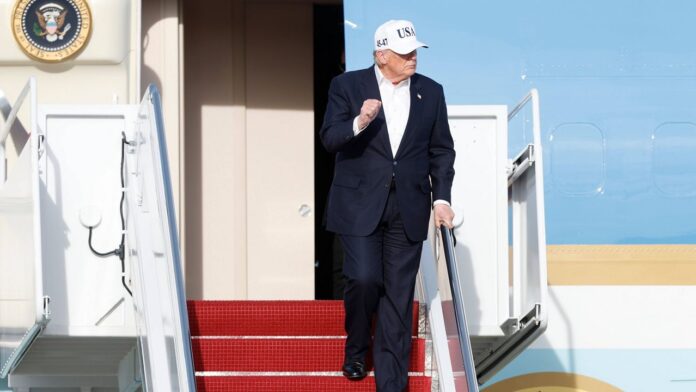
President Donald Trump announced Tuesday that his six-month examination at Walter Reed National Military Medical Center went flawlessly, posting on Truth Social that “Everything checked out PERFECTLY.” The visit was Trump’s fourth publicly disclosed medical examination since returning to the Oval Office, and his third in just 13 months — a frequency that has raised questions rather than quieted them. With Trump set to turn 80 years old on June 14, his health, transparency, and fitness for the nation’s most demanding job remain subjects of sustained political and medical scrutiny.
Story Highlights
- Trump spent more than three hours at Walter Reed on Tuesday for what the White House described as a routine annual medical and dental checkup.
- The White House did not immediately release a detailed written report from his physicians following the visit, departing from past practice.
- Trump is the oldest sitting president in U.S. history, surpassing his predecessor Joe Biden, who left office at age 82.
What Happened
President Donald Trump traveled to Walter Reed National Military Medical Center on Tuesday for a comprehensive medical and dental assessment. The White House had announced the appointment two weeks in advance, characterizing it as a routine element of the president’s regular preventive healthcare program. Trump spent more than three hours at the military hospital before publishing a post on both Truth Social and X: “Just finished my 6 month physical at Walter Reed Military Medical Center. Everything checked out PERFECTLY. Thank you to the great Doctors and Staff! Heading back to the White House.”
The visit was Trump’s fourth publicly disclosed medical examination since he began his second presidential term. His first physical of the new term was conducted in April 2025, and a follow-up examination was completed in October 2025 — one that the White House also described as routine. After that October visit, Trump’s personal physician, Dr. Sean P. Barbabella, issued a brief one-page summary stating the president was in “exceptional health,” but offered no explanation of why a follow-up appointment had been medically necessary just six months after a comprehensive annual exam.
The White House did not immediately release a written medical report following Tuesday’s examination, in contrast to procedures followed after the April 2025 visit, when full results were published two days later. That earlier report painted an optimistic picture of Trump’s health: a resting heart rate of 62 beats per minute, blood pressure of 128/74 mmHg, weight of 224 pounds, and a perfect score of 30 out of 30 on the Montreal Cognitive Assessment. The president was described as being in excellent cognitive and physical health and fully fit for duty.
Trump turns 80 years old on June 14, making him the oldest person ever to take the presidential oath of office. His predecessor, President Joe Biden, left office at 82 after withdrawing from the 2024 presidential race under mounting pressure stemming from public concerns about his cognitive fitness. Trump has consistently used Biden’s health struggles as a political contrast, frequently citing his own cognitive test scores and energy levels as proof that his age presents no barrier to effective leadership.
Despite the president’s upbeat self-assessment, questions have continued. Observers have pointed to visible swelling in Trump’s ankles and bruising on his hands in recent public appearances, prompting speculation about underlying health conditions. The three Walter Reed visits in 13 months is a notably high frequency for what the White House insists is purely preventive care. The combination of incomplete disclosure and elevated visit frequency has led some medical commentators to argue that the public is not receiving a complete picture of the president’s health status.
Why It Matters
Presidential health is a matter of constitutional and national significance in a way that has no parallel in other areas of political life. The United States is currently engaged in an active military conflict with Iran, navigating complex ceasefire negotiations, managing economic pressures from tariff policy, and preparing for a consequential midterm election cycle. The demands on a commander-in-chief in this environment are extraordinary, and the American public has a genuine interest in knowing whether its president is physically and cognitively capable of meeting them.
Trump’s decision to convey his health status via a brief social media post — without accompanying medical documentation — reflects a tension at the heart of presidential health communication. His base accepts the declaration at face value and sees the demand for more detail as politically motivated harassment. His critics argue that the constitutional duty to govern transparently includes basic medical disclosure, and that a self-assessment published on social media does not constitute adequate accountability.
The Biden precedent looms large here. The systematic minimization of Biden’s cognitive decline through vague and carefully worded medical statements ultimately did more damage to public trust — and to Democratic electoral prospects — than an earlier, more candid disclosure would have. The Trump administration appears determined to avoid the same trap by projecting confident assertions of good health, but the pattern of incomplete disclosure creates its own credibility problems.
Age is not inherently disqualifying, and many individuals in their eighties remain vigorous and capable. However, the statistical and medical realities of advanced age — including increased risk of cardiovascular events, cognitive changes, and physical decline — make rigorous and transparent health reporting a reasonable public expectation for any president, regardless of political affiliation.
Economic and Global Context
Markets and international partners pay close attention to presidential health because of its direct bearing on policy continuity. Trump’s administration has pursued highly personalized diplomatic and economic strategies — from the Iran war to tariff negotiations with China to bilateral trade restructuring with European allies. The president’s specific involvement in these processes means that any disruption to his capacity to govern would introduce significant uncertainty across multiple policy domains simultaneously.
From a market perspective, Trump’s health is an underlying variable in the stability calculus that institutional investors apply to U.S. political risk. Equities, Treasury bonds, the dollar, and commodity prices — including oil, which is already elevated due to the Iran conflict — are all sensitive to sudden changes in U.S. political leadership. Hedge funds and global macro traders monitor the White House’s health communications for signals about continuity risk.
For America’s allies and partners, particularly those engaged in active negotiations with the administration — including Gulf state partners coordinating on the Iran ceasefire, Asian trading partners navigating tariff disputes, and NATO allies managing defense burden-sharing talks — the consistency and capacity of presidential leadership is a practical operational concern, not merely a political one.
Implications
In the immediate term, the absence of a detailed written report from Walter Reed will sustain media inquiry and Democratic criticism. Pressure will mount on the White House to release documentation comparable to what was published after the April 2025 exam. Whether the administration complies will itself be read as a signal about what the examination found.
For Republican candidates heading into November, Trump’s health narrative is both an asset and a liability. A vigorous, engaged president who can actively campaign is invaluable. Any perception of diminishment — physical, cognitive, or energetic — complicates the party’s electoral prospects. Republican leaders will therefore reinforce the “PERFECTLY” declaration at every opportunity while privately watching the situation closely.
Ultimately, the episode renews a broader national conversation about what voters are owed in terms of medical transparency from the people who hold ultimate power over decisions of war, economy, and law. The current norms of presidential health disclosure were developed in a different era and for different circumstances. The age of America’s recent presidents has made that conversation both more urgent and more politically charged than at any prior moment in American history.
Source
Trump physical: President declares ‘Everything checked out PERFECTLY’

