Story Highlights
- Businessman Zach Lahn defeated Trump-backed Rep. Randy Feenstra in Iowa’s Republican primary for governor.
- Trump endorsed Feenstra only days before the vote, but the late endorsement was not enough to stop Lahn’s surge.
- Lahn now faces Democratic state Auditor Rob Sand in a governor’s race that could become unexpectedly competitive.
What Happened
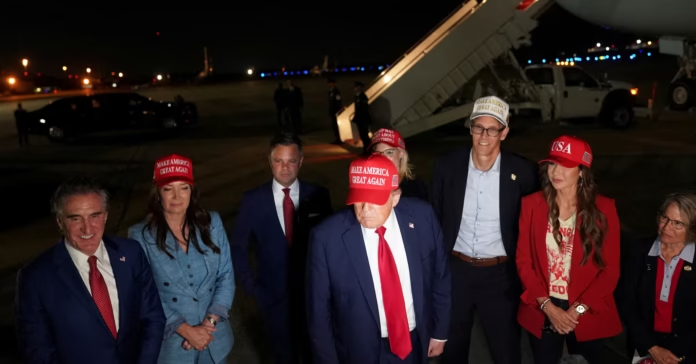
President Donald Trump suffered his first major statewide endorsement loss of the 2026 midterm cycle after businessman Zach Lahn defeated Rep. Randy Feenstra in Iowa’s Republican primary for governor.
Feenstra entered the race with major establishment support and received Trump’s endorsement in the closing days of the campaign. But Lahn, a farmer and businessman running as an outsider, narrowly won the nomination in a crowded Republican field.
- Lahn defeated Feenstra by less than one percentage point.
- Trump endorsed Feenstra shortly before Election Day.
- Lahn cleared the 35% threshold needed to avoid a nominating convention.
The result marked a rare rebuke of Trump’s influence inside a Republican primary. Trump had described Feenstra as “MAGA all the way” and praised his record in Congress, but the endorsement came too late to reshape the race.
Lahn benefited from support tied to the “Make America Healthy Again” movement and from former Rep. Steve King, who had lost his House seat to Feenstra in a bitter 2020 primary. That history gave the race an added layer of personal and factional tension inside Iowa Republican politics.
Democrat Rob Sand, Iowa’s state auditor, ran unopposed in his primary and will face Lahn in November. Sand is the only Democrat currently holding statewide office in Iowa, making the governor’s race a key test of whether Democrats can still compete in a state that has moved sharply Republican over the past decade.
Why It Matters
The Iowa result matters because Trump’s endorsement power has been one of the defining forces in Republican politics. His backing can clear fields, pressure donors, and reshape primaries almost overnight.
But Iowa showed that his influence has limits, especially when an endorsement comes late and when a rival candidate has built a strong local coalition before Trump enters the race.
- The result breaks Trump’s major primary endorsement streak this cycle.
- It shows that local dynamics can still overpower national endorsements.
- It gives Democrats a possible opening in a race Republicans expected to control.
For Feenstra, the loss was especially striking because he was not an anti-Trump Republican. He had aligned himself with Trump’s agenda and worked to appeal to the president’s voters. The problem was that Lahn ran as an outsider with a more insurgent message.
That made the race less about Trump versus anti-Trump forces and more about which faction inside the broader Republican coalition could claim the future of Iowa conservatism.
Political and Public Context
Lahn’s victory reflects a growing tension inside the Republican coalition between establishment-aligned Trump supporters and newer populist movements focused on health policy, agriculture, food systems, and distrust of large institutions.
The MAHA-aligned message helped Lahn connect with voters concerned about food quality, rural health, pesticide use, pharmaceutical influence, and the economic power of major agricultural interests.
- Lahn positioned himself as a farmer and businessman outside the political establishment.
- Feenstra carried Trump’s endorsement but struggled to stop the late momentum shift.
- Steve King’s support helped Lahn tap into old anti-Feenstra resentment in western Iowa.
For Trump’s political operation, the loss is not catastrophic by itself. His endorsement record remains strong overall, and Iowa is only one race. But the result will be studied closely by candidates and consultants looking for signs that Trump’s endorsement is no longer unbeatable.
For Democrats, the result creates a more complicated but potentially promising general-election matchup. Sand can argue that Iowa Republicans nominated a more ideological outsider, while Lahn will argue that he represents a fresh populist direction for the state.
Economic and State Context
Iowa’s economy is deeply tied to agriculture, ethanol, livestock, manufacturing, and rural healthcare. Those issues are likely to dominate the general election, especially as farmers continue dealing with price volatility, trade uncertainty, and rising input costs.
Lahn’s MAHA-aligned message could create friction with parts of Iowa’s traditional agribusiness establishment. Some of the movement’s priorities, including scrutiny of pesticides, food additives, and pharmaceutical influence, could have real implications for the state’s farm and food industries.
- Iowa is a major producer of corn, soybeans, pork, and ethanol.
- Trade policy and tariffs remain major concerns for farmers and exporters.
- Rural health and food-system issues could become central themes in the campaign.
Sand is expected to focus on government accountability, cost of living, healthcare, and rural economic stability. His statewide profile as auditor gives him a platform to appeal to independents and moderate Republicans who may be uneasy with a more insurgent GOP nominee.
The general election will therefore test two competing messages: Lahn’s outsider conservative populism versus Sand’s pitch as a pragmatic Democrat who can still win crossover support in a Republican-leaning state.
What Happens Next
Lahn now needs to unify Iowa Republicans after a bruising primary. Feenstra’s supporters, establishment donors, and Trump-aligned voters will all be important to his general-election coalition.
Trump’s team has already moved to downplay the defeat as a candidate-specific problem rather than a sign of weakening influence. But if Lahn struggles in November, the primary result will likely be revisited as a warning sign for the GOP.
- Lahn must consolidate Republicans after defeating Trump’s endorsed candidate.
- Sand will try to appeal to independents, moderates, and dissatisfied rural voters.
- The race could become a national test of whether Democrats can compete again in Iowa.
For Trump, the Iowa loss is a small but visible crack in an endorsement machine that has shaped Republican politics for years. It does not mean his grip on the party is gone, but it shows that even in Trump-friendly states, the right local candidate can still beat his pick.
The November race will determine whether Lahn’s primary upset was simply a Republican family fight — or the beginning of a broader political opening in Iowa.

