Story Highlights
- President Donald Trump abruptly ended a “Meet the Press” interview with Kristen Welker after a tense exchange over election fraud claims.
- The interview also covered Iran, gas prices, California’s vote count, and Trump’s proposed anti-weaponization fund.
- Trump blasted NBC as “crooked” before leaving, turning a Wisconsin economic trip into a media confrontation.
What Happened
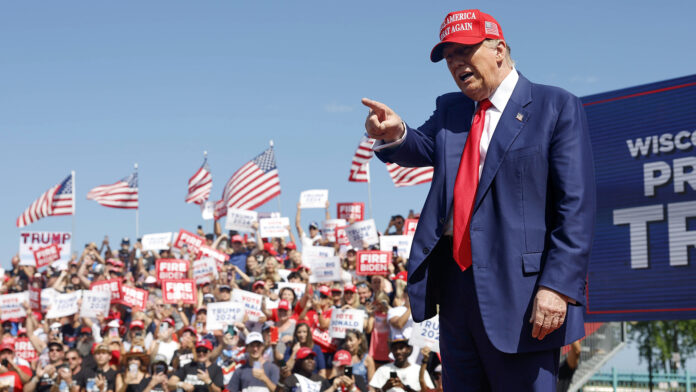
President Donald Trump walked out of a tense “Meet the Press” interview with NBC’s Kristen Welker during a Wisconsin visit that was originally intended to highlight agriculture, the economy, and Republican midterm priorities.
The interview took place at Custer Farms in Chippewa Falls, Wisconsin, where Trump was holding a farm-focused event. The setting was selected as part of the White House’s effort to connect the president’s economic message with rural voters in a key battleground state.
- The interview lasted roughly 50 minutes before Trump ended it.
- Welker pressed Trump on election fraud claims and California’s slow vote count.
- Trump accused NBC and other major networks of being dishonest and biased.
The exchange became especially heated when Welker challenged Trump’s claims that the 2020 election was stolen and asked about his recent allegations that Democrats were trying to manipulate California’s primary elections.
Trump repeated his claims, saying problems were happening again in California. Welker pressed him for evidence, and Trump responded by attacking the press, saying a country cannot be great with a dishonest media.
He then ended the interview, telling Welker he had given her enough time. As he left, Trump called NBC a “one-sided crooked network” and criticized other major media outlets as well.
Why It Matters
The walkout matters because it overshadowed the policy message Trump’s Wisconsin trip was supposed to deliver. Instead of focusing on agriculture, fuel costs, or rural economic issues, the main story became the president’s confrontation with a national journalist.
Trump has long used conflict with the press as a political weapon. His attacks on mainstream media resonate strongly with his base, which often views major networks as hostile to conservative voters.
- The confrontation may energize Trump supporters who distrust national media.
- It may also reinforce concerns among critics about Trump avoiding accountability.
- The episode gives both parties new material for midterm messaging.
The substance of the interview also matters. Trump was pressed on several politically sensitive issues at once: the Iran conflict, gasoline prices, California election claims, and the proposed anti-weaponization fund.
Those are all active controversies for the administration. Walking out did not end scrutiny of those issues; it likely increased attention on them.
Political and Public Context
The interview came at a difficult moment for Trump and congressional Republicans. The 2026 midterm environment has become more challenging, with polling showing economic frustration, concern over the Iran conflict, and growing Democratic enthusiasm.
Wisconsin is one of the most important swing states in national politics. Trump’s visit was meant to strengthen his connection with farmers, rural voters, and working-class communities that remain central to the Republican coalition.
- Wisconsin remains a key battleground for both parties.
- Rural voters are central to Trump’s midterm strategy.
- The walkout shifted attention away from the economic message of the trip.
For Republicans, the moment may still be useful with the base because Trump’s media attacks often perform well among loyal supporters.
For Democrats, the interview offers a different narrative: that Trump is unwilling to answer sustained questions on election claims, foreign policy, and controversial spending proposals.
Economic and Global Context
The Wisconsin trip was designed around economic concerns, especially agriculture, energy costs, and rural business pressure. Farmers in the state are closely affected by fuel prices, export conditions, trade policy, and federal agricultural support.
Those issues remain politically important because Trump is trying to convince voters that his administration can manage inflation, trade disruption, and global instability.
- Gas prices remain tied to the Iran conflict and broader energy-market uncertainty.
- Farmers are watching export markets affected by tariffs and foreign policy tensions.
- Rural voters remain sensitive to fuel, fertilizer, equipment, and borrowing costs.
The Iran conflict was one of the major topics in the interview. Trump defended his approach, while critics argue the conflict has contributed to energy instability and raised questions about his “no new wars” message.
The walkout therefore did not occur in isolation. It came during a broader period of political strain involving war, prices, election trust, and Trump’s relationship with the press.
What Happens Next
The interview footage is likely to circulate widely across conservative and liberal media. Trump allies will present the moment as another example of the president confronting a hostile press, while critics will frame it as an inability to withstand scrutiny.
The White House may try to refocus attention on the Wisconsin trip’s economic themes, but the walkout is likely to dominate coverage in the short term.
- Republicans may use the clip to rally voters who distrust mainstream media.
- Democrats may use it to argue Trump avoids accountability.
- NBC and other outlets are likely to keep airing the exchange as part of broader coverage.
The political impact will depend on which audience sees the moment. To Trump’s core supporters, it may look like defiance. To swing voters, especially in a state like Wisconsin, it may reinforce concerns about temperament and accountability.
For now, the episode has turned a farm-state economic trip into another national fight over Trump, the press, and the boundaries of presidential accountability.
Sources
- Donald Trump cuts ‘Meet The Press’ interview short: ‘I’ve had enough’
- 5 key moments from Trump’s cut-short “Meet the Press” interview
- Trump storms off ‘Meet the Press’ interview after fiery exchange with NBC’s Kristen Welker
- Trump storms off ‘Meet the Press’ interview, rips Welker, ABC, CBS, CNN as ‘crooked’

