Story Highlights
- Trump defended potential payouts to January 6 defendants, saying many “should be compensated” on a case-by-case basis
- The president called NBC a “one-sided crooked network” before ending the interview when pressed for evidence of California election fraud
- The $1.8 billion anti-weaponization fund has already been blocked in court and faces bipartisan opposition in Congress
What Happened
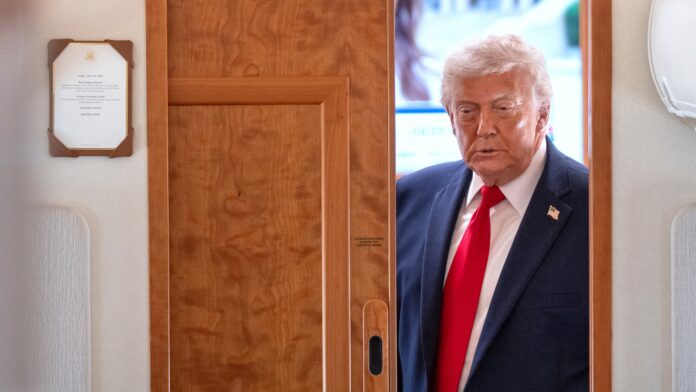
President Donald Trump sat for a taped interview with Kristen Welker, moderator of NBC’s “Meet the Press,” on Friday, June 5, at Custer Farms in Chippewa Falls, Wisconsin. The interview aired Sunday, June 8, and quickly became the dominant political story of the day. The conversation ranged across several major topics — the ongoing Iran war, gas prices, Federal Reserve policy, and California’s recent primary elections — but the most volatile exchanges centered on the Justice Department’s proposed $1.8 billion anti-weaponization compensation fund and Trump’s persistent claims that California elections are being rigged.
On the anti-weaponization fund, Trump was unambiguous in his support. He described the fund as a great idea and said that Republicans who fail to approve it would disappoint him. He argued that people who had been harmed by what he characterized as politically motivated prosecutions deserve meaningful financial compensation. When Welker raised the question of whether January 6 defendants who had pleaded guilty to assaulting police officers should also be eligible for taxpayer money, Trump said he would not be inclined to pay those individuals but added that he would have to evaluate each case. He then suggested that many defendants pleaded guilty out of fear rather than actual guilt, a claim widely disputed by prosecutors and documented court records.
The interview turned sharply confrontational when Welker pressed Trump for evidence supporting his election fraud claims, particularly his assertion that recent California primary elections were rigged. Trump had contended without supporting documentation that Democratic victories in the state reflected manipulation rather than voter preference. Welker challenged the claim directly, telling the president there was no evidence to support it. Trump responded by dismissing her objections and escalating his criticism of the network. He told Welker she was either crooked or stupid, called NBC a one-sided and dishonest organization, and insisted the broader press corps was contributing to the country’s problems by ignoring what he described as evidence of systemic fraud.
The confrontation reached a breaking point when Welker pressed Trump again for specific, verifiable evidence. Rather than answer, Trump accused NBC of a pattern of dishonest coverage, said that the press needed to straighten itself out, and brought the interview to an end. NBC’s production team confirmed the exit was abrupt and unscheduled. In the hours that followed, the White House did not issue a formal statement, and Trump did not address the walkout on Truth Social during Sunday morning.
Why It Matters
The significance of Trump’s exit from the interview extends well beyond media optics. By walking out on a nationally broadcast Sunday program — one of the most traditional forums for presidential accountability — Trump signaled a continued escalation of his administration’s posture toward mainstream media. This matters for governance because it reinforces a dynamic in which the president selectively engages with press institutions and exits when lines of questioning become substantively difficult. For voters, the interview exit raises the broader question of whether a sitting president can or should be expected to answer for specific factual claims in real time.
The anti-weaponization fund segment is particularly significant because it exposes a real and unresolved conflict between the White House and Congress. The $1.8 billion fund, which grew out of a settlement related to the leak of Trump’s IRS returns, has been blocked in court and faced bipartisan resistance in the Senate. Senior Republicans, including members who broadly support the Trump agenda, have pushed back against the fund on both procedural and substantive grounds. Trump’s defense of it in the NBC interview — and his suggestion that January 6 defendants deserve individual case-by-case compensation — effectively reopened a legislative wound that Senate Republican leaders had tried to close last week.
The election fraud claims carry their own weight. Trump has made similar assertions for years without providing evidence that has withstood legal scrutiny. His willingness to repeat those claims in a nationally televised presidential interview, and then abandon the conversation when pressed for proof, will likely fuel continued debate about the administration’s relationship with factual standards in public discourse.
There is also a political dimension that Republicans must navigate heading into the 2026 midterms. Trump’s performance in the NBC interview will energize his base, which views hostile media questioning as a form of institutional bias worth resisting. But it could complicate messaging for Republican candidates in competitive districts who need to demonstrate independence and substantive engagement with policy questions.
Economic and Global Context
The domestic political turbulence captured in the NBC interview occurs against a backdrop of real economic uncertainty. Markets have grown increasingly sensitive to signals from Washington, particularly around Federal Reserve independence and the potential for interest rate increases. In the same interview, Trump said he did not want to heavily influence new Fed Chair Kevin Warsh while simultaneously warning that a rate hike would be the wrong move. This mixed messaging contributed to brief instability in bond markets on Friday before the interview aired, with futures traders already pricing in roughly a 61 percent probability of a rate increase by year’s end.
The anti-weaponization fund debate, meanwhile, intersects with a broader fiscal conversation. Congress passed a $70 billion immigration enforcement funding package last week, and Republican leadership is managing multiple competing budget priorities. A new compensation mechanism running nearly $1.8 billion would require offsets or supplemental appropriations that do not currently exist in the legislative queue.
Internationally, the interview aired on a day when fresh exchanges of strikes between Israel and Iran were once again testing the fragile ceasefire framework. Trump’s remarks in the NBC interview about the Iran war — suggesting the adversary has no choice but to eventually deal — were part of his broader communications pattern on the conflict, which markets have used as signals for oil price volatility throughout the spring.
Implications
For the White House, the NBC walkout is likely to generate short-term enthusiasm among Trump’s core supporters and provoke condemnation from Democratic lawmakers and media critics. The administration’s communications team will need to decide whether to respond to the factual challenges Welker raised or allow them to remain unanswered in public record. History suggests the latter approach is more likely, given the administration’s consistent posture toward press challenges.
For Congress, Trump’s on-air defense of the anti-weaponization fund creates renewed pressure on Republican senators who worked hard to pass the ICE funding bill last week without explicitly killing the fund. Several senators who opposed the fund by amendment may now face direct questions from constituents about whether they are defying the president, complicating their positioning ahead of November.
For broadcast media and the White House press corps, the walkout underscores the fragility of presidential access arrangements. Networks that invest in lengthy taped interviews assume a degree of institutional cooperation. When that cooperation is withdrawn mid-interview, it raises questions about what ground rules, if any, govern future access to the president outside press gaggles.
For voters evaluating the Trump administration in the lead-up to midterms, Sunday’s events offer a concentrated summary of several persistent tensions — executive authority, press freedom, legislative-executive relations, and the enduring fallout of January 6.
Sources

