Story Highlights
- Vance met Iranian negotiators in Lucerne, Switzerland on June 21 as part of a 60-day diplomatic sprint to finalize a deal
- Iran has been accused of failing to reopen the Strait of Hormuz as required under the memorandum signed by Trump last week
- Lawmakers from both parties are questioning whether Trump gave away too much leverage in the framework agreement
What Happened
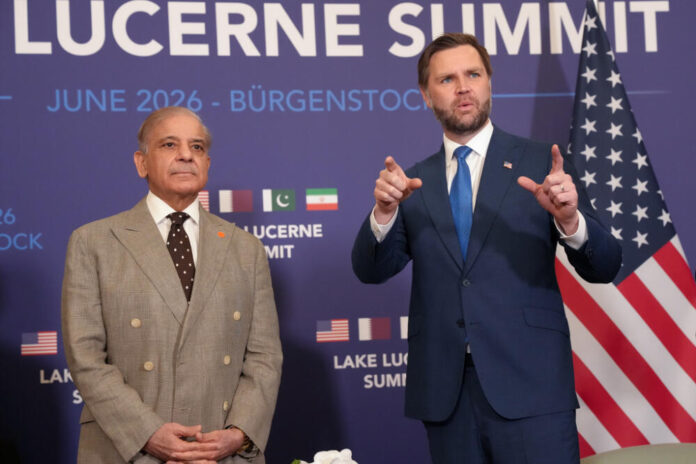
Vice President JD Vance and other U.S. negotiators were in the same room as Iranian officials at a resort in Switzerland on Sunday — a rare face-to-face meeting as the two countries launched a 60-day sprint to negotiate over the fate of Iran’s nuclear program. More talks were scheduled for Monday.
The memorandum of understanding signed by Trump in France last week halts fighting, opens the Strait of Hormuz, and offers economic incentives to Iran in exchange for a pledge never to develop nuclear weapons. However, the agreement has proven immediately contentious. Iran reportedly failed to fully reopen the Strait of Hormuz despite committing to do so under the terms of the deal, prompting a sharp response from Washington.
President Trump remains deeply frustrated with Iran. He repeated the kind of threats that failed during the war to make Tehran comply with the memorandum. On Sunday, for instance, he threatened to take over the Strait of Hormuz himself if Iran did not reopen it. The threat, delivered during a Fox News interview, was seen by analysts as an escalation that raises questions about U.S. credibility at the negotiating table.
Senator Lindsey Graham warned that if the diplomatic effort fails, President Trump would take control of the Strait of Hormuz by force, charging a fee for all ships passing through to fund the operation. Graham added that the United States would work to expand the Abraham Accords by the end of 2026 if the deal held, but would respond forcefully if Iran continued to attack Israel and Lebanon.
An emergency session on the fighting in Lebanon was added to the agenda for the Swiss talks after a diplomat told CBS News that Israel and Hezbollah had agreed to a ceasefire in Lebanon, scheduled to begin at 9 a.m. Eastern on Friday. Iran has insisted that fighting stop in Lebanon as a condition of any broader deal with the United States, complicating the already difficult negotiations significantly.
Why It Matters
The Switzerland talks represent the highest-stakes diplomatic effort of Trump’s second term. A successful deal would eliminate Iran’s nuclear weapons program and potentially reshape the geopolitics of the Middle East. Failure could return both countries to open conflict, with severe consequences for global energy markets and American standing in the region.
The fallout from the memorandum is already causing political uproar in Washington. It worsened tensions between the president and Republican senators already inflamed by a showdown over his choice of Bill Pulte as interim director of national intelligence and his attempts to force a reluctant GOP majority to pass sweeping changes to voting arrangements before the midterms.
Lawmakers from both parties have expressed deep skepticism over the memorandum’s terms — including waiving sanctions on Iran’s energy and pharmaceutical exports while the 60-day talks are underway, and a $300 billion fund to reinvigorate Iran’s economy that the administration says will be funded by regional partners. Critics warned that Trump simply paid for the reopening of the strait and squandered U.S. leverage in the delicate talks ahead on Iran’s nuclear program.
Vance sought to project confidence despite the turbulence. He said he felt great about where things stood in Lebanon and that great progress had been made in recent days, noting that the president had committed the United States to seeing a full regional ceasefire.
Economic and Global Context
The Strait of Hormuz is one of the world’s most strategically critical chokepoints. Approximately 20 percent of global oil supply passes through it daily, meaning any prolonged closure would send energy prices sharply higher worldwide. The mere threat of its closure during the Iran-U.S. conflict contributed to elevated oil market volatility throughout the conflict period.
A Middle Eastern official indicated that the special envoys leading the negotiations are out of sync with Secretary of State Rubio, especially as it pertains to the strategy for dealing with Israel and Hezbollah in Lebanon. This internal disagreement within the U.S. diplomatic team adds another layer of uncertainty to the talks.
Qatar and Pakistan, serving as mediating partners, described the weekend sessions as producing encouraging progress. Their involvement reflects a broader regional stake in the outcome — Gulf states in particular have major economic interests tied to the security of the strait and the stability of the broader Middle East.
Implications
For Republican lawmakers, the deal presents a delicate balancing act. Supporting the president on a major foreign policy initiative is a political default, but the terms of the memorandum have prompted rare intra-party friction. Several senators have suggested the deal gave Iran significant economic relief without securing firm, verifiable commitments on nuclear disarmament.
For American consumers, the outcome of these talks will directly affect energy prices. A durable agreement that secures the Strait of Hormuz and ends regional hostilities could ease global oil supply concerns and provide relief at the gas pump. A breakdown in talks, by contrast, could reignite conflict and push prices higher.
Trump is operating with political urgency. Tehran understands that Trump is in a hurry as he seeks to recoup economic and political benefits of a peace deal before November’s midterm elections. That urgency could be leveraged by Iranian negotiators to extract further concessions in the remaining weeks of the 60-day framework period. CNN

