Story Highlights
- Carlson told the Canadian podcast “Can’t Be Censored” that “there’s no chance I would support the Republican Party”
- He cited the Iran war and what he described as foreign loyalty over American interests as his primary reasons
- Trump previously labeled Carlson “a Low IQ person” after months of public feuding over the war
What Happened
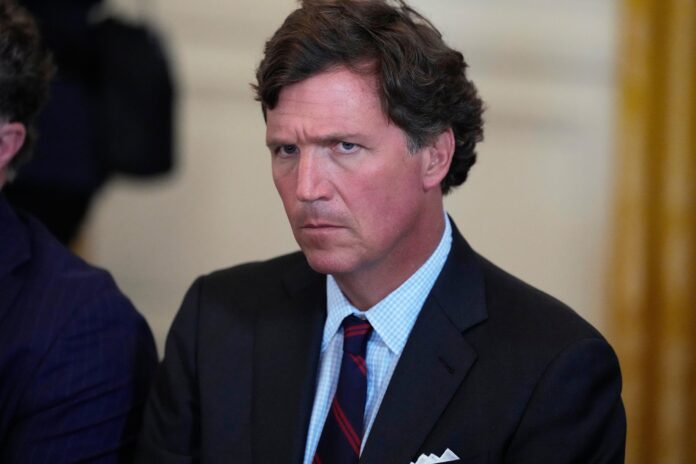
Tucker Carlson has broken with the Republican Party, declaring he will no longer support the GOP after decades as one of its most prominent defenders. Carlson remains a major figure in conservative media, and his rejection of the party signals a deeper fracture inside the right as the Iran war and U.S.-Israel policy dominate internal debate.
Carlson made the comments on an episode of the “Can’t Be Censored” podcast that aired Thursday but gained traction online Monday. “I’m out,” Carlson said. “And if I’m out, then I think a lot of other people are out.” “I would not support the Republican Party. There’s no chance I would support the Republican Party,” Carlson said, adding that the GOP has “betrayed” voters by prioritizing Israel’s national security over America’s.
“Not gonna support the Democratic Party,” Carlson was quick to add. “I don’t know what I’m going to do.” Carlson, who has amassed a large following on his own podcast since being fired from Fox News in 2023, has more recently diverged from the party — a disillusionment supercharged by President Donald Trump’s decision to go to war with Iran in February.
Carlson told the podcast hosts that he last spoke to Trump on February 27, 2026, the night before the United States went to war, after a series of conversations in which he said Trump privately understood the risks but proceeded regardless. “I’m positive he didn’t want to do it,” Carlson said. “He understood the risks. He did it anyway, and I want to know why.”
The White House pushed back swiftly. “President Trump campaigned proudly on his promise to deny the Iranian regime the ability to develop a nuclear weapon, which is what this noble operation accomplishes,” White House spokesman Davis Ingle said. “The President does not make these incredibly important national security decisions based on fluid opinion polls or podcast hosts, but on the best interest of the American people.”
Why It Matters
Carlson’s break with the Republican Party is not simply a celebrity political statement. For years, he functioned as one of the most effective messengers of the America First movement, shaping how millions of working-class conservatives understood domestic and foreign policy. His nightly Fox News program was, at its peak, the most-watched cable news show in the country. Even after his departure from Fox, his Tucker Carlson Network and social media presence have maintained a formidable audience.
Research published by the Brookings Institution in June 2026 found that opposition to the Iran war has come “not from the MAGA base but from non-MAGA Republicans,” a segment showing signs of low turnout enthusiasm heading into November. Carlson’s departure from the coalition could accelerate that disengagement, particularly among libertarian-leaning Republicans and younger voters who were drawn to the America First message specifically because of its anti-interventionist foreign policy promises.
Former Representative Marjorie Taylor Greene has suffered a similar falling out with the party and the president, in part over positions on foreign wars and Israel. “What the American people voted for with MAGA was to put the American people first,” she said. “Stop sending foreign aid, and stop being involved in foreign wars.” The convergence of Carlson’s and Greene’s breaks with Republican leadership illustrates that populist-nationalist dissatisfaction with the party’s current direction extends beyond any single media personality.
The timing amplifies the concern. With midterm elections approaching in November, Republicans defending House and Senate seats in competitive districts need maximum enthusiasm from their base. Any erosion of turnout among disaffected conservatives who align with Carlson’s critique — even a modest shift — could determine the outcome of close races in states where the GOP has thin margins.
Economic and Global Context
Carlson’s critique is rooted substantially in foreign policy, but his audience is economically focused as well. The Iran war has contributed to sustained volatility in oil markets, and its cost in American lives, treasure, and military equipment has entered the political conversation. A CBS poll showed that a large majority of Americans want the Iran war to end and believe that the costs of the war did not justify the result. That sentiment, if it continues to solidify, creates a political environment in which candidates running on a platform of ending the conflict could find receptive audiences.
The broader economic context matters here too. Trump’s second-term domestic agenda — including tariffs, deregulation, and tax policy — has been partially overshadowed by the costs and controversy of the Iran war. Carlson’s critique of the GOP is not merely moral; it is a political argument that the party’s foreign entanglements are consuming bandwidth and political capital that should be directed at the economic concerns of ordinary Americans. That message resonates with the working-class voters who powered Trump’s 2024 victory.
Carlson’s significant independent media platform — estimated to reach tens of millions of viewers and subscribers — also gives him real economic leverage to influence advertising markets and donor behavior independent of party structures. His ability to sustain that audience outside the Republican Party umbrella will be closely watched by media industry observers and political fundraisers alike.
Implications
Carlson’s public split underscores growing fractures inside the broad MAGA coalition Trump built, as his Iran war and handling of the economy continue to divide Republicans. For the White House, the immediate political calculus is to dismiss Carlson as irrelevant to the core MAGA base — a strategy Trump has already pursued by publicly mocking him on Truth Social. But the risk is that continued attacks on a figure with loyal followers among the very voters Republicans need only deepen the sense of alienation.
For Republican congressional candidates, Carlson’s departure creates an uncomfortable choice. Openly criticizing Trump’s Iran war to appeal to disaffected Carlson supporters risks a presidential endorsement withdrawal and a primary challenge. Staying silent frustrates constituents who want elected officials to speak plainly about the costs of the conflict. That political trap will define the communication strategies of several vulnerable Republican incumbents over the next four months.
The long-term significance may be generational. Carlson has a particularly strong following among younger conservatives and right-leaning independents who were already skeptical of the Republican establishment before Trump’s rise. If those voters follow Carlson’s lead in withholding party support, it could accelerate the fragmentation of the conservative coalition into competing factions — MAGA loyalists, nationalist-populists, libertarians, and traditional conservatives — that no single leader can reliably unify.
Sources
“Tucker Carlson says he is done with Republicans in MAGA crackup”

