Story Highlights
- President Trump told Louisiana Sen. Bill Cassidy to sit down during the meeting; Cassidy refused on his own terms
- The tense exchange centered on the War Powers Resolution and Iran conflict strategy
- The meeting came one day after the Senate passed a war powers resolution rebuking Trump’s Iran campaign
What Happened
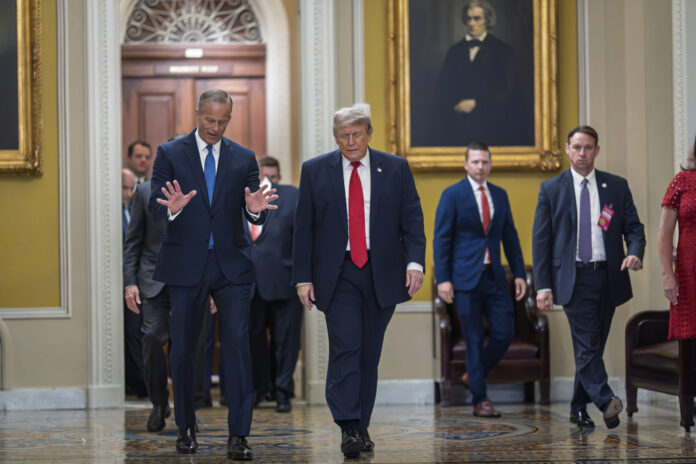
President Donald Trump‘s meeting with Republican senators on Wednesday turned testy, and at one point, he sternly told Louisiana Sen. Bill Cassidy to sit down, after questions arose about the War Powers Resolution, according to sources directly familiar with the meeting. The confrontation was one of the more public displays of intra-party friction seen during Trump’s second term, and it drew immediate attention from reporters and lawmakers alike.
Cassidy had been trying to respond to the president, telling the president he should sit down — but Cassidy later relented, saying he would be seated, but not at Trump’s behest. “He raised his voice. I lost my temper. That’s not appropriate. It’s the Irish in me, but I again matched his tone and his volume,” Cassidy told reporters after the meeting.
The more-than-hourlong meeting with Trump focused mostly on the Iran war and the War Powers Resolution. On Tuesday, the Senate approved a Democrat-led resolution to keep the president from ordering further military action in Iran. Four Republicans voted in favor of the concurrent resolution, which is symbolic and does not carry the force of law.
Cassidy did not advance to the runoff in his Louisiana Republican Senate primary, likely ending his political career, a point Trump highlighted in his remarks. “I make no apologies for standing up to the president,” Cassidy said. “I am sticking up for the American people, even if I’m speaking to the president.”
Wednesday’s late-night Senate vote came after Trump expressed frustration with Republican senators who voted for an Iran war powers resolution on Tuesday, as well as Republicans who missed that vote, arguing that Congress had undermined his position at the negotiating table with Iran.
Why It Matters
The confrontation between Trump and Cassidy is more than a dramatic moment — it reflects a broader tension within the Republican Party over executive war-making authority and the appropriate role of Congress in matters of military conflict. With ceasefire negotiations ongoing in Switzerland and the political landscape ahead of the 2026 midterms already taking shape, Republican unity on Iran is increasingly fragile.
Several GOP senators have broken with Trump over his 14-point memorandum of understanding with Iran, with Armed Services Committee Chair Roger Wicker, Tom Cotton, and Ted Cruz pushing back against it. Their skepticism of the agreement has complicated Trump’s diplomatic positioning and added pressure to an already strained relationship between the White House and Capitol Hill Republicans.
Trump responded to the Senate war powers vote in a Truth Social post Tuesday night, calling the four Republicans “losers” who “have just made my job more difficult.” The president’s public castigation of members of his own caucus is an unusual escalation, one that risks deepening the rift rather than resolving it.
The episode also places Cassidy in an unusual spotlight for his final days in office. Having lost his primary race with Trump’s active opposition, Cassidy has arguably little left to lose politically — a dynamic that may encourage even bolder challenges to the administration in the weeks ahead.
Economic and Global Context
The Iran conflict, which began with U.S.-Israeli air strikes in February, has generated significant economic turbulence both domestically and internationally. Markets have reacted with volatility to each escalation and diplomatic development, and consumer prices have reflected the disruption, particularly in energy costs. The conflict has strained U.S. alliances and complicated ongoing negotiations with Iran in Switzerland.
Tensions within NATO have risen over burden-sharing, defense spending, and U.S. complaints over allies’ involvement in re-opening the Strait of Hormuz during the U.S.-Iran war. These friction points illustrate how the Iran conflict has ripple effects extending well beyond bilateral negotiations between Washington and Tehran.
Negotiations are currently under way in Switzerland, as the Trump administration and Iran continue to discuss the terms of a ceasefire set out in a June 17 memorandum of understanding. But whether that memorandum will hold remains unclear. Israel, the U.S.’s partner in the war against Iran, has continued to carry out strikes in Lebanon, violating the terms of the agreement, which called for a halt to fighting on all fronts.
Congressional discord, as displayed in Wednesday’s meeting, carries direct economic consequences. Uncertainty over the war’s trajectory delays investment decisions, affects oil markets, and complicates the administration’s foreign policy messaging at a time when stability is badly needed.
Implications
The fracture between Trump and Senate Republicans — particularly over war powers — has real consequences for the president’s ability to govern effectively during the final stretch of his Iran military campaign. While the war powers resolutions remain largely symbolic, the political signal they send to Tehran and to U.S. allies is significant.
Some Republican senators warned that the war powers resolution would weaken Trump’s standing in the Switzerland negotiations. “If this passes, the Iranians are going to simply stand up and walk away from negotiations,” Sen. James Risch of Idaho told the Senate. Whether that assessment proves accurate will become clearer as talks continue.
For Cassidy personally, the confrontation may burnish his legacy as a principled dissenter even as his Senate career concludes. For the broader Republican caucus, the episode raises questions about how long senators facing difficult 2026 reelection races will continue to stand firmly behind the administration’s Iran strategy.
The White House, for its part, appears determined to use social pressure and primary threats to keep Republicans in line. But as Wednesday’s meeting showed, that strategy has its limits — especially with senators who have little left to lose.

