Story Highlights
- Trump canceled the signing of the 21st Century ROAD to Housing Act, which incorporated provisions from more than 60 individual bills and passed with overwhelming bipartisan support
- Trump said he will not sign the housing bill until Congress passes the SAVE America Act, which would require proof of citizenship to register to vote
- Senior Republican senators warned Trump is damaging his own agenda and jeopardizing the party’s electoral prospects by conflating the two issues
What Happened
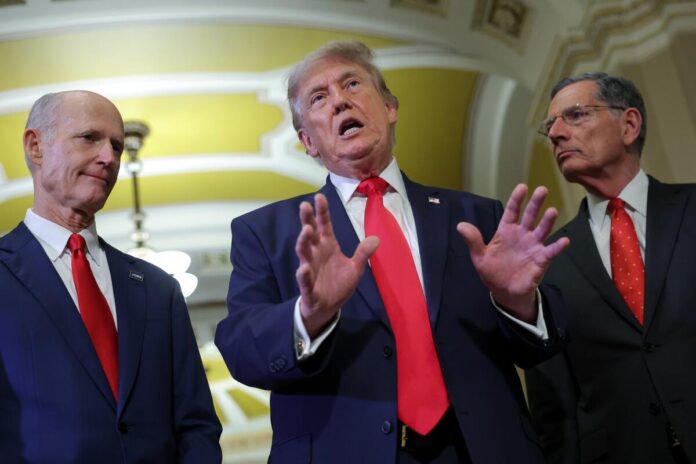
President Donald Trump posted on social media Wednesday morning that he was canceling the planned signing ceremony for the 21st Century ROAD to Housing Act, a sweeping bipartisan bill passed by Congress to address the country’s worsening housing affordability crisis. The signing had been scheduled to take place at the Capitol, where a stage and signing table had already been prepared with the presidential seal when the announcement came. In his post, Trump declared the event “hereby cancelled until such time as we pass the desperately needed SAVE AMERICA ACT, which I consider to be a National Emergency.”
The SAVE America Act would require proof of citizenship for voter registration and impose restrictions on mail-in voting. Trump has been pressing Senate Republicans to eliminate the legislative filibuster in order to pass the measure. Senate Majority Leader John Thune has repeatedly told Trump that neither the filibuster elimination nor the SAVE Act itself has the votes to clear the upper chamber. Republican senators have been largely unified in their opposition to removing the filibuster, viewing it as a long-term institutional protection.
The housing bill Trump refused to sign was no minor measure. The 21st Century ROAD to Housing Act, described by analysts as the most comprehensive overhaul of federal housing policy in decades, drew from more than 60 individual bills introduced in the House, Senate, or both chambers, 36 of which had bipartisan sponsorship. The legislation contains no new federal spending but seeks to lower the cost of home construction by streamlining environmental reviews, easing zoning restrictions, and updating building codes to allow greater density. It passed Congress with broad support, including from endangered House Republicans who saw it as a critical election-year campaign issue on kitchen-table affordability.
When asked by reporters in the Oval Office whether he intended to veto the bill, Trump declined to answer directly, saying only that he was not signing it and wanted to “see what happens.” He separately described the housing bill in a social media post as “Warren-centric” — a reference to Senator Elizabeth Warren — and dismissed it as of minor importance compared to his voter ID priorities. That framing drew immediate pushback, given that the bill had extensive Republican co-sponsorship and was being celebrated by House GOP leadership just moments before Trump pulled the plug.
Senator Lisa Murkowski of Alaska, one of Trump’s most frequent Republican critics, told reporters after the episode that the president was not being helpful to himself or the country. “If he chooses to hold up his own agenda because he wants action on the SAVE Act, that’s, I guess, his call. It is not helpful to him,” she said. Representative Mike Lawler of New York, considered among the most endangered House Republicans ahead of November, had appeared on national media that morning promoting the housing bill as a centerpiece of his re-election pitch.
Why It Matters
Housing affordability is one of the defining economic issues heading into the 2026 midterm elections. Home prices have remained historically elevated relative to incomes, mortgage rates have stayed well above pre-pandemic levels, and rental costs in most major metro areas continue to squeeze working and middle-class families. For Republican candidates in competitive districts, the housing bill represented a concrete legislative achievement they could campaign on — proof that Congress was addressing the cost-of-living concerns their constituents raise at every town hall.
Trump’s decision to weaponize the housing bill as leverage for an unrelated political priority strikes at the core of that electoral strategy. Republicans who spent months negotiating and voting for the bill now face the awkward task of explaining to voters why a bill their party supported is sitting unsigned. Several Republican senators were candid about the damage. Senator John Cornyn of Texas, who has grown more openly critical of Trump since losing his reelection bid, said the party was “not on the same page” and warned that the division was “dangerous” for the midterms.
The SAVE America Act at the center of Trump’s demand is itself deeply contested. Democrats universally oppose the measure, arguing it amounts to a voter suppression mechanism that would disenfranchise millions of eligible citizens who lack qualifying identification documents. Even some Republicans have expressed private reservations. The insistence on linking it to housing legislation ensures that neither bill moves forward in the near term, a political outcome that seems to serve no one in the Republican caucus except Trump himself.
The episode also reinforces a pattern of Trump using legislative hostage-taking as a negotiating tool, a strategy that has produced mixed results throughout his second term. While it can sometimes shake loose movement on stalled priorities, it frequently alienates the congressional allies whose cooperation is essential for any legislative agenda to succeed.
Economic and Global Context
The housing bill Trump is declining to sign addresses a genuine and worsening economic problem. The United States has faced a persistent housing shortage for years, with estimates suggesting a deficit of several million homes relative to demand. That shortage drives up both purchase prices and rents, contributing to broader inflationary pressures and constraining economic mobility for younger Americans and lower-income households. The bill’s approach — reducing regulatory barriers to new construction rather than deploying new federal spending — represented a market-oriented framework with genuine bipartisan appeal.
Economists have long identified land-use regulation, lengthy environmental review processes, and restrictive zoning as key contributors to the housing shortage. The 21st Century ROAD to Housing Act targeted each of these bottlenecks directly. If signed, analysts projected it would meaningfully increase housing supply over a five-to-ten-year horizon, though the full effects would take time to materialize in local markets.
The absence of a presidential signature does not necessarily kill the bill permanently. Under long-standing constitutional rules, if the president neither signs nor vetoes a bill within ten days while Congress is in session, it becomes law automatically. Whether Trump allows that clock to run, actively vetoes it, or uses it as ongoing leverage remains to be seen. The political calculus will likely be shaped by polling data and pressure from Republican incumbents as the midterm campaign intensifies.
Implications
The most immediate impact is on the Republican candidates who staked their campaigns on housing affordability as a signature issue. Members like Lawler now face a difficult messaging challenge heading into the fall. The broader effect is to signal to voters that even rare bipartisan accomplishments can be held hostage to Trump’s political priorities at any moment, a message that could dampen congressional enthusiasm for negotiating further cross-aisle deals.
For Trump, the gamble is whether the threat of withholding a popular bill produces enough Senate pressure to move the SAVE Act. Historical precedent suggests it will not. Thune has been clear that the votes are not there, and Senate Republicans have shown little appetite for abolishing the filibuster. The standoff is likely to persist through the summer, with neither side willing to publicly capitulate.
Longer term, this episode may define how historians assess the legislative productivity of Trump’s second term. A presidency that began with ambitious legislative goals — including the One Big Beautiful Bill Act — now finds itself deliberately blocking its own achievements in service of a voter ID priority that lacks the congressional support to become law. The electoral price of that calculation will become apparent in November.
Sources
“Trump says he won’t sign major housing bill until Congress passes SAVE Act”

