Story Highlights
- Hardline conservatives led by Representative Anna Paulina Luna blocked House procedural votes over demands to pass the SAVE Act, a citizenship voter ID bill
- Trump canceled a signing ceremony for a separate bipartisan housing bill out of frustration that Congress had not passed the SAVE Act
- Speaker Johnson is now pursuing a third reconciliation bill, “Reconciliation 3.0,” as the only viable path to pass the SAVE Act with a simple Senate majority
What Happened
A group of hardline House conservatives, led by Representative Anna Paulina Luna of Florida, brought most House legislative activity to a halt this week by refusing to support procedural rules needed to advance floor votes, a tactic effectively blocking debate on multiple bills until the Safeguard American Voter Eligibility Act, commonly known as the SAVE Act, received a path to passage. The bill would require documentary proof of citizenship to register to vote in federal elections and mandate photo identification to cast a ballot. It has passed the House previously but remains stalled in the Senate, where it lacks the 60 votes needed to overcome a Democratic filibuster.
The standoff escalated when President Trump, who has repeatedly called on Congress to pass the SAVE Act, canceled a planned signing ceremony for the 21st Century ROAD to Housing Act, a separate bipartisan housing measure that had already passed both chambers, citing his frustration that Congress had not yet delivered the SAVE Act. Trump’s decision to withhold his signature from an unrelated, already-passed bill as leverage in the SAVE Act fight intensified pressure on Speaker Mike Johnson to find a resolution. Following a Thursday meeting between Trump and Johnson at the White House, Trump posted publicly urging House Republicans to “stop grandstanding” and unify behind the broader legislative agenda, a message aimed squarely at the conservative holdouts blocking procedural votes.
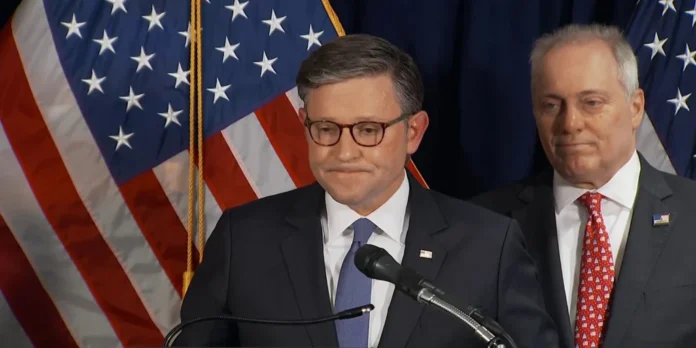
Johnson emerged from the meeting with what aides described as two significant wins: Trump’s public call for Republican unity, which eased pressure on members who had been navigating between conservative primary bases and the practical need to advance legislation, and a commitment to transmit the housing bill to the White House for signature despite the SAVE Act remaining unresolved. Johnson subsequently outlined his strategy for breaking the underlying impasse, telling reporters that reconciliation, the special budgetary process allowing certain legislation to pass the Senate with a simple majority rather than the standard 60-vote threshold, represents “the only path” to enacting the SAVE Act given that Democrats have shown no willingness to provide the votes needed to overcome a filibuster.
Johnson’s proposed approach would attach SAVE Act-style provisions to a third reconciliation package this year, dubbed “Reconciliation 3.0,” structured around a grant program that would allow states to draw down federal funding if they adopt election integrity measures consistent with the bill’s citizenship and identification requirements. Johnson said he discussed the plan with Trump in detail, telling him “we can” get it done “if the Republicans will stand together.” However, the strategy faces a significant procedural obstacle: the Senate parliamentarian has already ruled that the SAVE Act’s substantive provisions do not satisfy the Byrd Rule, which restricts reconciliation bills to matters directly affecting federal spending and revenue, a ruling that has led some conservative supporters of the bill, including those who pushed hardest for it, to express skepticism that the reconciliation approach can actually work.
Why It Matters
The episode illustrates the recurring tension within the House Republican conference between hardline members willing to use procedural leverage, including blocking routine floor business, to force leadership’s hand on priority legislation, and a broader conference focused on maintaining functional governance and protecting vulnerable incumbents heading into a difficult midterm environment. Luna’s tactics, while disruptive, succeeded in elevating the SAVE Act to the top of the legislative agenda and securing direct presidential engagement, demonstrating the continued leverage a relatively small group of committed members can exercise given Republicans’ narrow House majority.
For voters who support stronger voter identification and citizenship verification requirements, framed by supporters as essential safeguards for election integrity, the renewed push through reconciliation represents a potential path to enactment that has eluded the bill through normal legislative processes given Senate filibuster rules. Proponents argue that documentary proof of citizenship and identification requirements protect the integrity of federal elections, even though instances of confirmed noncitizen voting in federal elections have been documented as exceptionally rare in independent studies.
For the broader functioning of Congress, Trump’s willingness to withhold his signature from an already-passed, unrelated bipartisan bill as leverage in an entirely separate legislative fight illustrates the considerable influence the president continues to exercise over the House Republican agenda, even on matters where his formal constitutional role, signing or vetoing legislation that reaches his desk, would not typically extend to shaping unrelated procedural fights still underway in Congress.
For Senate Republicans, Johnson’s reconciliation strategy puts pressure on the chamber to find a path around the parliamentarian’s Byrd Rule finding, a technical but consequential obstacle that has stymied previous attempts to use reconciliation for policy goals extending beyond straightforward budgetary matters, setting up a potential internal disagreement between House and Senate Republicans over the viability of the approach.
Economic and Global Context
While the SAVE Act itself is not primarily an economic policy matter, its potential inclusion in a broader reconciliation package carries budgetary implications, since reconciliation bills are by definition built around federal spending and revenue provisions. Johnson’s proposed grant program structure, offering federal funding to states that adopt the bill’s election integrity requirements, would need to demonstrate a sufficiently direct fiscal effect to survive the Byrd Rule’s procedural requirements, a technical challenge that has complicated similar legislative efforts in the past.
The broader context of a third reconciliation bill this year also reflects the Republican Congress’s continued reliance on the reconciliation process as its primary legislative vehicle given persistent Senate gridlock on a range of priorities, following the party’s earlier use of reconciliation to pass its core domestic policy package, the so-called big, beautiful bill, in 2025.
The standoff over the housing bill signing also highlights how unrelated legislative priorities can become entangled through presidential leverage tactics, a dynamic with potential economic consequences for the housing sector specifically, given that the 21st Century ROAD to Housing Act had already cleared both chambers with bipartisan support before its signing became contingent on progress in an entirely separate legislative fight.
Implications
In the near term, expect Speaker Johnson to convene further meetings with House Republicans to determine what additional provisions might be included in the third reconciliation package, with the SAVE Act’s voter identification and citizenship verification provisions as the centerpiece, while Senate Republicans assess whether any version of the proposal can survive the Byrd Rule’s procedural constraints.
For Representative Luna and the conservative bloc that initiated the standoff, the resolution represents a partial victory, having successfully elevated the SAVE Act to active legislative consideration through reconciliation, even though the bill’s ultimate fate remains genuinely uncertain given the parliamentary hurdles ahead.
For House Republican leadership, successfully navigating the reconciliation strategy without further internal revolt will be an important test of Johnson’s ability to manage competing factions within his conference heading into the heart of the midterm election season, when legislative dysfunction carries heightened political risk for vulnerable incumbents.
For Democrats, continued Republican efforts to advance voter identification and citizenship verification requirements through reconciliation are likely to draw sustained opposition and messaging focused on ballot access, setting up the SAVE Act as a likely flashpoint in midterm campaign messaging regardless of whether the legislation ultimately becomes law before November.
Sources

