Story Highlights
- The Senate initially adopted a resolution directing Trump to remove US military forces from the conflict with Iran, a significant rebuke to the president
- Trump expressed fury at Republican senators who voted for the resolution, arguing Congress had undermined his negotiating position with Iran
- Republican Senators Rand Paul and Bill Cassidy, who had voted for the initial resolution, changed their positions within 24 hours after Trump’s intervention
What Happened
The Senate adopted a resolution directing President Donald Trump to remove military forces from the conflict with Iran, a significant rebuke to Trump and a strong message that the war lacks support in Congress. The vote represented the most serious legislative challenge yet to the administration’s conduct of the conflict, coming at a moment when both sides were trading military strikes and ceasefire negotiations remained fragile.
One day after adopting a resolution aimed at removing US military forces from the conflict with Iran, the Senate walked back its rebuke of President Donald Trump’s handling of the war, rejecting an attempt to advance a similar war powers measure. The late vote came after Trump expressed frustration with Senate Republicans who voted for the Iran war powers resolution on Tuesday, as well as Republicans who missed that vote, arguing that Congress had undermined his position at the negotiating table with Iran.
GOP Senators Rand Paul and Bill Cassidy, who had previously voted to rein in the president’s war powers on Iran, changed their votes. Paul voted present and Cassidy voted against advancing the resolution. GOP Senators Susan Collins and Lisa Murkowski once again voted for the resolution. The reversal underscored the precarious balance of power within the Republican caucus on matters of war and presidential authority.
Trump said of the initial vote: the Senate has voted that they would like Trump to stop the war. So Iran sees that, they go, what’s that all about? He described the resolution as meaningless, but his subsequent pressure campaign on Republican senators revealed he took it very seriously. The president’s response was swift and personal, according to sources familiar with the White House’s outreach to Capitol Hill.
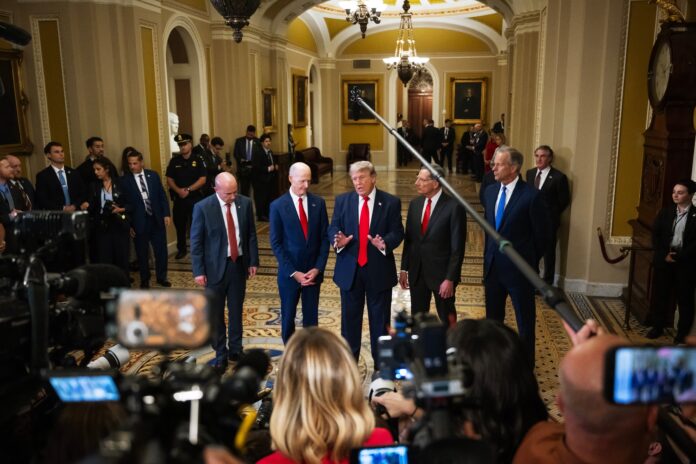
Sen. Rick Scott told reporters he was the one to deliver the direct message to Trump during a closed-door lunch meeting that there simply are not the votes to pass the election overhaul legislation. He then laid out different options Republicans have at their disposal, including breaking the legislation down into pieces, pushing it through reconciliation, or eliminating the filibuster. The lunch meeting captured the complicated dynamic between Trump and his Senate allies as they navigate multiple simultaneous crises.
Why It Matters
The war powers episode strikes at the heart of the constitutional balance between the executive and legislative branches on questions of war and peace. The Constitution grants Congress the authority to declare war, but presidents of both parties have conducted military operations for decades without formal declarations, relying instead on statutory authorizations and executive authority claims. The War Powers Resolution of 1973 attempted to impose a check on that practice, but its enforcement has proven elusive.
Trump’s ability to pressure two Republican senators into reversing their votes within a single day illustrates the degree to which the legislative branch currently functions more as an extension of presidential will than as an independent constitutional check. That dynamic may be electorally efficient for the White House in the short term, but it raises serious long-term questions about institutional integrity and whether Congress retains meaningful oversight authority over matters of war.
For the senators who changed their votes, the political calculus was clear: crossing Trump carries primary risks that are difficult to manage in the current Republican primary environment. But the reversal also exposed them to criticism that their positions on matters as consequential as war and peace are subject to rapid revision under executive pressure, a characterization that could prove damaging in general election campaigns.
The senators who maintained their opposition, including Collins and Murkowski, represent a diminishing tradition of Republican independence from the White House. Their willingness to vote against the president on war powers, even as colleagues reversed course, signals that at least some Republican senators believe Congress must maintain some independent role in decisions about when and how the United States uses military force.
Economic and Global Context
The war powers dispute has direct economic consequences because it intersects with the fragility of the US-Iran ceasefire and the status of the Strait of Hormuz. Any congressional action that signals diminished American resolve could affect how Iran calculates the risks of continued aggression against commercial shipping, with direct implications for oil prices, shipping costs, and global supply chains that affect American businesses and consumers.
The episode has been watched closely by allies and adversaries alike. For Iran, the initial Senate vote was a potential signal that congressional support for the military campaign was eroding. For US allies in the Gulf, the reversal offered some reassurance, but the volatility of the situation — where a Senate vote can be adopted and reversed within 24 hours based on presidential lobbying — introduces its own form of strategic unpredictability.
Markets responded cautiously to the initial Senate vote, with oil prices showing minor movement as traders assessed whether the resolution would affect the military campaign. The rapid reversal stabilized those concerns, but the underlying message — that congressional support for the Iran operation is not monolithic — will continue to be a factor in how energy markets price geopolitical risk going forward.
The constitutional question of war powers also has fiscal dimensions. Congress controls the power of the purse, and a more assertive legislative branch could theoretically use defense appropriations to constrain or shape military operations in Iran. The current episode suggests that threshold of independence is not yet near, but the fact that a majority of senators initially voted against the president on this issue indicates that ceiling exists and could be reached under certain circumstances.
Implications
The reversal sets a concerning precedent for congressional independence on military matters. If senators who vote according to their constitutional judgment can be pressured into reversing those votes within 24 hours through direct presidential intervention, the war powers framework becomes functionally unenforceable. Future presidents of both parties will note this episode as evidence that Senate war powers resolutions carry little practical constraint.
For Republican senators facing competitive races in November, the episode presents an awkward storyline. Supporting Trump’s handling of Iran is the safer political play within a Republican primary, but moderates in competitive general election environments may face pointed questions about whether they support meaningful congressional oversight of military operations or have ceded that authority entirely to the executive branch.
The Iran conflict itself remains the central variable. If ceasefire talks in Doha succeed and hostilities wind down, the war powers controversy may fade before the midterms. If the conflict escalates, congressional pressure to assert oversight authority will intensify, and the senators who reversed their votes may face renewed pressure from constituents and from within their own caucus to take a firmer stand.
For the broader question of American democratic governance, the episode is a reminder that constitutional checks depend not just on the text of law but on the willingness of elected officials to exercise the authority they hold. The Senate’s rapid retreat in the face of presidential pressure is a data point that will inform future debates about the balance of power between Congress and the White House for years to come.
Sources
“Trump administration news, DC rally kicks off America 250 celebration”

