Story Highlights
- Trump delivered a keynote address and watched a fireworks display at Mount Rushmore National Memorial on July 3
- White House said Friday that Trump “would make a great addition” to the monument, reviving a years-old debate
- Interior Secretary Doug Burgum and South Dakota Gov. Larry Rhoden introduced the president at the event
What Happened
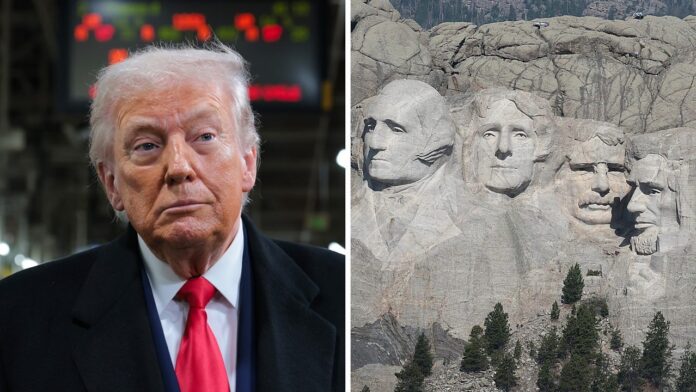
President Donald Trump traveled to Keystone, South Dakota, on Friday to headline America’s 250th anniversary celebrations at Mount Rushmore National Memorial, delivering a keynote address in the evening followed by a military flyover and fireworks display over the monument. The event marked Trump’s second appearance at the site as president, following a similar Independence Day celebration in 2020 during his first term. Friday’s visit was part of a broader multi-day “Freedom 250” tour that included a stop earlier in the week at the dedication of the Theodore Roosevelt Presidential Library in Medora, North Dakota, and will culminate Saturday with a major address and fireworks show on the National Mall in Washington.
Doug Burgum, the Interior Secretary who oversees the National Park Service and previously served as North Dakota’s governor, joined South Dakota Gov. Larry Rhoden in introducing the president at the Mount Rushmore event. Keith Krach, chairman of the Freedom 250 organizing committee, described the setting as a fitting tribute to “the leaders who shaped the American experiment,” framing the visit as both a patriotic milestone and a forward-looking moment for the country’s next chapter.
The visit also reignited a long-simmering debate about whether Trump’s own likeness could someday be added to the monument alongside the carved busts of Presidents George Washington, Thomas Jefferson, Theodore Roosevelt, and Abraham Lincoln. The White House explicitly weighed in on the question Friday, with officials saying Trump would make a great addition to the mountain, even though the president himself has not made the request publicly. Trump has previously joked about the idea at rallies and on social media, and has reportedly raised it privately with South Dakota officials, once telling former Gov. Kristi Noem, “Do you know it’s my dream to have my face on Mount Rushmore?”
Despite the renewed attention, monument experts and National Park Service officials say the idea faces serious structural obstacles. Gutzon Borglum, the original sculptor of Mount Rushmore, wrote in 1936 that the granite’s composition was fixed and that adding a fifth face was likely impossible. Nonetheless, Rep. Anna Paulina Luna, a Florida Republican and Trump ally, has introduced legislation that would authorize such a carving, though the bill remains stalled and is considered to have little chance of passing the Senate. Trump’s 2020 visit to the same site was notable for a speech that focused heavily on cultural and historical themes, including criticism of what he called efforts to “wipe out” American history, a message that later became a hallmark of his broader cultural agenda, including the revival of his “Garden of American Heroes” sculpture park project.
Why It Matters
Trump’s return to Mount Rushmore carries significant symbolic weight for his political base, reinforcing his long-standing emphasis on traditional American iconography and historical memory as central pillars of his political identity. The renewed discussion about adding his likeness to the monument, however unlikely to materialize given the structural constraints, underscores how central personal legacy-building has become to the president’s second-term messaging, particularly as his administration marks the milestone of America’s 250th birthday.
For Republicans, the visit offers an opportunity to showcase patriotic unity and national pride at a moment when the party faces challenging headwinds heading into the 2026 midterms. Events like the Mount Rushmore address allow the White House to control the narrative around a historically resonant holiday, presenting an optimistic vision of American achievement that contrasts with ongoing political and economic controversies dominating other headlines.
The debate over Trump’s potential inclusion on the monument also highlights broader questions about how presidential legacies are memorialized while a president is still in office, a practice with virtually no precedent in American history. Critics argue that entertaining such proposals, even informally through White House commentary, reflects a departure from historical norms around modesty in self-commemoration among sitting presidents.
Economic and Global Context
The Mount Rushmore event and broader America 250 celebrations come with significant costs and logistical planning, including military flyovers, security operations, and coordination between federal and South Dakota state officials. Tourism officials in the Black Hills region anticipate a substantial economic boost from the influx of visitors drawn to the anniversary festivities, with local businesses reporting increased bookings tied to the holiday weekend despite record-breaking heat affecting much of the country.
The broader national celebration, including Saturday’s Washington event, has drawn corporate sponsorship and philanthropic support, with the Kennedy Center reporting more than $1 million raised through a ticketed rooftop watch party this week, drawing corporate sponsors including major aerospace and defense contractors. This private fundraising reflects the scale of coordinated public and private investment surrounding the 250th anniversary celebrations nationwide.
Internationally, the anniversary celebrations have prompted diplomatic gestures from foreign leaders, including a congratulatory call from Israeli Prime Minister Benjamin Netanyahu, who according to his office’s readout praised the United States as a “guarantor of global freedom.” Such exchanges underscore how the milestone anniversary is being leveraged not only domestically but as a moment for reinforcing key international relationships.
Implications
In the immediate term, attention shifts to Saturday’s Washington, D.C., event, where Trump is expected to deliver what he has previewed as a lengthy address on the National Mall despite forecasts of extreme heat approaching 107 degrees. The president has publicly committed to following through regardless of conditions, framing the endurance itself as a symbolic display of resolve.
For South Dakota and the broader Mount Rushmore debate, the structural limitations identified by experts make any formal move toward carving Trump’s likeness highly improbable in the near term, regardless of legislative efforts by allies like Rep. Luna. The renewed conversation is more likely to remain a symbolic talking point than a literal engineering project, given the mountain’s well-documented geological constraints.
Politically, events like this weekend’s celebrations are likely to remain a recurring feature of Trump’s second-term messaging strategy, particularly as his administration seeks to project strength and national unity ahead of a challenging midterm election cycle. How effectively this messaging resonates with voters concerned about economic pressures and other pressing issues will likely become clearer as polling data develops in the coming months.
Sources
“Trump heads to Mount Rushmore, where efforts to impose his likeness have stalled”

