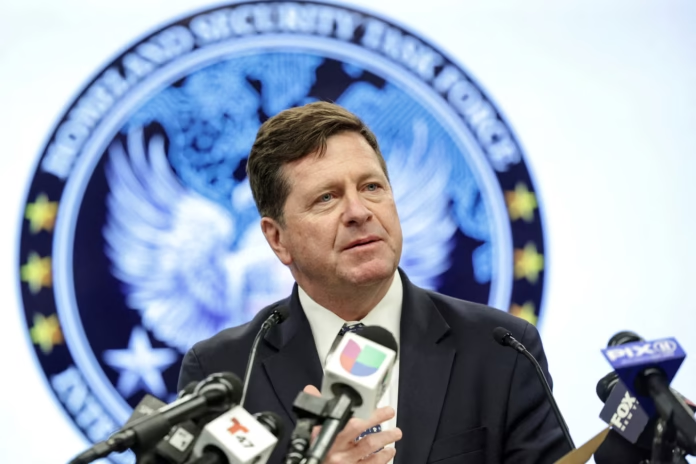
The Senate Intelligence Committee has scheduled a confirmation hearing for July 15 for Jay Clayton, President Trump’s nominee to serve as director of national intelligence, following weeks of confusion after Trump abruptly canceled an earlier hearing date. The renewed timeline offers a path toward resolving a leadership vacancy at the top of the U.S. intelligence community that has persisted since Tulsi Gabbard’s departure earlier this year.
Story Highlights
- The Senate Intelligence Committee has scheduled Jay Clayton’s confirmation hearing for July 15, after Trump canceled the originally planned June 17 hearing.
- Clayton, currently U.S. Attorney for the Southern District of New York, previously served as SEC chairman during Trump’s first term and was confirmed 61-37 in 2017.
- Trump named FHFA Director Bill Pulte as acting DNI in June after Gabbard’s departure, a move that drew bipartisan criticism over Pulte’s lack of intelligence experience.
What Happened
President Trump nominated Jay Clayton, a former Securities and Exchange Commission chairman and current U.S. Attorney for the Southern District of New York, to serve as the next director of national intelligence following the departure of Tulsi Gabbard, who left the administration in May to care for her husband amid his cancer diagnosis. The director of national intelligence position oversees coordination across 18 U.S. intelligence agencies and serves as the president’s top intelligence adviser, a role created in the aftermath of the September 11 attacks to address information-sharing failures among federal spy agencies.
Trump initially named Federal Housing Finance Agency Director Bill Pulte as acting DNI, a decision that drew significant pushback from lawmakers in both parties given Pulte’s lack of national security or intelligence background. Senate Democrats, including Minority Leader Chuck Schumer, said the appointment jeopardized their willingness to reauthorize Section 702 of the Foreign Intelligence Surveillance Act, a critical surveillance authority used to monitor foreign intelligence targets, which had already lapsed amid the standoff.
Clayton’s confirmation process initially moved with unusual speed, with Senate Democrats signaling willingness to expedite his confirmation given their concerns about Pulte. However, Trump abruptly canceled Clayton’s scheduled June 17 hearing just hours before it was set to occur, catching senators from both parties off guard. Senate Intelligence Committee Chair Tom Cotton initially indicated the hearing would proceed despite Trump’s announcement before ultimately confirming the president had directed his own nominee not to appear. Trump simultaneously linked FISA reauthorization to passage of his SAVE America Act, further complicating negotiations.
The Senate Select Committee on Intelligence has now formally scheduled Clayton’s hearing for July 15, according to a committee notice. Clayton has received broad bipartisan praise from lawmakers including Senators Dave McCormick, Thom Tillis, and Mark Warner, along with several House Republicans, who have described him as an experienced and highly qualified candidate for the role given his background leading the SEC and overseeing high-profile national security prosecutions as U.S. Attorney, including the indictment of Venezuelan President Nicolás Maduro on narco-terrorism charges.
Why It Matters
The prolonged vacancy at the top of the intelligence community, now stretching several months since Gabbard’s departure, has left a critical national security position filled only by an acting official with no intelligence background, a gap that lawmakers across the political spectrum have said carries real operational risk given the range of active threats the intelligence community is monitoring, including the ongoing conflict with Iran.
The episode also illustrates the unusual dynamic of a president delaying his own nominee’s confirmation, a move Trump used as leverage in an unrelated legislative fight over voter identification requirements. This linkage between an intelligence leadership vacancy and a separate domestic policy priority drew criticism from senators in both parties who argued national security appointments should not be used as bargaining chips in unrelated legislative disputes.
For the intelligence community itself, continued leadership uncertainty complicates long-term planning and coordination across the 18 constituent agencies, particularly at a moment when the United States is engaged in active military operations against Iran and monitoring a range of other global security threats.
Economic and Global Context
The lapse of FISA Section 702 authority during the standoff carries direct implications for the intelligence community’s ability to monitor foreign threats, a capability officials have described as essential for tracking terrorism plots and other national security risks. The program’s expiration during the leadership dispute represented a rare instance of a critical surveillance tool going dark amid domestic political maneuvering.
Clayton’s confirmation would bring continuity to an agency navigating an unusually active threat environment, including recent terrorism cases his office has prosecuted involving plots linked to retaliation for U.S. military action against Iran, underscoring the stakes of resolving the leadership vacancy promptly as the broader Iran conflict continues to escalate.
Implications
For the Senate, the July 15 hearing represents an opportunity to resolve months of uncertainty, though the timeline for a final confirmation vote remains unclear given the chamber’s broader July work period, which also includes the NDAA and other pending nominations.
For the intelligence community, confirming a permanent director would provide stability at a moment of heightened global tension, replacing an acting arrangement that lawmakers from both parties have described as inadequate for the position’s responsibilities.
For the Trump administration, successfully confirming Clayton would resolve a self-inflicted controversy while potentially reviving stalled negotiations over FISA reauthorization, though the underlying dispute over linking the surveillance authority to the SAVE America Act remains unresolved heading into the hearing.
Sources
Senate Committee Sets New Hearing Date for Trump’s DNI Pick Jay Clayton

