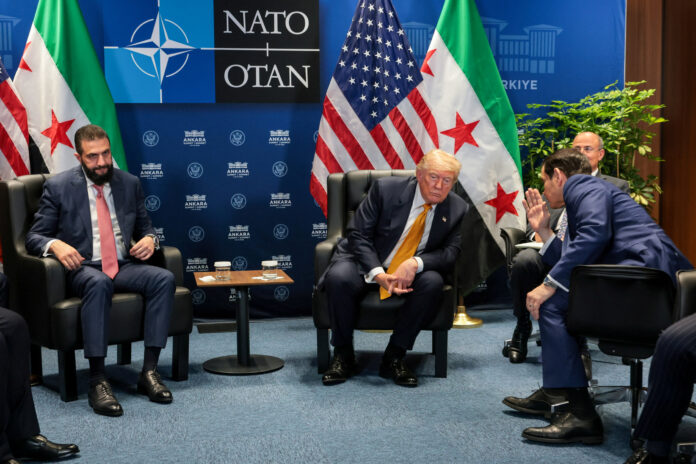
President Trump has formally notified Congress of his intent to remove Syria from the United States’ list of state sponsors of terrorism, a designation that has stood since 1979. The decision, delivered during a meeting with Syrian President Ahmed al-Sharaa on the sidelines of the NATO summit in Turkey, marks one of the most significant shifts in U.S.-Syria relations in decades and could unlock billions in international investment for the war-torn nation.
Story Highlights
- Trump informed Congress of his intent to rescind Syria’s terrorism designation, triggering a 45-day review period
- The move follows a meeting with Syrian President Ahmed al-Sharaa, a former al-Qaeda affiliate commander, at the NATO summit in Ankara
- Secretary of State Marco Rubio confirmed the decision, citing “positive changes and counterterrorism actions” by Syria’s new government
What Happened
President Trump announced Wednesday that he intends to remove Syria from the State Department’s list of state sponsors of terrorism, ending a designation first imposed in 1979 under the elder Hafez al-Assad’s regime. The announcement came during a bilateral meeting with Syrian President Ahmed al-Sharaa, held alongside the NATO leaders’ summit in Ankara, Turkey. “I think I will, yeah,” Trump told reporters when asked directly about the decision. “Why wouldn’t I? He’s done a great job.”
Secretary of State Marco Rubio formally notified Congress of the administration’s intent shortly after the meeting, beginning a 45-day pre-notification review period during which lawmakers could theoretically block the move, though significant opposition is not expected. Rubio’s statement cited an executive order Trump signed last year directing a review of Syria’s designation, along with “positive changes and counterterrorism actions” taken under al-Sharaa’s leadership and formal assurances that Syria will not support international terrorism going forward.
Al-Sharaa’s own transformation has been remarkable. He once commanded al-Qaeda’s Nusra Front in Syria before cutting ties with the group in 2016, later leading a coalition of rebel factions that toppled dictator Bashar al-Assad in December 2024. He also served time in Iraq’s Abu Ghraib prison and once carried a $10 million U.S. bounty on his head. Trump praised him effusively, saying al-Sharaa is “respected by everybody, including me.”
Trump also delivered a personal letter to al-Sharaa following their meeting, seen by Reuters, in which he wrote, “I promised to remove all barriers stopping you from rebuilding your country, and very soon, you will finally be able to do so.” The letter noted that American companies are prepared to invest in Syria’s reconstruction. The move follows earlier steps including a 2025 executive order lifting most sanctions and a December 2025 congressional repeal of the Caesar Syria Civilian Protection Act.
Why It Matters
For American businesses, the removal of Syria’s terrorism designation would eliminate one of the last major legal barriers preventing companies from operating in the country. Energy firms including Chevron and ConocoPhillips have already entered agreements with Syria’s state oil company, reportedly anticipating this outcome, while telecommunications companies have faced licensing delays tied directly to the designation.
For the Syrian people, the decision could accelerate access to international financial systems following nearly 14 years of civil war that left the country’s economy in ruins. Analysts note the designation had become one of the most significant remaining impediments to reconstruction, blocking access to U.S. assistance and complicating transactions with international banks wary of running afoul of American sanctions law.
The move also carries strategic weight for U.S. foreign policy in the Middle East. Strengthening ties with al-Sharaa’s government helps the United States maintain influence in Syria at a moment when Gulf states and Saudi-backed investors are already committing billions to the country’s recovery, while reducing the risk that Damascus turns toward China or Russia for economic partnership.
Economic and Global Context
Syria’s isolation from the global financial system has been nearly total since sanctions intensified during the 2011 civil war. With the terrorism designation removed, international banks and multinational corporations would gain far greater legal clarity to engage with Syrian institutions, potentially unlocking billions of dollars in pledged reconstruction investment from Gulf allies including Saudi Arabia.
A bipartisan trio of lawmakers, including Democratic Senators Jeanne Shaheen and Elizabeth Warren alongside Republican Representative Joe Wilson, had lobbied the administration for the delisting, arguing it represented the most significant remaining legal obstacle to Syria’s financial reintegration. Business leaders have echoed that concern, with Nokia recently facing a delayed deal to sell telecom equipment to Syria’s parliament due to licensing complications tied to the designation.
Globally, the decision arrives amid broader diplomatic activity, including French President Emmanuel Macron’s recent visit to Damascus, underscoring renewed international interest in Syria’s reconstruction. The timing also follows explosions in Damascus during Macron’s visit, adding urgency to efforts to stabilize and legitimize al-Sharaa’s government on the world stage.
Implications
Congress now enters a 45-day review window during which lawmakers could attempt to block the delisting, though officials do not anticipate serious resistance given the bipartisan support already expressed. Should the period pass without action, the designation would be formally lifted, opening the door to expanded U.S. corporate investment in Syria.
For the Syrian government, the coming months will likely focus on demonstrating continued counterterrorism cooperation and progress on human rights and governance concerns, which some lawmakers and advocacy groups say still require attention, including equal representation for women and minority communities.
For American energy and technology companies, the delisting removes legal uncertainty that has slowed deal-making, potentially accelerating billions of dollars in previously stalled agreements. Gulf allies are expected to continue expanding their own investment commitments in parallel, positioning Syria’s economic recovery as a broader regional project rather than a purely American initiative.
Sources
“Trump says he’ll remove Syria as state sponsor of terrorism for the first time since 1979”

