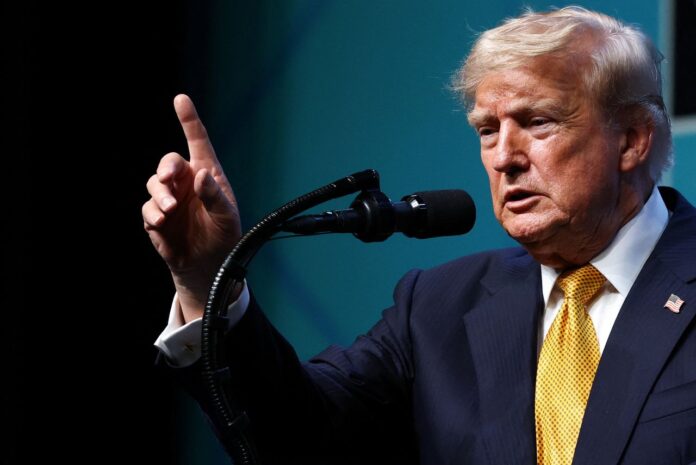
President Trump announced he will formally ask the Supreme Court to rehear its recent ruling striking down his executive order restricting birthright citizenship, calling the 6-3 decision a “miscarriage of justice.” The rare request comes just over a week after the high court affirmed that the 14th Amendment guarantees citizenship to nearly all children born on U.S. soil, dealing a major blow to one of Trump’s signature immigration policies.
Story Highlights
- Trump said he will immediately seek a Supreme Court rehearing of its June 30 ruling against his birthright citizenship order
- The court’s 6-3 decision found Trump’s order unconstitutional under the 14th Amendment’s Citizenship Clause
- Legal experts note the Supreme Court has not granted a plenary rehearing since 1956
What Happened
President Trump announced Wednesday on Truth Social that he intends to petition the Supreme Court for a rehearing of Trump v. Barbara, the case in which the justices struck down his executive order seeking to end birthright citizenship for children born to parents who are undocumented or in the country temporarily. “I will be asking for a Rehearing by the United States Supreme Court, IMMEDIATELY,” Trump wrote. “This miscarriage of justice will destroy America if they don’t change their absolutely insane decision.”
The ruling, issued June 30 by Chief Justice John Roberts, found that Trump’s January 2025 executive order could not be reconciled with the 14th Amendment, which grants citizenship to anyone “born … in the United States, and subject to the jurisdiction thereof.” Roberts was joined by conservative Justice Amy Coney Barrett and liberal Justices Sonia Sotomayor, Elena Kagan, and Ketanji Brown Jackson in the majority. Justice Brett Kavanaugh concurred in the outcome but on different grounds, arguing the order violated federal statute rather than the Constitution directly, while suggesting Congress could legislate exceptions.
Justices Clarence Thomas, Samuel Alito, and Neil Gorsuch dissented. Alito wrote in a 39-page dissent that the court “made a serious mistake” in upholding birthright citizenship as currently understood. The case originated after a federal judge in New Hampshire blocked the order in 2025 and certified a nationwide class protecting the citizenship rights of children born after February 20, 2025. The administration appealed directly to the Supreme Court, which agreed to hear the case in December 2025 and heard oral arguments in April.
Trump’s rehearing request faces long odds. Georgetown University law professor Steve Vladeck has noted that the Supreme Court has not granted a plenary rehearing of an argued case since 1956, and has not agreed to reconsider any argued decision since 1965. In the immediate aftermath of the ruling, Trump also called on Congress to pursue legislation restricting birthright citizenship, writing on Truth Social that lawmakers should “start TODAY to work on ending expensive and unfair” birthright citizenship policy.
Why It Matters
For American families, particularly immigrant communities, the ruling preserves a constitutional guarantee that has applied for more than 125 years: that children born on U.S. soil are automatically citizens regardless of their parents’ immigration status. Had Trump’s order taken effect, advocacy groups warned it could have rendered some children stateless and barred them from Social Security cards, passports, and programs like Medicaid and SNAP.
The rehearing request, however unlikely to succeed, signals the administration’s determination to continue pursuing the policy through alternative means, including a possible legislative push in Congress. That effort faces a steep climb, since altering birthright citizenship as constitutionally guaranteed would likely require a formal constitutional amendment, needing two-thirds approval in both chambers of Congress plus ratification by three-quarters of state legislatures.
For policymakers, the case underscores a broader pattern in Trump’s second term of testing the boundaries of executive authority through orders that federal courts have repeatedly found to conflict with constitutional protections. The birthright citizenship fight has become a flashpoint in the administration’s wider immigration agenda, which has included expanded deportation efforts and challenges to other longstanding legal protections for noncitizens.
Economic and Global Context
Economists and demographic researchers have pointed to the potential labor market consequences had the order taken effect, given that undocumented immigrants and their families fill significant roles in agriculture, construction, and caregiving industries nationwide. Research cited by advocacy organizations found that immigrants, a majority of whom are Latino, paid over 579 billion dollars in taxes in 2022, with undocumented immigrants contributing more than 31 billion dollars specifically to Social Security and Medicare.
Internationally, the United States is one of more than 30 countries that recognize unrestricted birthright citizenship, a practice rooted in English common law that crossed the Atlantic with American colonists. The Supreme Court’s reaffirmation keeps the U.S. aligned with that broader international norm, even as some European nations have moved toward more restrictive citizenship-by-descent models in recent decades.
The ruling also arrives as the administration pursues an aggressive immigration enforcement agenda more broadly, meaning the practical fight over immigration status and citizenship access will likely continue playing out through enforcement actions and other executive measures even as the birthright citizenship question itself appears settled for now.
Implications
In the near term, expect the Supreme Court to decline Trump’s rehearing request, given the historical rarity of such reversals and the decisive 6-3 margin of the original ruling. That would leave legislative action, and ultimately a constitutional amendment, as the only viable paths for opponents of birthright citizenship, both of which face significant political hurdles given consistent public support for the current system.
For congressional Republicans, Trump’s call to “start TODAY” on legislation puts pressure on GOP leadership to at least engage with the issue, even though most legal observers view a constitutional amendment as functionally unattainable in the current political environment. Democrats and civil rights organizations, meanwhile, are likely to use the ruling as a rallying point heading into the 2026 midterms.
For families directly affected by the litigation, the ruling provides immediate clarity and protection, though continued legal and political battles over immigration status more broadly mean uncertainty will likely persist for noncitizen households navigating the broader enforcement landscape.
Sources
“Donald Trump to seek rehearing of birthright citizenship case before Supreme Court”

