
Supreme Court Justices Amy Coney Barrett and Elena Kagan appeared before Congress on Tuesday in a rare joint appearance, personally detailing threats against themselves and their families as they pressed lawmakers for a significant increase in judicial security funding. The hearing, the first time sitting justices have testified before Congress since 2019, comes amid a documented surge in threats against federal judges nationwide. Barrett, a Trump appointee, and Kagan, a member of the court’s liberal wing, presented a unified, bipartisan front on an issue both justices described as deeply personal.
Story Highlights
- The Supreme Court is requesting $228.4 million for fiscal year 2027, a nearly 10 percent increase over the $207.8 million appropriated in 2026.
- Barrett disclosed she was issued a bulletproof vest and was the target of a swatting attempt at her home in May.
- U.S. Marshals Service data shows 512 investigations into threats against federal judges so far in 2026, compared to 807 for all of 2025.
What Happened
Justice Amy Coney Barrett and Justice Elena Kagan testified before House and Senate appropriations subcommittees on Tuesday, marking the first time sitting Supreme Court justices have appeared before Congress since 2019, when Kagan and then-Justice Samuel Alito testified about the court’s budget. The justices appeared to defend the judiciary’s request for $228.4 million in funding for fiscal year 2027, an increase of roughly 10 percent from the $207.8 million appropriated the previous year, with the bulk of the additional funding directed toward personal security measures.
Barrett, who was appointed to the court by President Trump in 2020, delivered an unusually personal account of threats she and her family have faced. She recalled being issued a bulletproof vest during a period when threats against her were “particularly intense,” and described a swatting incident at her home in May that was thwarted after police determined she was the target of a false report. “I didn’t expect that performing this service was going to put me in the position of explaining to my children what a bulletproof vest was and why I had to wear one,” Barrett told the House Appropriations Subcommittee on Financial Services and General Government. She added that “the threat level is really high” for federal judges broadly.
Kagan, appearing alongside Barrett despite sitting on opposite ends of the court’s ideological spectrum, offered a personal tribute to the late Senator Lindsey Graham, recalling his role questioning her during her 2010 confirmation hearings and a lighthearted exchange about the holidays that she said helped seal her confirmation. The bipartisan appearance underscored a shared institutional concern that transcends the court’s ideological divisions, even as lawmakers signaled they would also press the justices on more contentious topics, including ethics scrutiny following reports of undisclosed luxury travel involving other members of the court.
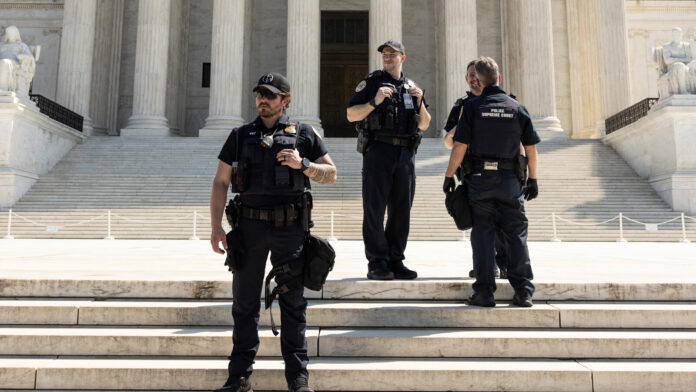
The funding request includes nearly $15 million specifically to expand the Supreme Court Police Department’s ability to protect justices and their families at their private residences, along with resources for a new visitor screening facility at the court itself. According to data from the U.S. Marshals Service, there have been 512 investigations into threats against federal judges since the start of 2026 alone, compared to 807 for the entirety of 2025, reflecting a continued escalation in judicial threats that has alarmed court security officials and lawmakers on both sides of the aisle.
Security incidents involving judges classified by the Marshals Service as being of “significant concern” rose 57 percent in 2025 compared to the prior year, a statistic the justices emphasized during their testimony. Chief Justice John Roberts had separately warned in March that hostility directed at judges in personal terms is “dangerous and it’s got to stop,” remarks that came days after Trump publicly criticized judges who ruled against his administration on social media.
Why It Matters
The rare appearance by sitting justices reflects the severity of the security challenges now facing the federal judiciary, a branch of government that has traditionally operated with minimal public visibility regarding its internal security concerns. The willingness of both a Trump appointee and a member of the court’s liberal wing to appear together and testify about deeply personal threats signals that judicial safety has become an issue transcending typical ideological divides in Washington.
For Congress, the funding request arrives at a politically sensitive moment, as lawmakers weigh substantial budget increases for judicial security against broader fiscal pressures and competing spending priorities across the federal government. Approving the requested increase would represent a significant commitment to protecting the judiciary at a time when public trust in the courts has faced sustained scrutiny.
The hearing also occurs against the backdrop of a Supreme Court term that saw the court back major elements of the Trump administration’s expansive use of executive authority, while also ruling against the administration on high-profile matters such as birthright citizenship. Barrett’s participation in that ruling against Trump has drawn attention to tensions between the justice and some elements of the conservative legal movement, even as she appeared alongside Kagan Tuesday focused squarely on security funding.
For the broader public, the testimony highlights a troubling trend: individuals tasked with interpreting the nation’s laws increasingly face direct threats to their personal safety and that of their families, raising fundamental questions about how democratic institutions protect those who serve within them without compromising judicial independence or accessibility.
Economic and Global Context
The judiciary’s overall security budget request reflects a broader trend across federal institutions toward increased spending on protective services amid a documented rise in threats against public officials. The nearly 10 percent year-over-year increase in the Supreme Court’s funding request outpaces general federal budget growth, underscoring the scale of the security challenge as perceived by court administrators.
The timing of the hearing, occurring the same week as the swearing-in of a new senator following Lindsey Graham’s death and amid escalating military action in the Middle East, illustrates a Washington grappling simultaneously with multiple high-stakes security and political developments. Congressional attention is being divided across several urgent priorities, which could affect how quickly the judiciary’s funding request moves through the appropriations process.
Internationally, rising threats against judicial officials are not unique to the United States, with several democracies reporting similar trends in recent years as political polarization intensifies globally. However, the scale and personal nature of the threats described by Barrett, including a swatting attempt at her home, represent an escalation that some judicial security experts describe as unprecedented for sitting Supreme Court justices in the modern era.
Implications
In the near term, House and Senate appropriators will need to weigh the judiciary’s funding request against other budget priorities as they finalize fiscal year 2027 appropriations. Given the bipartisan nature of Tuesday’s testimony, lawmakers from both parties appear likely to support at least a significant portion of the requested increase.
For the Supreme Court Police and U.S. Marshals Service, approval of the funding would enable expanded protective operations at justices’ private residences, a capability officials have argued is increasingly necessary given the volume of threats being investigated.
For the broader federal judiciary beyond the Supreme Court, the hearing could set a precedent for how lower federal courts advocate for similar security resources, particularly given that threats against federal judges generally have also risen sharply according to Marshals Service data.
For lawmakers, the hearing’s focus on security funding may prove to be only the opening topic, as congressional aides indicated further questioning on judicial ethics, transparency, and the court’s handling of internal controversies is likely to follow in subsequent sessions.
Sources

