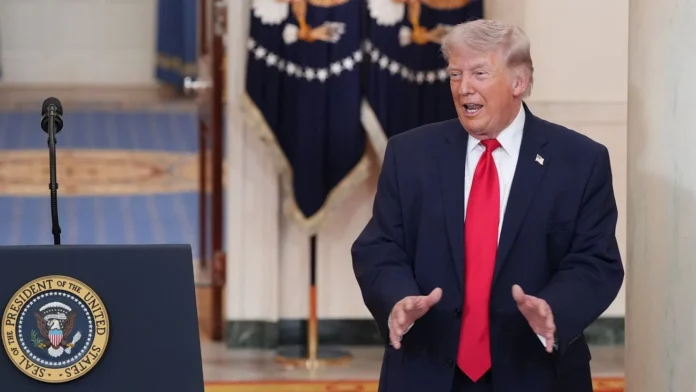
President Trump is set to deliver a rare primetime address Thursday evening focused on what he calls new findings about American election security, with the White House confirming he will draw on intelligence material tied to the 2020 election. The speech, scheduled for 9 p.m. Eastern, has been billed by Trump as “really, really big news,” though the exact contents remain closely guarded even among his own advisers.
Story Highlights
- Trump’s address is scheduled for 9 p.m. ET Thursday from the White House
- Officials say he will present material from the Office of the Director of National Intelligence related to the 2020 election
- A White House task force led by conservative writer John Solomon has spent weeks identifying documents for possible declassification
- Some administration officials privately worry the release could jeopardize intelligence sources or mislead the public
What Happened
President Trump confirmed this week that his Thursday evening address would center on election security, telling reporters in the Oval Office that the speech would touch on a “couple of other things” but that the elections portion would be the centerpiece. “It doesn’t get bigger, because without free and fair elections, you don’t have a country,” Trump said. He added that the address would include a “very big announcement,” though he offered no specifics.
According to multiple outlets, including ABC News, Reuters and The Washington Post, Trump is expected to detail newly declassified intelligence related to voting machine vulnerabilities and alleged foreign efforts to influence past U.S. elections, with particular emphasis on the 2020 race he lost to former President Joe Biden. Sources briefed on the planning said a White House task force, led by conservative writer John Solomon, has spent recent weeks combing through government files to identify material for declassification and public release.
The speech follows a confidential White House briefing held earlier this week to review the findings before they are made public. Internally, officials are divided over how much information to release. Some worry that declassifying broad swaths of material could create a muddled picture of election security or undermine public confidence in the voting system, while others are concerned about compromising intelligence collection methods used to track foreign interference efforts.
The address arrives against a backdrop of renewed scrutiny on election-related law enforcement actions. In January, FBI agents executed a search warrant at the Fulton County, Georgia, elections office, seizing roughly 700 boxes of 2020 ballots and related records as part of an investigation into alleged voting irregularities, an effort that has drawn criticism from state election officials who point to multiple audits finding no evidence of intentional wrongdoing. Trump’s newly nominated director of national intelligence, Jay Clayton, testified this week that he was not involved in preparing Thursday’s speech, saying doing so would conflict with the independence expected of the role.
Why It Matters
The address represents one of the most direct efforts by Trump during his second term to relitigate his 2020 loss using the machinery of the federal government, rather than campaign rhetoric alone. Because the material is being drawn from declassified intelligence rather than a political speech, it carries a degree of institutional weight that previous claims about the 2020 election lacked, raising the stakes for how state election officials and the public interpret what is presented.
Election administrators across the country have said they are watching the speech closely, wary that Trump could use the primetime platform to again cast doubt on the integrity of an election that has already been extensively reviewed. Previous government assessments, including a 2021 Justice Department and Homeland Security report, found no evidence that any foreign government-affiliated actor changed votes or disrupted vote tallying in 2020, and a National Intelligence Council report reached similar conclusions regarding technical interference.
For Republicans heading into the November midterms, the speech could reinforce base enthusiasm around election integrity as a campaign issue, particularly as the party continues pushing the SAVE America Act, a voter identification and citizenship verification bill. But it also risks reopening a politically fraught debate at a moment when GOP strategists are trying to keep midterm messaging focused on the economy and public safety.
Economic and Global Context
While the speech itself is not an economic event, it lands amid a period of significant political distraction for the administration, with the ongoing Iran conflict, a lapsed Section 702 surveillance authority, and unresolved government funding negotiations all competing for attention. The parallel confirmation fight over Clayton’s nomination to lead the intelligence community adds another layer of institutional uncertainty, given that his confirmation is viewed as a prerequisite for reauthorizing lapsed foreign surveillance powers that intelligence agencies rely on for national security operations.
Internationally, the speech could be scrutinized by foreign governments and allies for any claims made about specific countries’ interference activities, particularly given that past intelligence assessments have implicated Russia, China and Iran to varying degrees in efforts to influence American elections, findings that carry diplomatic implications regardless of domestic political framing.
Implications
In the immediate term, state election officials, voting rights organizations and members of Congress from both parties will be parsing the speech for specific claims that can be independently verified or refuted. Any assertions involving voting machine vulnerabilities are likely to prompt swift responses from election technology vendors and state election directors, many of whom have spent years defending the integrity of their systems against similar allegations.
For Democrats, the speech offers an opportunity to characterize the administration as using intelligence resources for political purposes, a narrative reinforced by Clayton’s contentious confirmation hearing this week. For Republicans, much will depend on whether Trump’s claims are substantiated by credible declassified material or amount to a repackaging of previously debunked theories, a distinction that will shape how the speech is received even within his own party.
Sources

