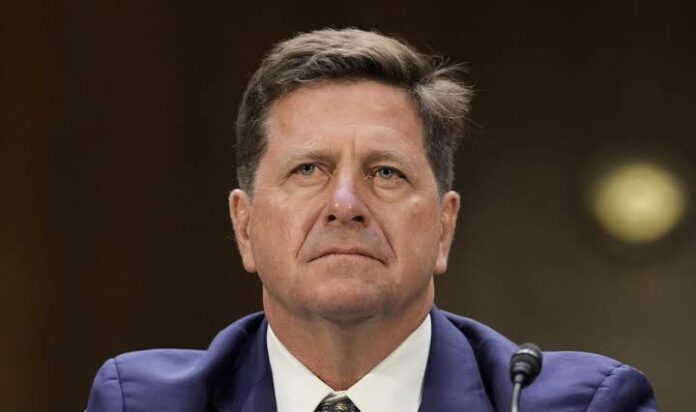
President Trump’s nominee to lead the nation’s intelligence community, Jay Clayton, faced pointed questioning from Senate Democrats this week over whether he accepts that Joe Biden legitimately won the 2020 election, exposing fresh fault lines just as his confirmation becomes critical to restoring a lapsed foreign surveillance authority. The hearing marks a pivotal moment in Trump’s monthslong effort to install permanent intelligence leadership after ousting his previous director.
Story Highlights
- Clayton testified before the Senate Intelligence Committee Wednesday after Trump abruptly canceled his original June hearing
- Clayton said he is “not an election denier” but stopped short of affirming Biden won legitimately
- His confirmation is seen as a prerequisite to reauthorizing Section 702 surveillance powers, which lapsed over a month ago
- Committee Chairman Tom Cotton plans a business meeting next week to advance the nomination to the full Senate
What Happened
Jay Clayton, the U.S. attorney for the Southern District of New York and Trump’s pick to serve as director of national intelligence, appeared before the Senate Select Committee on Intelligence on Wednesday for a confirmation hearing that had been delayed for weeks. Trump had abruptly canceled Clayton’s originally scheduled June hearing amid a dispute with Senate Republicans over his proposed SAVE America Act voter identification legislation, a move Committee Chairman Tom Cotton publicly called “regrettable.”
During the rescheduled hearing, Democratic senators including Mark Warner, the committee’s ranking member, pressed Clayton repeatedly on whether he believed Biden had legitimately won the 2020 presidential election. Clayton responded that he was “not an election denier” and confirmed that Biden “was certified as the president of the United States,” but he did not explicitly affirm that Biden won the race legitimately, a distinction Democrats seized on throughout the hearing. Senators Mark Kelly and Jon Ossoff also questioned Clayton on the topic, reflecting broader Democratic concern that Trump intends to use the intelligence community to bolster his unsubstantiated claims about the 2020 race.
Clayton was also asked directly whether he had any involvement in preparing Trump’s Thursday primetime address on election security. He said he was “not involved in that,” adding that participating would have violated the understanding under which he agreed to serve. In his opening statement, Clayton pledged to be “mission-focused” and “team-oriented,” emphasizing a goal of “enhancing the trust of the American people” in the Office of the Director of National Intelligence, which oversees seventeen separate intelligence agencies.
Clayton’s confirmation carries additional urgency because it is tied to the fate of Section 702 of the Foreign Intelligence Surveillance Act, a key foreign spy powers program that lapsed more than a month ago. Senate Democrats have refused to reauthorize the program while Bill Pulte, a Trump loyalist with no prior national security experience, continues serving as acting DNI following the departure of Tulsi Gabbard in June.
Why It Matters
Clayton’s hearing underscores how deeply the fight over the 2020 election has embedded itself into routine institutional processes, including the confirmation of the nation’s top intelligence official. His unwillingness to fully affirm Biden’s legitimate victory, even while avoiding explicit denial, illustrates the political tightrope Trump nominees must walk between satisfying Senate confirmation requirements and avoiding the president’s displeasure.
The stakes extend well beyond symbolism. Section 702 authorizes critical foreign intelligence collection used to track terrorism threats, cyberattacks and foreign espionage, and its continued lapse leaves a genuine gap in national security capabilities. Democrats have made clear that reauthorization remains linked to resolving concerns about Pulte’s leadership, meaning Clayton’s confirmation could directly determine how quickly that authority is restored.
For the broader intelligence community, the episode raises questions about independence and morale at a moment when the office has already seen significant turnover and, according to earlier reporting, plans for extensive staff reductions under Trump’s preferred leadership approach.
Economic and Global Context
The lapse of Section 702 carries tangible national security costs, as intelligence agencies lose streamlined legal authority to monitor foreign threats operating through U.S.-based communications infrastructure. Allied intelligence services that share information with the U.S. under longstanding cooperative frameworks may also be watching how quickly the authority is restored, given how central it is to joint counterterrorism and cyber-defense operations.
Domestically, the hearing intersects with the administration’s broader election security push, including Trump’s Thursday primetime address and the stalled SAVE America Act, both of which rely on the intelligence community’s credibility to be persuasive. Clayton’s handling of these issues during confirmation will likely shape how his eventual leadership of the ODNI is perceived by both parties in Congress.
Implications
In the near term, Cotton has indicated the committee will hold a business meeting early next week to vote on advancing Clayton’s nomination to the full Senate floor. Given Republicans’ majority on the committee and in the chamber, Clayton is likely to be confirmed, though largely along party lines given Democratic reservations expressed during the hearing.
For Senate Democrats, the confirmation vote offers another opportunity to formally register objections to the administration’s handling of 2020 election issues within intelligence circles. For the broader government, swift confirmation would clear the path toward negotiating a Section 702 reauthorization, a outcome both parties have signaled they ultimately want despite the political friction surrounding Clayton’s nomination.
Sources

