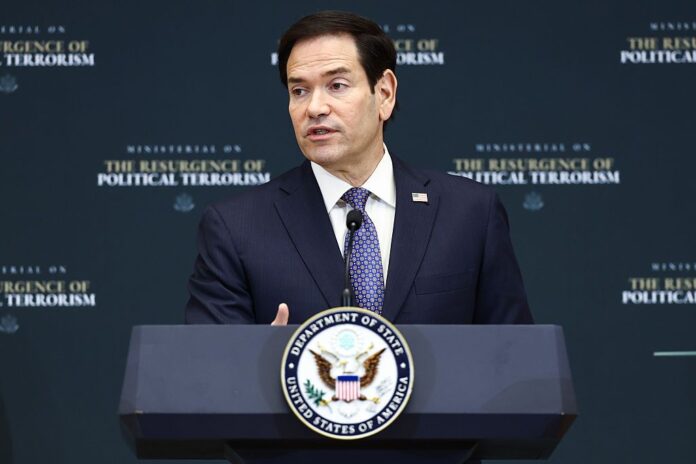
Secretary of State Marco Rubio convened representatives from more than 65 countries in Washington last week for a ministerial focused on combating what the administration calls the global resurgence of political terrorism, marking a significant international expansion of the Trump administration’s domestic campaign against left-wing extremist networks. The gathering, informally dubbed the “Antifa summit,” reflects a broader strategy built on a national security directive issued in the aftermath of the assassination of conservative activist Charlie Kirk. Administration officials say the effort is essential to confronting an escalating and increasingly coordinated international threat.
Story Highlights
- Secretary of State Marco Rubio hosted representatives from more than 65 countries in Washington for a summit on combating political terrorism
- The gathering builds on National Security Presidential Memorandum 7, which directs federal agencies to investigate and disrupt groups the administration says could incite political violence
- Rubio accused Iran and Cuba of helping fund antifa-aligned networks, though he did not provide public evidence for the claim
What Happened
Secretary of State Marco Rubio hosted a ministerial titled “The Resurgence of Political Terrorism” at the State Department on July 16, drawing representatives from more than 65 countries to Washington in what officials described as the launch of an “unprecedented global offensive” against what the administration terms “radical left terrorism.” The gathering, informally referred to by attendees and observers as the “Antifa summit,” represents the international extension of a domestic campaign that has already resulted in a series of high-profile federal prosecutions against left-wing protesters and activist groups across the country.
The underlying legal framework for the campaign traces back to National Security Presidential Memorandum 7, a directive issued by President Donald Trump following the assassination of conservative activist Charlie Kirk, which ordered a coordinated national strategy to investigate and disrupt groups the administration identifies as posing a risk of inciting political violence. The memorandum represents a significant departure from prior U.S. counterterrorism frameworks, which historically focused primarily on foreign terrorist threats rather than domestic ideological movements, and it has become the legal foundation for a wave of federal terrorism prosecutions over the past year.
During his remarks at the summit, Rubio described antifa-aligned networks as sharing coordinated infrastructure across international borders, and he directly accused Iran and Cuba of providing financial support to the movement, though he did not present public evidence to substantiate the claim. The accusation adds a new international dimension to a campaign that has, until now, been primarily focused on domestic prosecutions. Administration officials argue that treating these networks as having foreign backing justifies a more aggressive, internationally coordinated response involving allied governments.
The domestic prosecutions building on the NSPM-7 framework have already produced significant legal outcomes. In Texas, eight defendants connected to a group described as the “North Texas Antifa Cell” were sentenced in June for their role in a 2025 armed confrontation at an immigration detention facility, with one defendant receiving a 100-year sentence. In Minnesota, fifteen members and associates of a group called Direct Action Minnesota were indicted the same month on conspiracy and assault charges, with the indictment citing behavior including wearing clothing referencing antifa and using certain emoji in private messaging as supporting evidence of intent.
Why It Matters
For the Trump administration and its Republican allies, the international summit represents a significant escalation in efforts to confront what officials describe as a coordinated, ideologically motivated threat to public safety and political stability. Supporters of the campaign argue that left-wing political violence, including the assassination that prompted the original directive, demands a serious and sustained federal response, and that building international cooperation strengthens the government’s ability to disrupt cross-border financing and coordination among extremist networks.
The scale of the sentences handed down in cases like the North Texas prosecution, including a 100-year term for a defendant who did not fire a weapon, illustrates how significantly the terrorism sentencing framework has reshaped the legal consequences facing individuals connected to left-wing protest activity. Supporters view these outcomes as an appropriate deterrent against escalating political violence, while critics argue the sentences reflect prosecutorial overreach relative to the underlying conduct.
For allied governments participating in the summit, the gathering offers an opportunity to align counter-extremism strategies with Washington’s approach, potentially strengthening intelligence-sharing arrangements and coordinated enforcement actions against transnational networks. The broad international turnout, representing more than 65 countries, signals substantial global interest in engaging with the administration’s framework, even as questions remain about the underlying evidence supporting some of the claims made at the summit.
Economic and Global Context
The expansion of the anti-extremism campaign carries meaningful implications for U.S. relations with the specific countries named in Rubio’s remarks. The accusations against Iran are consistent with the broader deterioration in U.S.-Iran relations amid the ongoing military conflict between the two nations, while the allegations against Cuba add another point of friction to an already strained bilateral relationship shaped by decades of sanctions and diplomatic estrangement.
Building international coalitions around counter-extremism efforts also carries budgetary and resource implications for federal law enforcement and intelligence agencies, which must now coordinate not only domestic prosecutions but also international information-sharing arrangements with dozens of partner nations. The scale of this coordination represents a substantial expansion of federal counterterrorism resources devoted specifically to left-wing extremist networks.
Globally, the summit reflects a broader trend among some allied governments toward more aggressive domestic security measures targeting protest movements and activist networks, a trend that intersects with ongoing debates in democracies worldwide about balancing civil liberties with public safety concerns in an era of heightened political polarization.
Implications
In the coming months, expect continued federal prosecutions building on the NSPM-7 framework, with additional cases likely to emerge from ongoing investigations into activist networks across multiple states. The legal outcomes of pending cases, including whether appellate courts uphold the lengthy sentences already handed down, will be closely watched as a signal of how durable this prosecutorial approach proves to be over time.
For international partners, the coming period will likely bring further diplomatic and intelligence-sharing initiatives building on the framework established at the July summit, potentially including formal agreements on information sharing related to cross-border financing and coordination among extremist networks.
For civil liberties advocates and some legal scholars, the expansion of the campaign is likely to prompt continued legal challenges questioning both the scope of NSPM-7’s authority absent congressional approval and the evidentiary basis for specific prosecutions. How courts ultimately resolve these challenges will significantly shape the long-term durability of the administration’s approach heading into the 2026 midterms and beyond.
Sources
“How a little-known Trump directive reshaped the government’s counterterrorism approach”

