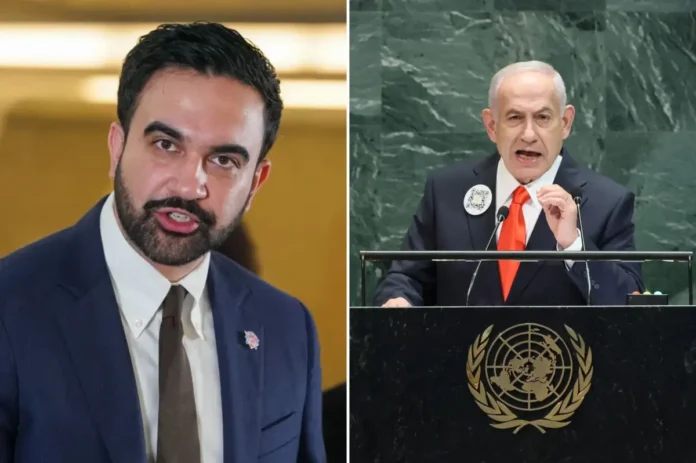
President Trump forcefully rejected New York City Mayor Zohran Mamdani’s suggestion that Israeli Prime Minister Benjamin Netanyahu could be arrested during his planned September visit to the United Nations, declaring the Israeli leader “will not be arrested, in any way, shape, or form” on American soil. The clash highlights an escalating confrontation between the Trump administration and a newly elected progressive New York mayor over an International Criminal Court warrant that the U.S. does not recognize. The dispute underscores broader tensions between Washington’s staunch support for Israel and local officials pursuing independent action on international law matters.
Story Highlights
- Trump declared Netanyahu “will not be arrested” in the U.S. after Mamdani said his office was in “active conversation” about a potential arrest
- Mamdani cited a 2024 International Criminal Court warrant charging Netanyahu with war crimes tied to the Gaza conflict
- Israeli officials, including UN Ambassador Danny Danon, dismissed Mamdani’s threat as lacking any legal jurisdiction
What Happened
President Trump posted on Truth Social Monday declaring that Israeli Prime Minister Benjamin Netanyahu “will not be arrested, in any way, shape, or form, while in the United States of America,” directly rebuffing comments from New York City Mayor Zohran Mamdani suggesting such an arrest could occur when Netanyahu travels to New York in September for the United Nations General Assembly. Trump’s statement praised Netanyahu for “fighting against the Islamic Republic of Iran,” and argued that “the only ones that should be arrested are the people that led Iran into this unprecedented spiral of death and destruction.”
The dispute traces back to comments Mamdani made in an interview published over the weekend on the New York Times podcast “The Interview,” in which he said his administration was in “active conversation with our legal department” about whether he has authority to direct the New York Police Department to detain Netanyahu. “I believe that Prime Minister Netanyahu belongs in The Hague,” Mamdani said, referring to the International Criminal Court’s detention facility in the Netherlands. The ICC issued an arrest warrant for Netanyahu in November 2024, charging him with war crimes and crimes against humanity connected to Israel’s military campaign in Gaza. The United States is not a member of the ICC and does not recognize its jurisdiction over American or Israeli officials.
When pressed for clarification, Mamdani softened his language somewhat, saying “whatever the law allows me to do in New York City, that’s what we will do, but we won’t be writing our own laws to that end.” Legal experts have raised significant doubts about whether Mamdani possesses any actual authority to arrest a sitting foreign head of government. Rebecca Ingber, a law professor at Cardozo School of Law, noted that Netanyahu would be protected by head-of-state immunity, a well-established principle of international law that shields sitting leaders from arrest by foreign domestic authorities.
Netanyahu’s office issued a sharply worded statement over the weekend dismissing both Mamdani and the ICC, calling the court a “kangaroo court” with “no jurisdiction over Americans or Israelis” and describing the arrest warrant as “bogus.” The statement also accused former ICC Chief Prosecutor Karim Khan, who issued the original warrant, of pursuing the case to divert attention from misconduct allegations against himself. Israeli Ambassador to the United Nations Danny Danon separately dismissed Mamdani’s threat, stating the mayor has “no jurisdiction” over the matter and suggesting he “learn something about the rule of law.” The Trump administration has previously imposed sanctions on Khan and roughly a dozen other ICC staff members in response to warrants issued against senior Israeli officials.
Why It Matters
The confrontation illustrates the widening gap between the Trump administration’s approach to Israel and the positions of some progressive local officials elected in major American cities. Trump’s forceful intervention signals that the federal government intends to actively shield Netanyahu from any local enforcement action, reinforcing the administration’s broader posture of full diplomatic and political support for Israel amid its ongoing regional conflicts, including the current confrontation with Iran.
For policymakers, the episode raises unresolved questions about the limits of local government authority when it intersects with international law and federal foreign policy. While legal experts broadly agree Mamdani lacks the authority to arrest a visiting head of government, his willingness to publicly entertain the idea reflects a broader trend of local officials using symbolic gestures to signal opposition to federal foreign policy positions they disagree with.
The dispute also has implications for how foreign leaders navigate travel to the United States going forward. New York City has hosted the UN General Assembly for decades without incident regarding foreign leader detentions, and any perceived threat to that arrangement could complicate diplomatic protocol and security planning for future high-profile international gatherings hosted in the city.
Economic and Global Context
The dispute unfolds against the backdrop of sustained American financial and military support for Israel amid its continuing conflicts in the region, including the broader war involving Iran that has drawn in Hezbollah in Lebanon and other regional actors. The Trump administration’s willingness to sanction ICC officials over warrants targeting Israeli leadership reflects a broader pattern of using American economic and diplomatic tools to counter international legal actions it views as illegitimate.
New York City’s status as host to the United Nations headquarters gives it unique diplomatic significance, and any disruption to the normal flow of foreign leader visits could have ripple effects on the city’s standing as a global diplomatic hub. The city has for decades balanced its role as an international meeting point with its own local political dynamics, and Mamdani’s comments represent one of the more direct challenges to that arrangement in recent memory.
Internationally, the exchange adds to ongoing friction between the United States and the International Criminal Court, an institution Washington has never joined but which has increasingly targeted American allies, including Israeli officials, with formal legal proceedings. The sanctions imposed on ICC staff reflect the administration’s broader strategy of using economic leverage to push back against what it considers overreach by international bodies lacking jurisdiction over U.S. allies.
Implications
In the near term, both Trump and Netanyahu’s office are likely to continue framing the dispute as validation of their broader argument that the ICC lacks legitimate authority over Israeli officials, a position that resonates strongly with Republican voters and pro-Israel constituencies. Expect continued statements from administration officials reinforcing that federal authorities, not local governments, control matters of foreign head-of-state security and immunity.
For Mamdani, the episode places him in a politically delicate position as he balances progressive base expectations with the practical and legal realities of his limited authority over international law enforcement matters. How he navigates the issue in the coming weeks, particularly as September approaches, will likely shape perceptions of his administration’s approach to foreign policy-adjacent issues that fall outside traditional mayoral authority.
For Israel and its allies in Washington, the dispute reinforces the value of a supportive federal government willing to publicly and forcefully defend Israeli officials against what they consider illegitimate international legal actions. As the September UN General Assembly approaches, expect heightened security planning and continued political sparring between City Hall and the White House over the appropriate boundaries of local versus federal authority.
Sources
“Trump rejects Mamdani’s threat to arrest Israel’s Netanyahu for war crimes”

