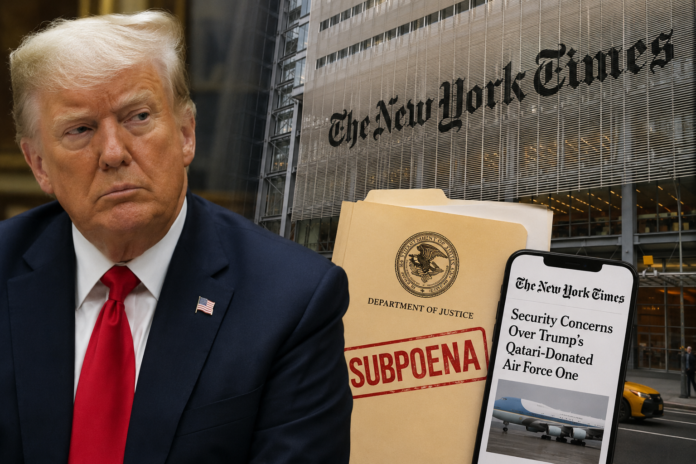
The Justice Department dropped subpoenas seeking grand jury testimony and phone records from New York Times reporters on Thursday, reversing course after a federal judge raised pointed questions about the government’s handling of the investigation. The subpoenas stemmed from Times reporting on security concerns involving President Trump’s Qatari-donated Air Force One replacement. The reversal marks a notable retreat for the administration in a case that touched on core press freedom protections.
Story Highlights
- The Justice Department withdrew subpoenas issued July 10 seeking testimony and phone records from New York Times journalists
- The subpoenas targeted reporters behind stories on security concerns tied to Trump’s new Qatari-donated Air Force One
- U.S. District Judge Arun Subramanian said the case raised “profound First Amendment” issues at a Thursday hearing
- The government maintained the subpoenas were authorized by Acting Attorney General Todd Blanche on national security grounds
What Happened
The Department of Justice withdrew subpoenas it had issued to New York Times reporters seeking grand jury testimony and phone records, according to an order from U.S. District Judge Arun Subramanian following a Thursday hearing in Manhattan federal court. The subpoenas, first issued July 10, sought to compel Times journalists to testify before a federal grand jury as part of what the government described as a national security investigation into the leak of sensitive information. Federal agents delivered several of the subpoenas directly to reporters’ homes.
The underlying reporting at issue involved two New York Times stories detailing security concerns that led the U.S. Secret Service to intervene and prevent Trump from flying home from Turkey aboard the administration’s new Qatari-donated Boeing 747-8, opting instead for the older Air Force One aircraft as a precaution tied to the resumption of hostilities with Iran. The Times had reported the story just two days before the Justice Department issued its initial subpoenas.
At Thursday’s hearing, Judge Subramanian pressed a government attorney, Sean Buckley, on what steps investigators had taken before resorting to subpoenaing journalists, a step generally treated as a last resort under longstanding Justice Department guidelines protecting press freedom. Subramanian noted the case raised “profound First Amendment” issues and criticized what he characterized as sloppy legal work by government attorneys, including an instance in which prosecutors sought a separate court order barring mobile phone providers from notifying reporters that their phone records had been subpoenaed, even after the Justice Department had already publicly confirmed the existence of the subpoenas.
The government maintained throughout the hearing that the subpoenas were properly authorized by Acting Attorney General Todd Blanche, whose approval can supersede standard journalist protections under Justice Department policy. Buckley would not specify whether Blanche’s approval was based on national security concerns, a threat to human life, or other grounds. Ultimately, facing the judge’s continued skepticism and the threat that he would grant the Times’ motion to quash the subpoenas outright, the government agreed to withdraw them voluntarily. Subramanian’s order noted that if the government seeks to renew the subpoenas in the future, it must first come before the court.
Why It Matters
The episode touches directly on one of the most sensitive areas of press freedom law: the government’s ability to compel journalists to reveal sources or testify before grand juries. Justice Department guidelines have long treated subpoenas to journalists as measures of last resort, reflecting a recognition that aggressive pursuit of reporters’ sources can chill investigative journalism and undermine the press’s constitutional role in holding government accountable.
For the Trump administration, the reversal represents a notable check on executive authority delivered not through legislative action but through judicial scrutiny, illustrating the continued role federal courts play in constraining aggressive prosecutorial tactics even when framed in national security terms. New York Times general counsel David McCraw characterized the outcome as “a great day for the First Amendment and a great day for the rule of law,” a characterization that underscores how seriously press freedom advocates viewed the stakes of the case.
At the same time, the episode reflects the broader tension between legitimate government interests in protecting sensitive national security information, particularly information touching on presidential security arrangements, and constitutional protections for a free press. The government’s stated justification, that the reporting concerned a genuine national security leak, is not inherently illegitimate, even if the specific execution of the subpoenas drew judicial criticism.
For journalists and news organizations more broadly, the case serves as a reminder that press freedom protections, while robust, are not absolute, and that the boundaries of permissible government action against journalists remain an active and evolving area of law.
Economic and Global Context
While the case does not carry direct economic implications, it unfolds amid broader scrutiny of the roughly $400 million Qatari-donated Boeing 747-8 that the administration announced in May 2025 it would use as Air Force One, with plans to eventually transfer the aircraft to Trump’s presidential library. That arrangement has itself drawn continued political and ethics scrutiny since it was first announced, making the underlying reporting at issue in this case part of a broader pattern of coverage examining the unusual gift.
The timing of the security concerns described in the Times’ reporting, tied to the resumption of hostilities with Iran, also places the episode within the broader context of an active and escalating military conflict that has dominated much of the administration’s foreign policy attention throughout the summer. Security precautions around presidential travel take on heightened significance during active combat operations, adding context to why the underlying leak investigation was framed in national security terms.
Press freedom organizations have tracked a broader pattern of tension between the current administration and news organizations throughout Trump’s second term, with this case representing one of the more prominent instances in which that tension escalated to direct legal confrontation in federal court.
Implications
For the Justice Department, the case is likely to prompt renewed internal scrutiny of how and when subpoenas targeting journalists are authorized, particularly given Judge Subramanian’s pointed criticism of the legal process followed in this instance and his warning that any renewed subpoenas must first be brought before the court.
For the New York Times and other news organizations, the successful challenge reinforces the practical value of aggressive legal defense against government subpoenas, while also highlighting the continued vulnerability journalists face when reporting on sensitive national security or presidential security matters.
For congressional oversight committees, the episode may prompt further questions about the Justice Department’s internal processes for authorizing subpoenas against members of the press, an issue that has drawn bipartisan concern in the past regardless of which administration is in office.
For the broader public, the case underscores the ongoing importance of judicial independence in checking executive branch overreach, illustrating how federal courts continue to serve as a critical venue for resolving disputes between government power and constitutional protections.
Sources
DOJ Drops New York Times Reporters Subpoenas in Air Force One Reporting Case

