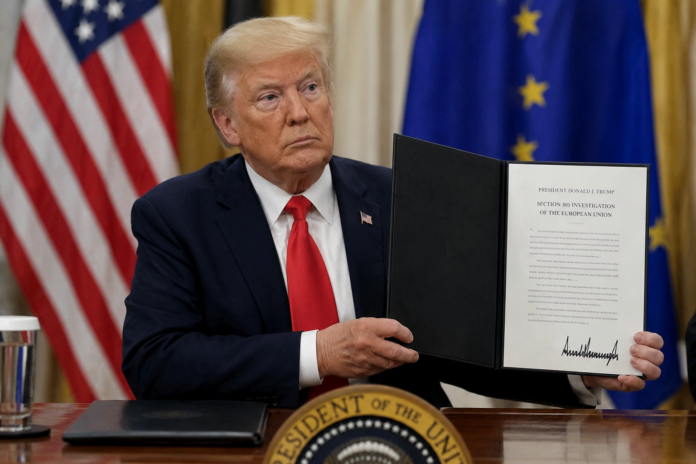
President Donald Trump announced Friday that the United States will launch a formal Section 301 investigation into the European Union’s pattern of fining American technology companies, threatening new tariffs on European goods in response. The move comes a day after the EU hit Google with a $1 billion fine for alleged antitrust violations, pushing the bloc’s total penalties against Apple, Meta, Amazon, and Google past $20 billion combined. The announcement injects fresh uncertainty into transatlantic trade relations at a moment when markets had hoped tensions were cooling.
Story Highlights
- Trump ordered a Section 301 investigation into EU trade practices after Google was fined $1 billion this week over antitrust violations tied to Google Play and search
- Combined EU fines against Apple, Meta, Amazon, and Google now exceed $20 billion since 2021, according to Trump’s own tally
- Trump threatened new tariffs on European goods, calling the fines an “illegal and highly discriminatory practice”
What Happened
President Donald Trump used a lengthy Truth Social post Friday to announce that his administration would open a formal trade investigation into the European Union, accusing Brussels of unfairly targeting American technology firms with billions of dollars in fines. The trigger was a fresh penalty against Alphabet Inc.’s Google, which the European Commission fined 890 million euros, roughly $1 billion, this week for allegedly violating the bloc’s Digital Markets Act by steering consumers toward its own Google Play store and search products over competitors.
Trump tallied the damage in his post, noting that Apple had been fined $15 billion, Meta $3 billion, and Amazon $2.5 billion in recent years, on top of Google’s now more than $18 billion in cumulative EU penalties. “The United States of America is not a ‘PIGGYBANK’ for Europe, nor will we allow it to be!” Trump wrote, describing the fines as an effort to “rob” American companies and, by extension, American taxpayers.
The president said he would invoke Section 301 of the Trade Act of 1974, the same authority he has used repeatedly since the Supreme Court struck down several of his earlier tariff actions this year. Section 301 allows the executive branch to investigate and respond to what it deems unfair foreign trade practices, potentially culminating in new duties on EU imports. Trump indicated the investigation would examine the EU’s conduct dating back to 2021, effectively covering the entirety of the Digital Markets Act enforcement era.
The European Commission pushed back the same day. Spokesperson Thomas Regnier said the EU’s competition rules exist to guarantee a level playing field, noting that so-called digital “gatekeepers” like Google, Apple, Meta, Amazon, Microsoft, and TikTok owner ByteDance have obligations to consumers that smaller competitors do not. Trump specifically objected to provisions requiring Google to display neutral search results rather than prioritizing its own travel, hotel, and pricing tools, calling the requirement a stripping away of features “Europeans love.”
The clash is not new. European regulators have spent much of 2026 preparing additional enforcement actions against Silicon Valley firms even as the Trump administration warned of retaliation, according to reporting from Brussels. Competition chief Teresa Ribera has publicly acknowledged the difficulty of enforcing EU digital law while avoiding a full-blown trade war with Washington.
Why It Matters
The dispute strikes at the heart of an unresolved question in U.S.-EU relations: whether European antitrust enforcement against American tech giants is legitimate consumer protection or a disguised tariff on U.S. innovation. For American businesses, particularly the five to six firms the EU designates as digital gatekeepers, the stakes are enormous. A reversal of $20 billion in fines, as Trump has demanded, would mark an extraordinary diplomatic and legal victory, but achieving it would require either EU capitulation or a drawn-out legal and trade confrontation with no clear precedent.
For everyday Americans, the practical effect could arrive through higher prices. If Trump follows through with new tariffs on European goods, U.S. importers of European cars, machinery, wine, and luxury goods would likely pass added costs to consumers, echoing patterns seen in earlier rounds of Trump-era tariff actions. Section 301 tariffs can also invite retaliatory measures from trading partners, raising costs on U.S. exporters who sell into European markets.
The move also underscores how central Big Tech has become to American economic diplomacy. Google, Apple, Meta, and Amazon collectively represent trillions of dollars in market value and are treated by the administration as strategic national assets whose profitability is now explicitly linked to U.S. trade policy, not merely private business interests.
Policymakers in Washington will need to weigh whether escalating this fight helps or hurts broader efforts to stabilize relations with European allies at a moment when the United States also needs European cooperation on Iran, Ukraine, and NATO defense spending.
Economic and Global Context
The EU’s Digital Markets Act, which came into force in 2023, was designed to curb the market power of large digital platforms by mandating interoperability, banning self-preferencing, and requiring fair access for competitors. Since then, EU fines against major American firms have piled up rapidly: Apple’s $15 billion penalty stands among the largest antitrust fines in EU history, while Google’s cumulative total, now above $18 billion, spans multiple cases dating back years before the DMA itself took effect.
Markets have grown accustomed to periodic Trump-EU trade flare-ups, but the timing here is notable. It comes as global markets are already absorbing volatility from the ongoing conflict with Iran, which has pushed oil prices and shipping costs higher. Adding a transatlantic trade dispute introduces another variable for investors already pricing in geopolitical risk premiums across equities and currencies.
A Section 301 investigation typically takes months to complete before any tariffs are formally imposed, giving both sides time to negotiate. However, Trump has shown a willingness in his second term to move quickly from threat to action, having previously imposed tariffs on Canada, Mexico, and China with limited advance notice. European officials will be watching closely for any executive order or proclamation that follows the investigation’s launch.
The broader technology sector, meanwhile, faces a bifurcated regulatory landscape: stricter compliance rules in Europe and increasingly protective, tariff-backed advocacy from Washington. This divergence could accelerate a trend already underway, in which large tech firms build separate product features and business models for the European market versus the rest of the world.
Implications
In the near term, expect the European Commission to reject any American demand to unwind existing fines, since doing so would functionally gut the enforcement mechanism of the Digital Markets Act and invite similar pressure from other trading partners. Brussels has significant political incentive to hold firm, particularly with elections and coalition politics across member states sensitive to perceptions of capitulating to Washington.
For American tech companies, the investigation offers rhetorical cover and potential future leverage, but it does not erase the fines already levied or guarantee relief from future EU enforcement actions. Executives at Google, Apple, Meta, and Amazon will likely continue quiet lobbying on both sides of the Atlantic while publicly staying neutral to avoid antagonizing regulators in either jurisdiction.
For American consumers and import-dependent businesses, the practical risk is a slow drift toward new tariffs on European goods, which could raise costs on autos, wine, cheese, and industrial equipment if talks fail to produce a resolution. Trade groups representing U.S. importers are expected to lobby against escalation, wary of repeating the retaliatory tariff cycles seen in prior trade disputes.
Diplomatically, the fight adds friction to a relationship the administration needs functioning smoothly on other fronts, particularly coordination with European allies on Iran policy and continued support for Ukraine. How aggressively the White House pursues this investigation may reveal how much priority trade grievances take relative to broader alliance management this year.
Sources

