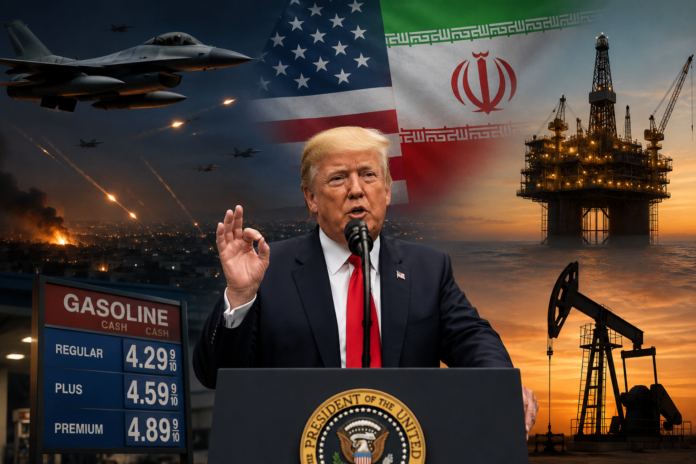
The U.S. military campaign against Iran extended into a 13th consecutive night of strikes on Friday, with President Donald Trump telling reporters that the United States and Iran remain in talks even as he met with top advisers to weigh further escalation. The renewed conflict has pushed global oil prices back near $100 a barrel and drawn Yemen’s Houthi rebels into fresh attacks on shipping in the Red Sea. American consumers are already feeling the effects, with average gasoline prices holding well above $4 a gallon.
Story Highlights
- U.S. strikes on Iran have continued for 13 consecutive nights after a ceasefire agreement collapsed earlier this month
- Global oil prices dipped below $100 a barrel Friday after briefly reaching that level for the first time in two months
- Trump met with Cabinet officials and advisers Friday to discuss potential further escalation if talks stall
What Happened
President Donald Trump told reporters Friday that the United States and Iran remain engaged in negotiations and that he believes Tehran is “getting more serious,” even as the American bombing campaign against Iranian military targets entered its 13th consecutive night. U.S. Central Command said strikes began at 6:45 p.m. Eastern time, describing the operation as an effort to hold Iran accountable and diminish threats posed by the Islamic Revolutionary Guard Corps to commercial shipping in the region.
The current escalation traces back to early July, when a temporary ceasefire that had included reopening the Strait of Hormuz broke down after Iranian forces attacked commercial vessels in the strait. Trump declared the truce “over” while attending a NATO summit in Ankara, Turkey, saying at the time that continued negotiations would be “a waste of time.” U.S. forces subsequently struck more than 80 targets across Iran and the Treasury Department revoked a sanctions waiver that had permitted Iran to resume oil exports under the earlier agreement.
Iran, for its part, rejected a ceasefire proposal presented by the Iraqi prime minister on behalf of Washington, according to reporting citing Iranian and Iraqi officials. Tehran reportedly objected to any temporary arrangement that left the question of control over the Strait of Hormuz unresolved, insisting instead on a permanent cessation of hostilities paired with sanctions relief.
Earlier this week, Trump told Axios he was “considering a massive attack” on Iran and said he was “close to making a decision,” while also noting that Israel “would join in two minutes” if asked, though he added the United States did not currently believe that step was necessary. On Friday, Trump convened a meeting with Cabinet officials and senior advisers specifically to weigh what escalation might look like should negotiations fail to produce results.
Adding to regional volatility, Yemen’s Iran-backed Houthi rebels targeted Saudi oil tankers in the Red Sea this week, introducing a new front of uncertainty for global shipping already strained by the effective closure of the Strait of Hormuz, one of the world’s most critical chokepoints for oil transport.
Why It Matters
The renewed conflict carries direct economic consequences for American households. Average gasoline prices in the United States have remained above $4 a gallon, a level that touches nearly every family’s budget and factors heavily into inflation calculations the Federal Reserve monitors closely. Extended military engagement in the Middle East also raises the specter of higher defense spending and potential troop deployments, issues that carry significant political weight heading into the 2026 midterm election cycle.
For policymakers, the conflict presents a genuine strategic dilemma. Trump has signaled willingness to pursue either a diplomatic or military resolution, but the collapse of the earlier ceasefire suggests that off-ramps are difficult to sustain once hostilities resume. Congress has already held hearings, including one addressing emergency funding requests tied to the Iran operation, reflecting bipartisan concern over the financial and strategic costs of an open-ended campaign.
The involvement of the Houthis adds another layer of risk. Attacks on Saudi tankers threaten to draw Saudi Arabia more directly into the conflict and could complicate the administration’s separate nuclear cooperation talks with Riyadh, which Trump has explicitly linked to Middle East normalization efforts under the Abraham Accords framework.
For American allies in the Gulf and Europe, the conflict’s trajectory will shape decisions on everything from energy security planning to military basing arrangements, particularly as NATO members watch how the United States balances its Middle East commitments against continued support for Ukraine and broader European security concerns.
Economic and Global Context
Oil markets have been on a volatile ride throughout 2026 as the Iran conflict has ebbed and flowed. Prices spiked above $115 a barrel in April during an earlier escalation, plunged by as much as 20 percent when a ceasefire was announced, then surged again in early July when that truce collapsed, and have now approached the $100 mark once more amid the latest round of strikes. Friday’s modest pullback below that threshold suggests markets remain uncertain rather than fully pricing in worst-case outcomes.
The conflict’s effect extends beyond crude prices. United Airlines and Norwegian Cruise Line have both seen share price declines tied to rising fuel costs during previous escalation periods, while Treasury yields have ticked upward as investors price in inflation risk connected to sustained higher energy costs. The bond market’s sensitivity reflects broader concern that an extended Middle East conflict could complicate the Federal Reserve’s efforts to manage inflation without further rate hikes.
Globally, Asian markets have shown outsized reactions to Iran-related news, with South Korea’s Kospi index experiencing sharp swings tied both to the conflict and separate volatility in AI-related technology shares such as Samsung Electronics and SK Hynix. European markets have also moved on Iran headlines, underscoring how interconnected global equity markets have become with Middle East security developments.
The Strait of Hormuz remains the central economic chokepoint in the crisis. A significant share of the world’s seaborne oil trade transits the strait, and any sustained disruption carries the potential to affect fuel costs far beyond the immediate region, touching supply chains, shipping insurance rates, and manufacturing costs worldwide.
Implications
In the near term, the trajectory of the conflict likely hinges on whether Iran responds to continued strikes with further attacks on shipping or moves toward genuine negotiation. Trump’s comment that Tehran is “getting more serious” suggests the administration sees some diplomatic opening, but the pattern of collapsed ceasefires this year gives reason for caution about any near-term resolution.
For American consumers, continued high gas prices and elevated inflation risk remain the most immediate and tangible consequence, with implications for household budgets and the broader political environment heading into the midterms.
For Gulf allies, particularly Saudi Arabia, the Houthi attacks on tankers raise pressure to either accept deeper security cooperation with Washington or seek independent de-escalation channels with Iran and its regional proxies. How Riyadh responds could shape the future of the pending U.S.-Saudi nuclear deal.
For Congress, expect continued hearings and funding debates as the conflict’s costs mount, with lawmakers from both parties likely pressing the administration for clearer benchmarks defining what victory or resolution would look like in this now weeks-long engagement.
Sources
Oil tops $100 a barrel, Houthi attack in Red Sea marks new escalation

