Story Highlights
- Alan Wilson defeated Pamela Evette by a roughly two-to-one margin in Tuesday’s GOP runoff
- Trump initially endorsed Evette but issued a rare dual endorsement of both candidates four days before the runoff
- Senator Tim Scott, Senator Ted Cruz, and Representatives Nancy Mace and Ralph Norman all rallied behind Wilson
- Wilson will face Democratic state Representative Jermaine Johnson in November’s general election
What Happened
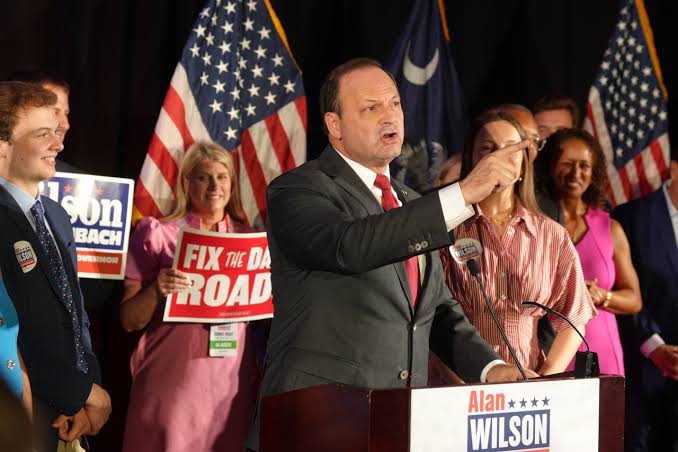
Alan Wilson, South Carolina’s attorney general since 2011 and the son of longtime U.S. Representative Joe Wilson, won the Republican nomination for governor in a runoff election held Tuesday, defeating Lieutenant Governor Pamela Evette by a commanding margin of roughly 69 percent to 31 percent. The race had been considered close heading into runoff day, but Wilson’s lead proved insurmountable, with the contest called by the Associated Press roughly half an hour after polls closed at 7 p.m.
The runoff capped a closely watched campaign to succeed term-limited Governor Henry McMaster in South Carolina’s first open gubernatorial race since 2010. In the initial June 9 primary, Evette had narrowly edged Wilson for first place, winning 25 of the state’s 46 counties on a campaign that cast her as a political outsider running against a “career politician.” She entered that primary with Trump’s “complete and total endorsement,” frequently featuring images and video of herself alongside the president in campaign materials, and had hired Trump’s longtime pollster, Tony Fabrizio, to help guide her campaign strategy.
Wilson’s fortunes shifted dramatically in the two-week runoff window. Polling, including a survey by Trump’s own pollster John McLaughlin, showed Wilson opening a substantial lead over Evette in a head-to-head matchup. Sensing the shift, Trump issued an unusual dual endorsement just four days before the runoff, writing on Truth Social, “These were the two that I was hoping would get into a Runoff, and they did. I can’t hurt one of them by only endorsing the other, so, therefore, I am going to endorse, for Governor of South Carolina, both Pam Evette and Alan Wilson! It’s a Wealth of Riches.” Shortly after, Senator Tim Scott of South Carolina, chair of the National Republican Senatorial Committee, formally backed Wilson, having reportedly already been making calls and helping with fundraising on Wilson’s behalf. Senator Ted Cruz traveled to South Carolina to campaign for Wilson days before the vote, and Representatives Nancy Mace and Ralph Norman, who had placed third and fifth respectively in the initial primary, also endorsed Wilson, despite a previous feud between Mace and Wilson that the two described as having “buried the hatchet.”
In his victory speech, Wilson outlined his priorities for the governorship, including a top-to-bottom audit of state government, renewed infrastructure investment, and an end to what he called “bad corporate deals that cost taxpayers billions.” Wilson, who credited his campaign team’s steady, methodical approach for the win, said, “My team put in a full year of hard work. We poured our guts into this campaign… people can assign it to the president, they can assign it to endorsements, but at the end of the day, it’s not” solely about that. Wilson will face Democratic state Representative Jermaine Johnson in the November general election, in a state that has elected Republican governors in every cycle since 2002.
Why It Matters
The result represents the latest data point in an unusually turbulent 2026 primary season for Trump’s endorsement record in gubernatorial races specifically. Trump’s preferred candidates lost outright in both the Iowa and Georgia governor primaries earlier this month, and his decision to hedge with a dual endorsement in South Carolina, rather than risk a clean loss, reflects a notably more cautious approach to wielding his political capital in races where his initial pick appeared to be faltering. For a president who has built much of his political brand around his record as a kingmaker within the GOP, three consecutive complicated outcomes in marquee governor’s races raises real questions about the current limits of his sway in statewide primary contests, even as his influence in House and Senate primaries has remained largely intact.
For South Carolina Republicans, the result also illustrates the value of institutional support and methodical campaign execution over reliance on a single high-profile endorsement. Wilson’s coalition, built from law enforcement officials, state legislators, and rival candidates who consolidated behind him after elimination, proved decisive even without Trump’s early backing. That dynamic offers a template other statewide candidates may study heading into their own primary contests later this cycle.
The race also matters nationally as a bellwether for how durable Trump’s coattails will prove heading into the November midterms. With Republicans defending narrow majorities in both chambers of Congress, the party’s broader fortunes will depend heavily on whether its base voters remain as motivated by presidential endorsements as in past cycles, or whether, as this race suggests, candidate quality and grassroots organization are reasserting themselves as decisive factors in competitive primaries.
Economic and Global Context
While a state gubernatorial primary carries no direct international dimension, Wilson’s stated priorities, including a comprehensive audit of state government and scrutiny of what he termed “bad corporate deals,” signal a fiscally focused governing approach that will be closely watched by South Carolina’s business community as the state continues competing for major manufacturing and economic development investments, an area where the state has had notable recent success attracting automotive and aerospace projects.
South Carolina’s economy has benefited substantially from major corporate relocations and expansions in recent years, and the governor’s office plays a significant role in negotiating the incentive packages that accompany such deals. Wilson’s campaign rhetoric suggesting skepticism toward “bad corporate deals” could signal a more cautious approach to incentive negotiations than his predecessor, a posture that economic development officials and prospective corporate investors will likely seek clarity on as his transition progresses.
The race’s outcome also factors into broader national fundraising and strategic calculations for the 2026 midterms, as the Republican Governors Association and allied groups assess which gubernatorial contests warrant the heaviest late-cycle investment. With Wilson heavily favored in the general election given South Carolina’s consistent Republican lean at the state level, national money is likely to flow toward more competitive gubernatorial battlegrounds elsewhere.
Implications
In the near term, Wilson and Evette have committed to a “unity barbecue” hosted by the South Carolina Republican Party, with more than 500 attendees already confirmed, signaling the party’s intent to project a unified front heading into the general election. State party Chairman Drew McKissick has emphasized that both campaigns are expected to honor that commitment despite the bruising nature of the runoff.
For Democrats, Johnson’s path to the governorship remains a significant uphill climb given the state’s Republican lean, though Democrats will likely use the primary’s internal GOP friction, including Trump’s hedge, as messaging fodder to suggest divisions within the South Carolina Republican Party heading into the fall campaign.
For national Republican strategists, the South Carolina result, paired with recent losses in Iowa and Georgia’s governor primaries, will likely prompt renewed internal discussion about how and when the White House deploys presidential endorsements in statewide executive races, particularly as several more competitive gubernatorial primaries remain on the 2026 calendar.
Sources
“Wilson wins GOP nomination for South Carolina governor after Trump hedges his bet on race”

