Story Highlights
- A federal appeals court heard arguments over whether Trump’s White House ballroom construction can continue during ongoing litigation.
- The $400 million project has drawn legal challenges from historic preservationists and scrutiny over congressional approval.
- The Trump administration argues the project is tied to national security and that courts lack authority to stop it.
What Happened
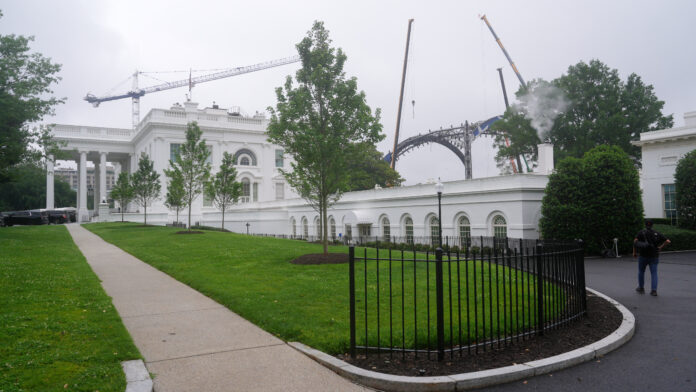
A federal appeals court heard oral arguments over President Donald Trump’s contested White House ballroom project, a $400 million construction plan that has become a major legal fight over presidential power, historic preservation, and congressional authority.
The case is before the U.S. Court of Appeals for the D.C. Circuit, where judges are weighing whether construction can continue while legal challenges move forward. The lawsuit was brought by historic preservationists who argue the administration moved ahead without the required authorization and review.
- The project would replace the demolished East Wing with a large ballroom and underground security facility.
- A federal district judge previously ordered aboveground construction to stop until Congress authorizes the work.
- The appeals court temporarily allowed construction to continue while it considers the administration’s appeal.
The Trump administration argued that the courts do not have authority to halt the project, especially because the construction includes sensitive security elements beneath the White House complex. Government lawyers said the project is not merely a ballroom, but part of a broader protective structure tied to national security.
Opponents say the administration is using national security language to justify a project that should have required congressional approval and compliance with historic preservation rules. They argue that the president cannot unilaterally demolish and rebuild major parts of the White House complex without legal limits.
The judges questioned both sides on whether the plaintiffs have standing, whether courts can intervene in White House construction decisions, and whether the administration’s national security argument overrides preservation and authorization requirements.
Why It Matters
The case matters because it is about more than a ballroom. It tests how much control a president has over federal property when that property is the White House itself.
The administration’s position is that the project falls within executive authority, especially because of the underground security component. Preservationists argue that accepting that view would allow presidents to bypass Congress and historic review whenever they attach a national security rationale to a construction project.
- A ruling for Trump could expand presidential control over White House construction decisions.
- A ruling against Trump could reaffirm congressional and judicial checks on major federal property changes.
- The decision could shape future disputes over national security claims and historic preservation law.
The lower-court ruling drew a distinction between security-related underground work and the aboveground ballroom. The Trump administration is asking the appeals court to reject that distinction and treat the project as an integrated security and construction plan.
That issue is central because the White House argues the ballroom structure helps protect sensitive facilities underneath. Critics argue that the ballroom itself is a presidential legacy project and should not be shielded from legal review simply because it sits above security infrastructure.
Constitutional and Legal Context
The legal fight centers on separation of powers, historic preservation law, and judicial authority. The administration has argued that only Congress can stop the project, while the plaintiffs argue that courts exist to review unlawful executive action.
During arguments, judges pressed the government on whether executive action becomes immune from review once construction moves quickly enough. That question goes to the heart of the case: whether the executive branch can create facts on the ground before courts have time to intervene.
- The administration says the courts cannot block the project.
- Preservationists say the executive branch cannot bypass legal review by moving quickly.
- The D.C. Circuit’s ruling could determine whether construction continues or pauses.
The National Trust for Historic Preservation and allied groups argue that the White House complex is not ordinary federal property. They say its historic and symbolic importance requires strict legal review before demolition or major alteration.
The administration counters that the president must retain broad control over White House security and operations, especially when construction involves protective facilities and classified national security concerns.
Political and Public Context
The ballroom project has become politically controversial because of its cost, financing structure, and symbolic meaning. Trump has personally tied the project to his vision for the White House and has treated it as part of his presidential legacy.
Critics have described it as an expensive and unnecessary project that mixes public funding, private donations, and political loyalty. Supporters argue that the White House needs a modern event space and upgraded security infrastructure.
- The project is estimated to cost about $400 million.
- It has drawn strong criticism from preservation groups and some members of Congress.
- Public comments during the review process were overwhelmingly negative, according to the pasted source material.
The issue has also surfaced in Congress. Some lawmakers have questioned whether federal funds should be used for the project without clearer authorization, and attempts have been made to restrict money tied to the ballroom.
For Trump, a court ruling allowing construction to continue would protect a highly visible legacy project. A ruling against the administration would mark another judicial limit on his second-term use of executive power.
What Happens Next
The appeals court is expected to issue a ruling in the coming weeks. For now, construction has been allowed to continue under the temporary stay while the court considers the legal arguments.
If the court sides with the Trump administration, work on the ballroom and related security facilities could proceed while the broader lawsuit continues. If the court sides with preservationists, aboveground construction could be halted unless Congress authorizes the project.
- The D.C. Circuit could allow construction to continue.
- It could reinstate the lower-court halt on aboveground work.
- The losing side could seek emergency review from the Supreme Court.
The ruling will decide the immediate future of the project, but the larger legal questions may continue. The case could become a major precedent on presidential authority over White House construction, the limits of national security claims, and the role of courts in reviewing executive action.
For now, Trump’s ballroom remains both a construction project and a constitutional test — one that asks whether the president can reshape the White House on his own terms, or whether Congress and the courts still have a meaningful say.
Sources
- Appeals court to hear arguments over whether Trump’s ballroom plans can continue
- Trump administration tells appeals court White House ballroom project must continue
- Court can’t stop Trump ballroom construction, government lawyer tells judge
- Appeals court allows construction on Trump’s White House ballroom to continue for now

