Story Highlights
- Representative Mike Collins won the Trump-endorsed Senate nomination, defeating former football coach Derek Dooley
- Healthcare executive Rick Jackson defeated Trump-backed Lieutenant Governor Burt Jones for the governor nomination after spending roughly $100 million of his own money
- Collins will face Democratic Senator Jon Ossoff, the only Senate Democrat seeking re-election in a state Trump won in 2024
- Republican Governor Brian Kemp suffered a significant political setback after heavily backing Dooley over the Trump-endorsed candidates
What Happened
Georgia Republicans held primary runoffs that produced a split decision for President Trump, delivering him a win in the state’s high-profile Senate race while rejecting his pick for governor. In the Senate contest, Representative Mike Collins, 58, defeated former University of Tennessee football coach Derek Dooley, advancing to face Democratic Senator Jon Ossoff in November. Trump had endorsed Collins just two days before the runoff, posting his support in the early hours of the weekend before the vote after largely staying out of the race during its earlier stages.
In the governor’s race, healthcare executive Rick Jackson, 71, defeated Lieutenant Governor Burt Jones, who had carried Trump’s endorsement since August of last year. Jackson’s victory came after he spent approximately $100 million of his own personal fortune on the campaign, a scale of self-funding that allowed him to compete aggressively against an opponent with substantial institutional backing. Notably, Jackson had sought to demonstrate his own loyalty to the Trump movement during the race, having donated $1 million to the pro-Trump super PAC MAGA Inc. more than a month before formally launching his gubernatorial campaign, even after Trump had already endorsed Jones.
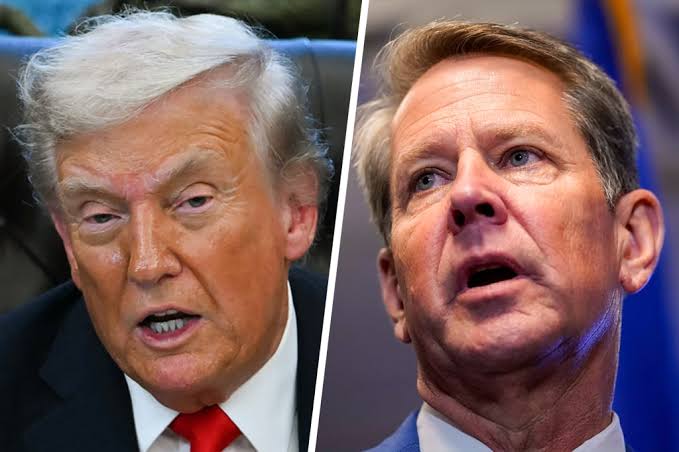
The results delivered a particularly stinging setback for Georgia Governor Brian Kemp, who is term-limited and chose not to run for the Senate seat himself, instead pouring substantial financial and political capital into backing Dooley’s Senate campaign. Kemp’s preferred candidate lost decisively to the Trump-endorsed Collins, while Jackson’s win in the governor’s race came against the candidate Trump had backed, underscoring a continued and complicated rift between Kemp’s wing of the state party and the more Trump-aligned faction. Collins, addressing supporters after his win, said he had “good conversations” with both Dooley and Kemp and that Republicans “stand united around one mission” of defeating Ossoff in November.
Jackson will face Democratic former Atlanta Mayor Keisha Lance Bottoms in the general election for governor, while Collins faces a significant financial disadvantage heading into his Senate race against Ossoff, who had raised more than $60 million by his last filing deadline before the primary, with roughly $32.5 million on hand, compared to Collins’ approximately $4.9 million raised and just over $1 million remaining after his runoff victory. National Republican groups, including the Senate Leadership Fund, have already pledged tens of millions of dollars to support Collins, while Democratic-aligned groups have committed similarly large sums to defend Ossoff’s seat.
Why It Matters
The split outcome in Georgia adds to a developing pattern across this primary season in which Trump’s endorsement has proven highly effective in federal races, particularly House and Senate contests, while facing more inconsistent results in gubernatorial primaries, where voters in Iowa, Georgia, and nearly South Carolina have shown greater willingness to back alternative candidates despite presidential backing. This distinction matters significantly for how national Republican strategists calibrate the deployment of presidential endorsements heading into the remainder of the primary calendar, particularly in other competitive gubernatorial races still to come.
The Georgia Senate race itself carries substantial national stakes, representing one of the most closely watched contests that will help determine which party controls the Senate for the remainder of Trump’s term. Ossoff is the only Senate Democrat seeking re-election in a state Trump carried in the 2024 presidential election, making the race a genuine test of whether Democratic incumbents can hold ground in modestly Republican-leaning territory amid a midterm environment that has historically favored the party out of power.
The continued friction between Governor Kemp and the Trump wing of the Georgia GOP also signals unresolved tension within the state party that could affect down-ballot organizing and turnout operations heading into November. With Kemp term-limited and increasingly positioned as a potential future national figure independent of Trump’s direct endorsement network, the outcome of these runoffs may offer early signals about the shape of intra-party competition for influence once Trump’s own political career eventually concludes.
Economic and Global Context
Jackson’s unprecedented level of self-funding, roughly $100 million from his personal fortune as a healthcare industry executive, sets a new benchmark for gubernatorial campaign spending in Georgia and reflects a broader national trend of wealthy, first-time candidates using personal resources to bypass traditional party infrastructure and fundraising networks. This dynamic raises ongoing questions about the influence of personal wealth in determining electoral outcomes, independent of traditional markers of political support such as endorsements or grassroots organizing.
The Senate race’s outcome will carry direct economic policy implications given the chamber’s role in confirming judicial and executive branch nominees, as well as its influence over tax, trade, and regulatory legislation during the remainder of Trump’s term. Both national parties view the Georgia seat as pivotal to broader legislative strategy through 2028, driving the scale of outside spending already committed by groups on both sides.
Democratic strategists have signaled they intend to tie Collins closely to Trump throughout the general election campaign, with the Democratic Senatorial Campaign Committee releasing advertising shortly after his runoff win labeling him a “puppet on Trump’s strings.” How Collins navigates that contrast, given his financial disadvantages relative to Ossoff, will shape the competitiveness of what both parties expect to be among the most expensive and closely contested Senate races of the cycle.
Implications
In the near term, both general election campaigns will move into an extended, multimillion-dollar advertising battle, with national party committees and allied super PACs already committed to spending tens of millions of dollars apiece in the Georgia Senate race between now and November.
For Republicans nationally, the Georgia results reinforce the importance of distinguishing between federal and state-level primary dynamics when deploying presidential political capital, a lesson likely to inform strategy in upcoming gubernatorial primaries elsewhere on the 2026 calendar.
For Georgia’s broader political landscape, the continued rift between Kemp-aligned Republicans and the more overtly Trump-aligned wing of the party will be a storyline to watch through the general election and beyond, particularly as both factions position themselves for future statewide contests once Kemp’s tenure as governor concludes.
Sources
“Georgia Republicans choose Collins for Senate and Jackson for governor, a mixed result for Trump”

