Story Highlights
- The House voted 198-218 against extending Section 702 of FISA through July 2, falling well short of the two-thirds majority required under the fast-track process
- Democrats withheld their votes in protest over Trump’s appointment of Bill Pulte, the federal housing finance regulator, as acting director of national intelligence
- Section 702 allows the CIA, NSA, and FBI to collect communications from foreign targets overseas without a warrant and is set to expire Friday
What Happened
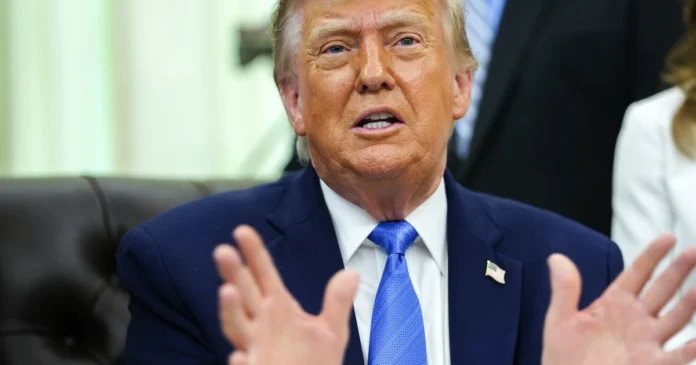
The House failed Thursday to temporarily extend the program that gives U.S. intelligence agencies broad authority to collect the communications of foreign targets, in a protest against President Donald Trump‘s refusal to name a permanent head of the nation’s intelligence community. The vote was 198-218, not even a simple majority, falling far short of the two-thirds support required because the bill was brought to the floor under a fast-track process known as suspension of the rules.
President Trump had asked House Republicans to advance a short-term extension of Section 702 warrantless surveillance authority, which will expire Friday. House Speaker Mike Johnson had said he would try to advance the measure at Trump’s request. The bill would have pushed back the expiration of the program’s powers from Friday to July 2. That would have given lawmakers an additional three weeks to negotiate a longer-term reauthorization deal that both parties had been close to finalizing.
Trump has doubled down on his selection of Bill Pulte, the federal housing finance regulator, as acting director of national intelligence, even though Pulte has little relevant experience for the role. Democrats made clear they would not support any FISA renewal that would place that surveillance authority in Pulte’s hands.
House Judiciary Chairman Jim Jordan of Ohio, a former critic of FISA Section 702 authority, framed the bill during Wednesday night’s debate as buying three weeks to continue working out a permanent deal so the powers do not go dark. Democrats in both chambers, however, said they would not approve an extension available to Pulte, who Trump announced would formally take the post on June 19.
The vast majority of House Democrats opposed the extension through July 2, joined by a group of conservatives who remain upset about the absence of additional reforms to the program. If Congress does not act before Friday, Section 702 will lapse entirely.
Why It Matters
Section 702 is not a peripheral intelligence program — it is one of the federal government’s most significant tools for tracking foreign threats, and its use has been central to counterterrorism and national security operations for nearly two decades. A lapse in this authority, even a brief one, would restrict the ability of the CIA, NSA, and FBI to monitor foreign targets in real time and could create gaps in intelligence gathering at a particularly volatile moment in U.S. foreign policy.
The timing could not be more consequential. The United States is actively engaged in military operations against Iran, a nation with a documented history of supporting proxy attacks on American personnel and facilities worldwide. The intelligence gathered under Section 702 plays a direct role in identifying and neutralizing threats to American forces. Allowing that authority to expire while U.S. troops are in active combat zones is a risk that most lawmakers in both parties acknowledge but are unable to resolve given the political standoff over Pulte.
For Trump and the Republican majority, the failure represents an embarrassing legislative defeat on a matter the president personally prioritized. Johnson’s decision to bring the bill to the floor under suspension of the rules — a process requiring broad bipartisan support — rather than a simple majority vote left the outcome entirely dependent on Democratic cooperation that was never forthcoming. The strategic miscalculation has drawn criticism from national security hawks within the Republican caucus who wanted a more aggressive legislative path.
Democrats have calculated that forcing a confrontation over intelligence leadership is worth the political and operational risk of a brief Section 702 lapse. Their argument is straightforward: allowing a housing regulator with no national security experience to oversee warrantless surveillance of foreign targets represents a fundamental threat to civil liberties and the integrity of the intelligence community. Whether that argument resonates with voters is a separate question from whether it succeeds as a legislative strategy.
Economic and Global Context
House Intelligence Chairman Rick Crawford of Arkansas accused Democrats of playing political chicken with an essential national security tool, noting that the United States is currently operating at an elevated threat level. The FIFA World Cup is underway, America’s 250th birthday celebrations are approaching, Iran and its proxies are targeting U.S. military personnel daily, and the 25th anniversary of the September 11 attacks is later this year. Each of those events represents a potential target for adversaries who would exploit gaps in U.S. intelligence coverage.
The broader institutional stakes extend beyond the immediate lapse. Section 702 allows agencies such as the CIA, the National Security Agency, and the FBI to collect communications from foreign targets overseas without a warrant. While members of both parties who cite privacy concerns have long sought to limit the authority, there had been broad bipartisan support to renew it, and Republicans and Democrats had recently reached a compromise bill. The political intervention of the Pulte appointment derailed that progress at the worst possible moment.
Senator Mark Warner of Virginia, the top Democrat on the Senate Intelligence Committee who had worked across the aisle on the compromise legislation, called Pulte’s appointment to replace Tulsi Gabbard as DNI “a live hand grenade” that disrupted the entire reauthorization process. His frustration reflects a genuine bipartisan consensus about the value of the program itself — a consensus that Trump’s personnel decisions have cracked.
The economic implications of degraded intelligence capabilities are harder to quantify than the national security costs, but they are real. Businesses operating in high-risk international markets depend indirectly on American intelligence assessments to make investment decisions, assess supply chain security, and evaluate partner risk. A prolonged lapse would create uncertainty among allies and partners who rely on intelligence sharing arrangements with Washington.
Implications
The House is scheduled to leave town until June 23, meaning that unless the Senate takes emergency action or Trump reverses course on Pulte, Section 702 will expire Friday with no clear timeline for restoration. The Senate’s parallel attempt to fast-track an extension had already failed earlier in the week when Democrats signaled they would object there as well. The most likely path to resolution runs through Trump choosing to withdraw Pulte’s appointment or name a permanent DNI nominee with credible national security credentials.
For the administration, the Pulte controversy is fast becoming a self-inflicted wound. The appointment of an official with no intelligence background to lead the nation’s spy agencies was always going to generate opposition. Allowing that opposition to jeopardize a surveillance program that the administration itself deems essential to prosecuting the Iran war represents a strategic incoherence that even some Republicans are finding difficult to defend publicly.
The midterm political calculus is also shifting. Democrats who vote against FISA renewal risk being tagged as weak on national security in campaign advertising — but the polling on civil liberties concerns with warrantless surveillance suggests the political risk is manageable. For Republicans who supported the extension and watched it fail, the frustration is directed squarely at the White House for creating an unnecessary obstacle to a renewal that was otherwise within reach.
Sources
“House rejects last-ditch FISA extension ahead of Friday deadline”

