Story Highlights
- Thirteen House Republicans voted with Democrats 224-198 to reject a procedural rule tied to the Save America Act and defense bill
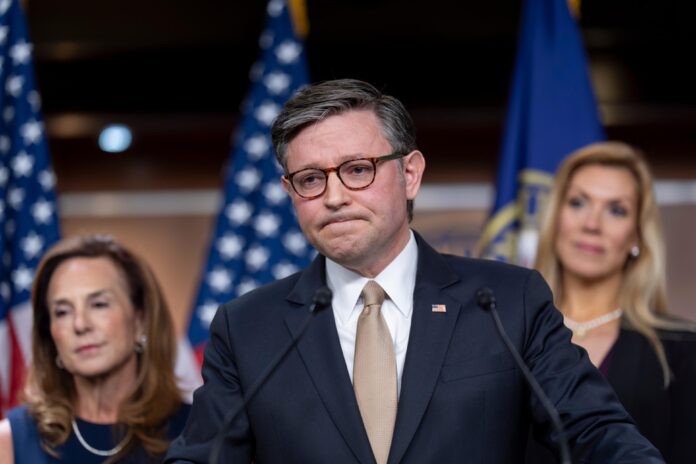
- Speaker Mike Johnson canceled the remainder of the week’s votes, sending the House into recess until July 13
- Rep. Anna Paulina Luna led the rebellion, arguing Johnson’s approach would let the Senate strip out election provisions
What Happened
The U.S. House of Representatives ground to a halt this week after a faction of Republican hardliners blocked a procedural vote that would have advanced the annual National Defense Authorization Act alongside President Trump’s Safeguard American Voter Eligibility, or Save America Act. Speaker Mike Johnson had proposed merging the two bills through a process known as “MIRVing,” which packages separately passed legislation together before sending it to the Senate, in hopes of forcing the chamber to consider Trump’s election overhaul alongside must-pass defense funding.
The maneuver failed Tuesday on a 224-198 vote, with thirteen Republicans joining every Democrat in opposition. Among them was Majority Leader Steve Scalise, who voted no as a procedural tactic allowing leadership to bring the measure back later. The rebellion was led by Rep. Anna Paulina Luna of Florida, who argued that combining the bills in this manner amounted to a “procedural head fake” since the Senate could easily strip the Save America Act provisions during conference negotiations. Other Republicans joining the revolt included Lauren Boebert, Thomas Massie, Chip Roy, Victoria Spartz, and Michael Turner, among others.
The Save America Act would require documented proof of citizenship and photo identification to vote in federal elections, provisions Trump has demanded but which Senate Republican leaders have repeatedly told him lack the votes to pass given the chamber’s filibuster rules. House Republicans have also discussed using the budget reconciliation process, which requires only a simple majority, to establish a grant program incentivizing states to adopt the voting restrictions rather than mandating them outright, a workaround intended to comply with Senate procedural rules.
Frustration among the rebels extended beyond the elections bill. Several Republicans, including Rep. Andy Harris of Maryland, who chairs the House Freedom Caucus, cited leadership’s failure to schedule a promised vote on HR 2, a border security package, as a central grievance. Trump had also fueled tensions the previous week by abruptly canceling a planned signing ceremony for a bipartisan housing bill in protest of insufficient momentum behind his election legislation, before later posting on social media urging Republicans to stop “grandstanding” and fall in line.
Facing the impasse, Johnson canceled votes scheduled for the remainder of the week, including consideration of the defense bill, a State Department appropriations measure, and a resolution commemorating the one-year anniversary of the tax cut law known as the One Big Beautiful Bill Act. The House will not return to session until July 13, leaving only a handful of legislative weeks before the August recess and the fall approach to the November midterms.
Why It Matters
The rebellion illustrates the practical limits of governing with a narrow House majority during an election year, when individual members have outsized leverage to extract concessions or block leadership’s agenda entirely. With Republicans holding only a slim margin, a dozen or so defectors can freeze the chamber’s business, as demonstrated this week when routine procedural votes on must-pass legislation became hostage to a dispute over election policy.
For Trump’s legislative agenda, the delay represents a meaningful setback. The Save America Act has been a top priority since early in his second term, and the president has applied direct pressure on House leadership, including the unusual step of withholding his signature from unrelated legislation to force action. The impasse demonstrates that even public pressure and social media appeals from the president have not been sufficient to unify his own party around a workable legislative strategy.
The delay to the defense authorization bill carries its own consequences. The NDAA typically includes funding tied to ongoing military operations, and Speaker Johnson had hoped to advance billions in Pentagon funding connected to the administration’s posture toward Iran as part of this legislative package. Its delay leaves that funding stream unresolved heading into the recess period.
Economic and Global Context
The stalled defense bill carries direct fiscal implications, as the NDAA typically authorizes hundreds of billions of dollars in annual defense spending and sets policy for military operations worldwide. With tensions surrounding Iran remaining unresolved and U.S. envoys continuing diplomatic engagement in the region, delays to defense authorization could complicate funding certainty for military planners at a sensitive moment.
The elections bill dispute also carries economic weight for state governments, which would need to implement new voter identification and citizenship verification systems if the legislation passes, requiring administrative investment that budget analysts estimate could run into the hundreds of millions of dollars nationally if adopted broadly.
Globally, congressional dysfunction of this kind is frequently cited by foreign observers and allied governments assessing the reliability of U.S. legislative commitments, particularly regarding defense spending levels tied to alliance obligations in Europe and the Indo-Pacific.
Implications
For House Republicans, the return from recess on July 13 will require Johnson to rebuild consensus among factions that remain deeply divided over tactics, even if most members support the underlying goal of passing election integrity legislation. Whether leadership pursues the reconciliation pathway or another legislative vehicle will shape the bill’s prospects for the remainder of the year.
For Senate Republicans, the pressure from House conservatives to bypass the filibuster or otherwise force through election provisions will likely intensify, testing Majority Leader John Thune’s willingness to alter chamber rules under pressure from the House and the White House.
For voters and state election administrators, the outcome remains uncertain heading into the fall, with implementation timelines for any new federal voting requirements increasingly compressed as the November midterms approach.
Sources

