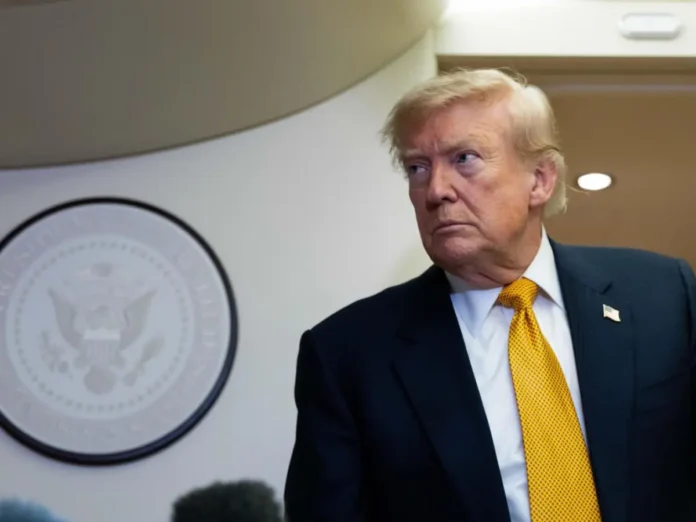
President Donald Trump allowed the most sweeping housing affordability legislation in decades to become law early Saturday without ever signing it, letting a constitutional deadline pass rather than approve the bipartisan measure. The 21st Century ROAD to Housing Act cleared Congress with overwhelming support, but Trump withheld his signature in protest of the Senate’s failure to pass his preferred election overhaul, the SAVE America Act. The episode highlights a rare and symbolically charged use of presidential inaction on major legislation.
Story Highlights
- The 21st Century ROAD to Housing Act became law automatically at midnight Saturday after Trump declined to sign or veto it within the constitutionally required 10-day window.
- The bill passed the House 358-32 and the Senate 85-5, reflecting rare bipartisan consensus on housing affordability.
- Trump tied his refusal to sign to the Senate’s inability to pass the SAVE America Act, a voter ID and citizenship-verification bill that lacks the 60 votes needed to advance.
What Happened
Speaker Mike Johnson delivered the housing legislation to the White House on June 29, starting a 10-day constitutional clock that required President Trump to either sign the bill, veto it, or allow it to become law without his signature. Trump chose the third option. In a Friday morning post on Truth Social, he wrote that he would not sign the bill “in PROTEST” over the Senate’s failure to advance the SAVE America Act, an election reform measure that would require proof of citizenship to register to vote and photo identification at the polls.
The housing measure, officially the 21st Century ROAD to Housing Act, had been scheduled for a formal signing ceremony on Capitol Hill last month. Invitations went out, a stage was built in Statuary Hall, and flags were arranged around a table bearing the presidential seal. Trump abruptly canceled the event hours before it was set to begin, telling reporters at the time that the housing bill was, in his words, “so unimportant” compared with his voting-law priority.
The legislation itself is packed with more than 45 provisions contributed by lawmakers from both parties. It aims to increase the national housing supply and bring down costs by streamlining environmental reviews for infill development, creating a federal grant program for pre-approved “pattern book” housing designs, easing rules on manufactured housing construction, and limiting large institutional investors from purchasing certain single-family homes. Senator Elizabeth Warren, the bill’s chief Senate sponsor, was a vocal proponent throughout the process and criticized Trump’s delay.
Speaker Johnson, while acknowledging Trump’s frustration over the SAVE America Act, expressed confidence the housing bill would ultimately take effect regardless of whether Trump personally signed it. “So I hope he does sign it. If he doesn’t, it’s still law; we’ll still celebrate it,” Johnson said, adding that Trump was “trying to make a point” effectively. At the stroke of midnight Saturday, with no signature and no veto issued, the bill became law under the Constitution’s default provision for congressional legislation left unaddressed by a sitting president.
Why It Matters
The episode is notable less for the housing law’s substance, which enjoyed broad bipartisan backing, than for what it reveals about Trump’s willingness to use even popular legislation as leverage for other priorities. Housing affordability consistently ranks as one of the top concerns for American voters; a Bipartisan Policy Center survey earlier this year found 89 percent of voters wanted congressional action on the issue. By withholding his signature, Trump denied himself a high-visibility political win on a subject Americans care deeply about, even as the substance of the law takes effect regardless.
For homebuilders, local governments, and prospective homeowners, the practical impact of the new law is unaffected by the absence of a presidential signature. Provisions streamlining environmental review processes and encouraging manufactured housing construction will move forward on their normal implementation timelines. That means the political theater surrounding the signature does not delay the substantive policy changes Americans have been waiting on.
The standoff also underscores how central the SAVE America Act has become to Trump’s broader legislative strategy heading into the midterms. By publicly linking an unrelated, broadly popular bill to a stalled voting-law priority, Trump signaled that he intends to keep pressuring Senate Republicans to find a path around the 60-vote filibuster threshold, even if that means forgoing credit for other achievements.
For congressional Republicans facing tough races this fall, the housing law offers a genuine accomplishment to tout on the campaign trail, regardless of the president’s signature. Lawmakers such as Representative Mike Lawler of New York, who represents a competitive district, have already said publicly that Trump should have signed the bill and “declared victory.”
Economic and Global Context
Housing affordability has been one of the most persistent drags on household budgets nationally, with elevated mortgage rates and constrained supply pushing homeownership out of reach for many middle-income families. The new law’s emphasis on boosting housing supply directly targets the imbalance between demand and construction that economists across the political spectrum have identified as a root cause of rising prices. Provisions permitting developers to skip duplicative environmental reviews for infill projects between already-approved sites are designed to shorten permitting timelines that can add months or years to construction schedules.
The law’s restrictions on institutional investors purchasing certain categories of single-family homes address a politically charged but economically contested issue. Researchers at Freddie Mac have found that private equity firms are a relatively modest driver of the housing shortage nationally, since such investors typically purchase distressed properties requiring significant repair rather than move-in-ready starter homes. Analysts at both the left-leaning Urban Institute and the right-leaning Taxpayers Protection Alliance have argued that institutional buyers can, in some cases, expand the usable housing stock by renovating properties that would otherwise sit vacant.
Manufactured housing provisions in the bill are likely to have outsized impact in rural and lower-income markets, where factory-built homes offer a substantially cheaper alternative to site-built construction. Grant funding for “pattern book” designs is intended to reduce architectural and permitting costs for local governments seeking to expand affordable housing stock without lengthy custom design processes.
Globally, the United States remains something of an outlier among developed economies in the severity of its housing affordability crisis, driven by decades of zoning restrictions, labor shortages in construction trades, and elevated materials costs. The bill’s zoning-reform incentives for local governments represent one of the few federal tools available to influence what has traditionally been an area of state and municipal policy.
Implications
For homebuilders and developers, the coming months will bring implementation guidance from federal agencies tasked with standing up the law’s new grant programs and streamlined review processes. Industry groups are likely to push for swift regulatory action to begin realizing the law’s supply-side benefits. Local governments seeking access to the new pattern-book grant program will need to begin preparing applications once implementing agencies issue guidance.
For voters, the law’s real-world effects on housing costs will likely take years to materialize fully, since construction timelines and permitting reforms do not translate into completed homes overnight. Nonetheless, Republicans and Democrats alike are expected to claim credit for the achievement heading into the 2026 midterms, given its rare bipartisan passage margins.
The unresolved fight over the SAVE America Act is far from over. Trump’s decision to use the housing bill as a protest vehicle suggests he will continue searching for leverage points to push the voting legislation, which remains short of the 60 votes needed in the Senate. Whether that pressure campaign succeeds may shape the broader legislative agenda through the rest of the year, particularly as both parties look toward the midterm elections in November.
Sources

