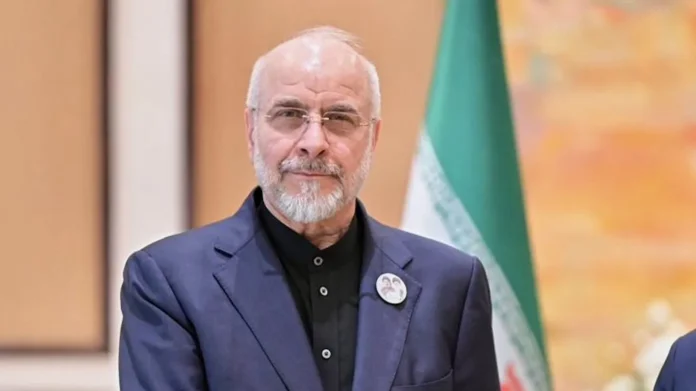
Iran’s Parliament Speaker issued a pointed warning on Friday that Tehran will resume military action if the United States and Israel fail to fully honor the terms of an interim peace agreement, as the country simultaneously prepares an elaborate funeral for its slain former supreme leader. The statement comes amid delicate ongoing negotiations between American and Iranian officials aimed at permanently ending regional hostilities following a brief but intense military conflict. The warning underscores the fragility of the ceasefire arrangement even as diplomatic talks continue toward a more comprehensive resolution.
Story Highlights
- Iranian Parliament Speaker Mohammad Bagher Qalibaf warned Iran will “resume proportionate actions” if the U.S. and Israel fail to fully implement the interim peace agreement.
- The warning comes as Iran prepares a multi-day funeral for former Supreme Leader Ayatollah Ali Khamenei, killed in targeted strikes during the recent conflict.
- The Trump administration held talks with an Iranian delegation in Qatar this week over terms including uranium enrichment limits and reopening the Strait of Hormuz.
- Qalibaf claimed the U.S. was not successful in its military operation against Iran, alleging Washington requested the ceasefire itself.
What Happened
Iran’s Parliament Speaker Mohammad Bagher Qalibaf issued a pointed public warning on Friday that Tehran would resume military action against the United States and Israel if both nations fail to fully honor the terms of an interim peace agreement reached following recent hostilities in the region. Speaking during a meeting with a Belarusian lawmaker, Qalibaf stated that Iran “will strongly demand full implementation of the agreements, and if the U.S. and the Zionist regime fail to fulfill their commitments, Iran will resume proportionate actions,” according to the semiofficial Iranian Students’ News Agency. Qalibaf, alongside Iranian Foreign Minister Abbas Araghchi, has served as one of Tehran’s lead negotiators in high-level talks with American officials aimed at finalizing a permanent resolution to the conflict.
The warning arrives at a particularly sensitive moment for the Iranian government, which is simultaneously preparing an elaborate, multi-day funeral for former Supreme Leader Ayatollah Ali Khamenei, who was killed in targeted strikes on his compound during the opening day of a joint U.S.-Israeli military operation. The strikes also killed several other senior Iranian military and political figures, including Ali Larijani, secretary of Iran’s Supreme National Security Council, and Gholamreza Soleimani, commander of Iran’s Basij paramilitary force. Khamenei’s funeral, scheduled to begin Saturday and continue for several days, will involve transporting his body to multiple cities across Iran and into neighboring Iraq, with authorities planning extensive street, airspace, and daily life closures throughout Tehran to accommodate the ceremonies.
Earlier in the week, the Trump administration held direct talks with an Iranian delegation in Qatar centered on the specific terms of a memorandum of understanding intended to formally end hostilities for a minimum period of 60 days. According to reporting on the negotiations, the administration’s core demands include Iran either surrendering or significantly diluting its stockpile of enriched uranium, ending its broader nuclear weapons development program, and permitting the full reopening of the Strait of Hormuz, a critical global shipping waterway through which a substantial portion of the world’s crude oil transits daily.
Qalibaf’s statement also included a notably defiant characterization of the recent conflict’s outcome, claiming that the American military campaign against Iran had not been successful and alleging that Washington itself had requested the ceasefire that ultimately halted hostilities, a characterization that runs counter to the Trump administration’s own public framing of the military operation’s results. Iranian state media has continued to display extensive public mourning imagery in the aftermath of the strikes, including ceremonies attended by families of those killed during what Iranian officials have described as a broader 12-day conflict extending from an earlier 2025 confrontation through the more recent hostilities.
Why It Matters
Iran’s warning underscores the fundamentally fragile and provisional nature of the current ceasefire arrangement, even as diplomatic negotiations continue toward what both sides have publicly described as a goal of permanent conflict resolution. The explicit threat to resume military action absent full compliance with agreement terms illustrates the significant remaining distance between the current interim arrangement and any durable, comprehensive peace settlement, and it places continued pressure on American negotiators to carefully balance verification and compliance mechanisms against the risk of provoking renewed hostilities.
The specific demands at the center of ongoing negotiations, particularly regarding uranium enrichment limits and the reopening of the Strait of Hormuz, carry substantial implications for both regional security and global energy markets. The Strait of Hormuz serves as one of the world’s most critical maritime chokepoints for oil transport, and any prolonged disruption to normal shipping through the waterway carries the potential for significant global economic consequences extending well beyond the immediate parties to the conflict.
For the Trump administration specifically, successfully navigating these negotiations toward a durable resolution would represent a significant foreign policy achievement, particularly given the administration’s stated objectives of curtailing Iran’s nuclear program while avoiding prolonged direct military engagement in the region. However, Qalibaf’s public characterization disputing the American narrative of the conflict’s outcome suggests that any final agreement will likely require careful diplomatic management of competing domestic narratives on both sides regarding which party achieved the more favorable outcome from the recent hostilities.
Economic and Global Context
The ongoing dispute over the Strait of Hormuz carries direct and substantial implications for global energy markets, given that the waterway serves as the transit route for a significant portion of the world’s daily crude oil shipments. Any prolonged uncertainty regarding the strait’s operational status, or renewed hostilities that might threaten shipping safety through the passage, carries the potential to generate significant volatility in global oil prices, with downstream effects on inflation and energy costs extending to economies well beyond the immediate Middle Eastern region, including the United States.
Iran’s internal political situation adds further complexity to the ongoing negotiations. The country faces significant internal challenges beyond the recent military conflict, including earlier this year’s protests against government economic policies that drew a substantial crackdown from authorities. The simultaneous need to manage an elaborate leadership transition following Khamenei’s death, alongside sensitive international negotiations and domestic economic pressures, places the Iranian government in an unusually complex position as it navigates the coming weeks.
Globally, the outcome of these negotiations carries significant implications for broader American alliance relationships in the Middle East, particularly with Israel, which participated directly in the military operation that resulted in Khamenei’s death. Regional allies and international observers will be closely monitoring whether the interim agreement can be successfully transitioned into a more durable framework, given the substantial stakes involved for regional stability, global energy security, and the broader nonproliferation objectives underlying American engagement with Iran’s nuclear program.
Implications
For American diplomats and the Trump administration, Qalibaf’s warning necessitates careful continued engagement to prevent a breakdown of the current ceasefire arrangement, particularly given the sensitive timing surrounding Iran’s ongoing leadership transition and funeral proceedings for Khamenei, which could complicate the political calculus for Iranian negotiators in the near term.
For global energy markets and businesses dependent on stable oil supply chains, continued uncertainty regarding the Strait of Hormuz’s operational status represents an ongoing source of potential volatility that market participants will likely continue monitoring closely as negotiations proceed toward, or potentially away from, a more permanent resolution.
For regional allies, including Israel and Gulf state partners, the coming weeks will serve as a critical test of whether the current diplomatic framework can successfully transition from a fragile interim ceasefire into a more durable, comprehensive peace arrangement, with significant implications for broader regional security architecture regardless of the specific outcome.
Sources

