

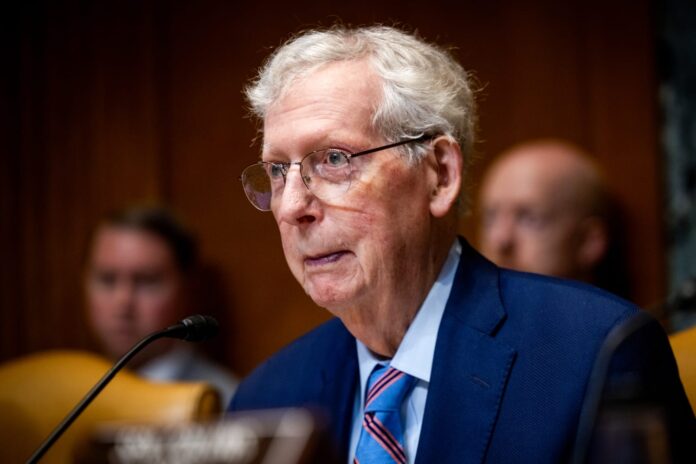
Senator Mitch McConnell has remained hospitalized for more than three weeks following a June 14 medical emergency, with his office offering only limited updates even as top Senate Republicans say they have spoken with him by phone. The prolonged silence surrounding the 84-year-old former Senate GOP leader’s condition has fueled speculation and raised fresh questions about aging leadership in Congress.
Story Highlights
- McConnell was hospitalized on June 14 after paramedics responded to a reported cardiac arrest at his Washington home, according to police scanner audio.
- Senate Majority Leader John Thune and GOP Whip John Barrasso both say they spoke with McConnell by phone this week, describing him as engaged and eager to return.
- McConnell has missed Senate votes on the NDAA, a housing affordability bill, and measures related to war powers in Iran during his hospitalization.
What Happened
Senator Mitch McConnell of Kentucky was admitted to the hospital on the morning of June 14, according to a statement from his office at the time, which said he was “receiving excellent care” without disclosing the reason for admission. The same day, according to police scanner audio later obtained by NBC News, paramedics responded to a “cardiac arrest” at an address matching McConnell’s Washington home, with a dispatcher reporting CPR in progress on an unconscious individual. McConnell’s office has not confirmed whether the emergency call was connected to the senator’s hospitalization.
In the weeks since, McConnell’s team has issued only sparse updates, saying in late June and again on July 2 that the senator “continues to improve” and remains engaged with Senate and Kentucky matters from his hospital bed. He last cast a vote on June 11. The lack of detailed information has fueled online speculation, including unverified claims from some commentators that McConnell’s condition had deteriorated significantly, prompting Kentucky Governor Andy Beshear to formally request that McConnell’s office provide Kentuckians with a fuller update on his health status.
In response to mounting questions, several senior Republicans stepped forward this week to affirm direct contact with McConnell. Senate Majority Leader John Thune’s office said the two had a lengthy, substantive phone conversation covering national security topics. Senate GOP Whip John Barrasso’s office said he spoke with McConnell for roughly 20 minutes, describing him as “fully engaged” and eager to return to the Senate, with the conversation reportedly touching on Senate races, the Graham Platner scandal, and the Supreme Court’s recent ruling on coordinated campaign spending limits.
McConnell, who served as Senate Republican leader from 2007 to 2025, the longest tenure in the chamber’s history, announced last year he would not seek reelection. He has faced a series of publicized health episodes in recent years, including a 2023 concussion from a fall, subsequent freezing episodes during press conferences that his office attributed to lightheadedness, and a hospitalization earlier this year for flu-like symptoms. His extended absence has meant he missed votes on a major housing affordability bill and on measures concerning congressional authority over military action in Iran.
Why It Matters
McConnell’s prolonged hospitalization, combined with his office’s limited disclosures, highlights a broader pattern of health transparency concerns among aging members of Congress. With narrow margins in both chambers, any prolonged absence carries direct legislative consequences, and Kentucky’s unique succession law, which requires a special election rather than a gubernatorial appointment to fill a Senate vacancy, adds political stakes to questions about McConnell’s condition given that the state’s governor is a Democrat.
For Senate Republicans, McConnell’s absence removes an influential voice from ongoing debates, including the fate of the SAVE America Act, the National Defense Authorization Act, and continued deliberations over the administration’s Iran policy. His institutional experience and relationships, built over four decades in the Senate, have historically played an important role in navigating complex legislative negotiations, particularly on defense and national security matters.
The situation also reflects a broader challenge facing both parties as the average age of congressional leadership continues to rise, with several other lawmakers facing serious undisclosed health conditions this Congress, underscoring questions about institutional norms around health disclosure for public officials in positions of significant authority.
Economic and Global Context
While McConnell’s hospitalization carries no direct market impact, his absence during a period of significant legislative activity, including the NDAA and ongoing debates over Iran war powers, removes a historically influential voice from defense and national security policymaking at a consequential moment given the escalating conflict with Iran.
McConnell’s institutional role in shaping defense appropriations and his historical alignment with robust national security funding make his prolonged absence notable as Congress works through the annual defense authorization process, a bill with direct implications for military spending levels and Pentagon priorities heading into the next fiscal year.
Implications
For the Senate, McConnell’s continued absence will likely keep pressure on Republican leadership to provide clearer updates on his prognosis and expected return timeline, particularly as the chamber returns from recess on July 13 to a packed legislative calendar including the NDAA and continued intelligence nominee confirmations.
For Kentucky voters and officials, the situation raises practical questions about representation should McConnell’s health prevent a return to active Senate service, given the state’s special election process for filling vacancies.
For the broader conversation around congressional leadership, McConnell’s case is likely to reinforce calls from some quarters for greater transparency requirements or age-related fitness standards for elected officials serving in positions of significant institutional responsibility.
Sources

