Story Highlights
- Colby’s 2026 National Defense Strategy emphasizes China deterrence and homeland defense, calling for reductions in US military commitments in Europe and the Middle East
- At least two senior Republican lawmakers have publicly accused Colby of dishonesty, and Republicans have blocked two of his nominated deputies from confirmation
- The administration withdrew an Army brigade from Romania’s NATO flank and Colby’s office notified the Romanian government only two days before the announcement
What Happened
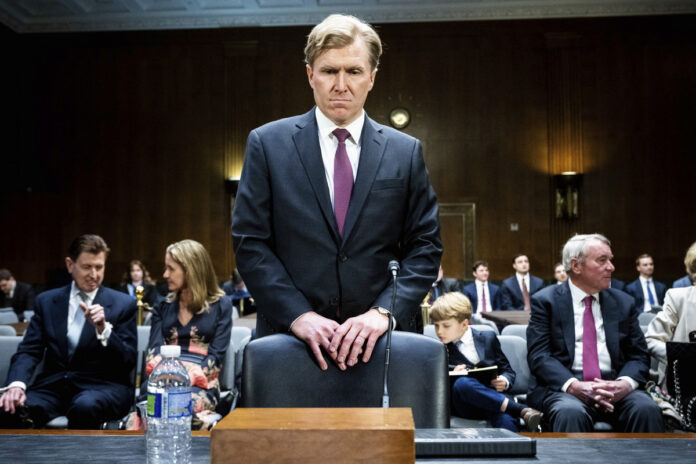
Elbridge Colby, the Trump administration’s Under Secretary of Defense for Policy, has become the central figure in a battle to define the future of America First foreign policy, dividing top Republicans over his Pentagon strategy. Colby has emerged as the intellectual standard-bearer for a GOP faction that prioritizes deterring China in the Indo-Pacific, even if that means scaling back commitments in Europe and the Middle East.
House and Senate Republicans have conducted more aggressive oversight of Colby than nearly any other Trump appointee. They have overruled his policies and blocked the confirmation of two officials nominated to serve as his top deputies. At least two prominent Republicans have publicly accused him of dishonesty. The extraordinary feud has become an open proxy war within the GOP over what America’s rightful global role should be.
Rep. Mike Rogers devised what people familiar with his thinking described as an honesty test. In an October meeting with Colby, Rogers asked whether any troop reductions were coming. Colby said he was not aware of any. Two weeks later, the administration announced it was removing an Army brigade that had fortified NATO’s eastern flank since Russia’s 2022 invasion of Ukraine. Rogers was livid.
The friction centers on specific Pentagon moves influenced by Colby’s strategy. These include withdrawing Army brigades from Romania, conducting a review of the AUKUS nuclear submarine pact with Australia and Britain, pausing some Ukraine assistance, and cutting aid to Baltic nations. Romania learned of the troop withdrawal decision only two days before it was announced, prompting NATO diplomats to call the rollout an unwelcome surprise.
In a statement, Pentagon press secretary Sean Parnell forcefully defended Colby, saying the policy chief was in lockstep with Defense Secretary Pete Hegseth. Colby, in his own interview, denied having misled the congressman, saying that at the time of the October meeting, the final order to withdraw the brigade had not yet been given. The Pentagon maintains Colby has engaged extensively with lawmakers and is executing a coherent peace through strength strategy.
Why It Matters
The Colby controversy matters because it reflects a genuine and unresolved debate about what the United States can actually afford to do militarily in a world of constrained resources and multiple simultaneous threats. For decades, America has maintained a global presence premised on the assumption that it could deter adversaries in Europe, the Middle East, and Asia simultaneously. Colby’s doctrine challenges that assumption directly, arguing that prioritization is necessary and that China represents the defining challenge of the era.
Colby accused both parties of ignoring the limits of America’s power, saying it was the same people calling for attacking Iran who were also calling for escalating the war in Ukraine. That critique resonates with a growing segment of the Republican base that is skeptical of open-ended overseas military commitments, but it has alienated defense hawks who see robust US engagement as essential to deterring adversaries everywhere.
Senate Armed Services Chair Roger Wicker has been particularly vocal, saying there really hasn’t been any consultation with Congress on the updated strategy and that that is not the way it is supposed to work. Senator Dan Sullivan of Alaska expressed similar frustration, saying Colby is the hardest guy to get ahold of in the Trump administration despite pledging to work closely with Congress.
The stakes are not merely bureaucratic. Decisions about where to station troops, which alliances to prioritize, and how much military aid to send to partners have direct consequences for US credibility. If allies in Europe and Asia conclude that Washington cannot be relied upon to consult or communicate, they will begin making independent security arrangements that may not align with American interests.
Economic and Global Context
The 2026 National Defense Strategy that Colby developed reflects a significant shift in how the United States allocates its defense resources. The strategy emphasizes homeland defense and the Western Hemisphere alongside deterring China, codifying the sharp changes already underway in US alliance politics and national security policy. That shift has direct implications for defense contractors, base communities, and allied nations who have built their own security planning around assumptions of continued American presence.
Colby pushed for Japan to increase its military spending to 3.5 percent of its GDP, a move that led Japan to cancel a meeting between US Secretary of State Marco Rubio, Defense Secretary Pete Hegseth, and their Japanese counterparts. The episode illustrates the diplomatic friction that strategic reorientation produces, particularly when communicated in ways that allies find abrupt or disrespectful.
For European defense industries and governments, Colby’s strategy is accelerating the push toward autonomous European security capabilities. Countries that were already increasing defense spending in response to US pressure are now also hedging against the possibility of reduced American engagement by building up their own capabilities and deepening intra-European defense cooperation. That transition has significant implications for NATO’s long-term structure.
The Iran conflict has added complexity to Colby’s China-first framework. The US military has been deeply engaged in the Middle East at precisely the moment Colby argues American attention and resources should be shifting to the Indo-Pacific. Managing those competing demands simultaneously is straining both military capacity and strategic clarity in ways that neither Colby’s critics nor his supporters have fully resolved.
Implications
The Colby dispute will likely reach a decisive moment at or after the upcoming NATO summit in Ankara, where the administration’s posture toward Europe will be on full display. If Trump uses that summit to further signal reduced American commitment to European defense, Colby’s critics in Congress will find their arguments harder to dismiss and their pressure campaigns harder to contain.
For defense contractors and the industrial base, the strategic pivot toward China-deterrence priorities means different weapons systems, different procurement timelines, and different bases of operations. Companies heavily invested in legacy platforms built for European contingencies may face reduced demand, while those focused on Indo-Pacific capabilities, including long-range strike, undersea warfare, and space-based systems, stand to benefit significantly.
Republican unity on national security, long one of the party’s defining electoral assets, is being tested by the Colby dispute in ways that could complicate midterm messaging. Democrats have traditionally struggled to outflank Republicans on defense issues, but a public intraparty fight over whether senior Pentagon officials lied to Congress provides unusual ammunition.
For Trump himself, the Colby controversy presents both a risk and an opportunity. A coherent, executable China-deterrence strategy would represent a genuine achievement of strategic prioritization. But if the strategy produces visible failures in Europe, the Middle East, or relations with allies, the political costs will fall on an administration that chose to concentrate authority in a single official with poor relationships on Capitol Hill.
Sources
“The Trump Pentagon appointee who has divided top Republicans”

