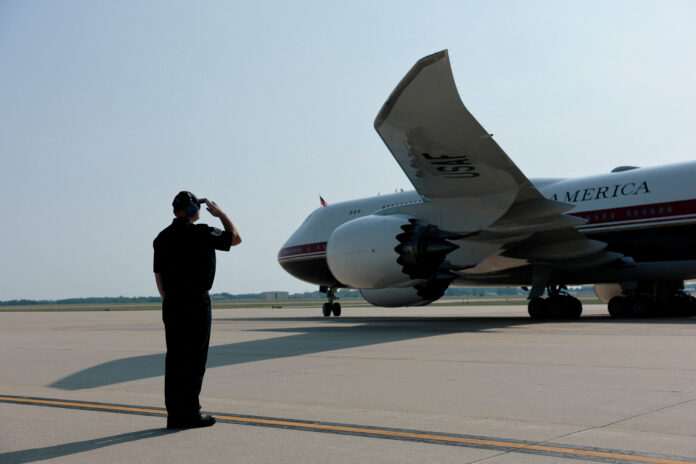
President Trump confirmed that the luxury Boeing 747 jet gifted by Qatar and now serving as Air Force One will be pulled from service for roughly a month to undergo additional security upgrades, following mounting questions about the plane’s defensive capabilities. The announcement comes after reports that the Secret Service advised against flying the jet into higher-risk regions amid the ongoing conflict with Iran, and as federal prosecutors have subpoenaed journalists who reported on the aircraft’s security features. The episode has reignited scrutiny of the unprecedented $400 million foreign gift even as the administration defends the arrangement.
Story Highlights
- Trump said the Qatari-gifted Air Force One will be sent for “maxed out” security upgrades beginning in about a month, taking it out of service for roughly that period
- The jet reportedly lacks certain missile-defense capabilities present on the older presidential aircraft it has partially replaced
- The Justice Department subpoenaed four New York Times journalists who reported on the plane’s security features, prompting a legal challenge from the paper
What Happened
President Trump told reporters at Joint Base Andrews on Sunday that the Qatari-donated Boeing 747-8 now serving as Air Force One will be sent for additional security upgrades in about a month, a process he said would take roughly that long to complete. “It has a lot of capability but, as I understand it, in about a month or so they’re going to send it to have it be maxed out,” Trump said, responding to a reporter’s question about why he continued flying on the jet despite reports it lacked certain missile-defense systems found on the older, traditional Air Force One aircraft.
The jet, an unprecedented gift from the Qatari royal family valued at approximately $400 million, was formally accepted by the administration last year and began operational use as Air Force One on July 1, when Trump flew it to South Dakota. It later carried the president to a NATO summit in Ankara, Turkey. However, on the return leg of that trip, Trump unexpectedly switched to a different presidential aircraft, flying the first portion of the journey from Ankara to RAF Mildenhall in England aboard the new jet before completing the return home differently. While the White House characterized the switch as an opportunity for U.S. service members stationed at Mildenhall to tour the aircraft, multiple reports indicated the change was made at the recommendation of the Secret Service due to the plane’s proximity to the Middle East amid renewed hostilities with Iran.
CNN reported that administration officials had internally discussed the need for Trump to avoid flying the jet into higher-threat areas, specifically citing Israel, given the ongoing conflict. The White House has been working to expedite upgrades to the aircraft, though the full scope and timeline of the modifications required remain unclear. Former Secret Service agent and Maryville University professor Brian Gant noted that Air Force One functions as a mobile command center with extensive communication capabilities connecting the president to global counterparts via satellite, suggesting any gaps in the jet’s systems could carry significant operational consequences beyond physical security concerns alone.
The controversy has also drawn legal scrutiny toward journalists covering the story. The Justice Department subpoenaed four New York Times reporters who had written about the security features of the new aircraft, prompting the Times to petition a federal court in Manhattan to block the subpoenas ahead of a scheduled grand jury appearance. The gift itself has faced criticism since it was first announced, with ethics experts and even some Republican lawmakers raising concerns about the propriety and long-term implications of accepting such a valuable gift from a foreign government. Under the current arrangement, the jet will serve as Air Force One for the remainder of Trump’s presidency before being transferred to his future presidential library.
Why It Matters
The episode raises substantive national security questions about whether the president has been flying aboard an aircraft without the full complement of defensive systems historically considered standard for Air Force One, particularly missile-defense technology designed to protect against attacks during international travel. Trump’s acknowledgment that the plane needs to be “maxed out” represents his first public admission that the jet may not have been fully equipped when it entered service.
For lawmakers and ethics watchdogs, the situation reinforces earlier concerns about the wisdom of accepting a foreign-government gift of this scale and complexity for use as the presidential aircraft. Modifying a foreign-built jet to meet the stringent security and communications standards required for presidential travel is a technically demanding and time-consuming process, and questions about whether those standards were fully met before the plane entered active service go to the heart of presidential security protocols.
The Justice Department’s decision to subpoena journalists who reported on the story also raises press freedom concerns, particularly given the sensitive nature of the underlying reporting on presidential security vulnerabilities. How the courts handle the New York Times’ challenge to those subpoenas could set an important precedent for the boundaries between national security reporting and government efforts to identify sources or limit disclosure of security-related information.
Economic and Global Context
The $400 million valuation of the Qatari gift places it among the most valuable gifts ever received by the U.S. government from a foreign power, raising broader questions about the diplomatic and financial dynamics of accepting high-value gifts from allied nations. Qatar has increasingly used large-scale gestures, including major investment announcements and infrastructure gifts, to deepen its relationship with Washington amid its role as a key mediator in numerous regional conflicts, including recent U.S.-Iran ceasefire negotiations.
The timing of the security concerns coincides with heightened regional instability, as the United States continues military operations against Iran and its proxies across the Middle East. The need to avoid flying an inadequately defended aircraft into higher-risk airspace reflects the practical constraints that ongoing hostilities are placing on presidential travel logistics, an issue that could recur as the conflict continues.
The upgrade process itself is likely to be costly, though the administration has not disclosed detailed figures for the additional retrofitting required. Previous reporting has indicated that the initial turnaround to convert the jet for presidential use was completed on an accelerated timeline, raising questions among aviation security experts about whether corners were cut in the original modification process that now must be addressed in this second round of upgrades.
Implications
In the near term, the aircraft’s roughly monthlong absence from service will require the administration to rely on older Air Force One aircraft for presidential travel, a logistical shift that underscores the practical challenges created by the gap in the new jet’s capabilities. How smoothly that transition proceeds will offer an early indication of whether backup aircraft can adequately support the president’s travel schedule during the upgrade period.
For congressional overseers, the episode is likely to renew calls for greater transparency regarding the terms of the original Qatari gift and the specific security standards the aircraft was required to meet before entering presidential service. Ethics committees and relevant oversight bodies may seek additional briefings on the scope of the planned upgrades and their associated costs.
For press freedom advocates, the outcome of the New York Times’ legal challenge to the Justice Department subpoenas will be closely watched as a test of how aggressively the administration is willing to pursue journalists reporting on sensitive presidential security matters. The coming weeks are likely to bring further developments both in the aircraft’s upgrade timeline and in the ongoing legal dispute over the subpoenaed reporters.
Sources
“Trump Says New Air Force One From Qatar Will Get ‘Maxed Out’ Upgrades”

