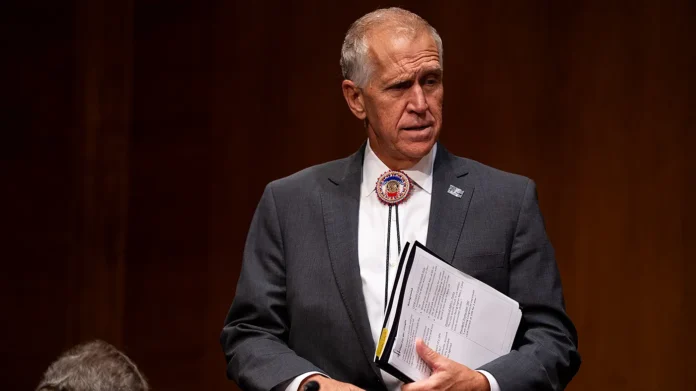
North Carolina Republican Senator Thom Tillis, who is not seeking reelection in 2026, has declared he will use every procedural tool available to block President Trump’s top legislative priority, the SAVE America Act, and has warned he will slow down unrelated Senate business if House Republicans attempt to attach the measure to a reconciliation bill. The standoff highlights a rare and public rift within the Republican Party over election policy just months before critical midterm elections. Tillis’s opposition adds a significant obstacle to a bill Trump has made central to his second-term agenda.
Story Highlights
- Tillis says the SAVE America Act is “dead” on Capitol Hill due to insufficient time before the midterms, even if it eventually passes
- The retiring senator has vowed to “use every device” available to slow Senate business if the measure is attached to a reconciliation bill
- Tillis previously drew Trump’s public criticism for opposing the president’s tax and spending package over Medicaid cuts
- The dispute unfolds as Trump pushes the SAVE America Act following his Thursday primetime address on election security
What Happened
Senator Thom Tillis took to the Senate floor Thursday morning to deliver a pointed rebuke of the SAVE America Act, President Trump’s signature election reform legislation that would impose stricter voter identification and proof-of-citizenship requirements nationwide. Tillis, who announced last year he would not seek reelection after opposing Trump’s sweeping tax and spending package over its Medicaid provisions, argued the bill has no realistic path to implementation before the November midterms even if it eventually secures the 60 votes needed to overcome a filibuster. “Unless they do the work to get to the 60 votes, they know it’s dead, and so all this is theater,” Tillis told The News & Observer, a position he has repeated in multiple venues over recent weeks.
The North Carolina Republican went further than simply opposing the bill on its merits. He explicitly warned House Republicans against attempting to fold the SAVE America Act into a future reconciliation package, a legislative maneuver that would allow the measure to bypass the standard 60-vote threshold in the Senate. Tillis promised to “use every device I have available to slow down the wheels of government” if House leadership pursued that strategy, a threat that extends beyond simply voting against the bill to potentially obstructing broader Senate business unrelated to the election measure itself.
The confrontation comes at a politically charged moment. Trump used his Thursday primetime address to the nation to make a forceful public case for the legislation, alleging Chinese interference in the 2020 election and calling on Congress to act. White House Press Secretary Karoline Leavitt framed the push as a bipartisan imperative ahead of the speech, telling reporters that “all Americans — Democrat, Republican — should agree” on the need for secure elections. Tillis’s public defiance just hours before and after that address represents one of the more visible instances of intraparty Republican resistance to a Trump priority in recent months.
The dispute has drawn sharp criticism from conservative commentators and Trump allies. Townhall and other conservative outlets have highlighted Tillis’s past campaign contributions from industries associated with labor practices some Republicans view unfavorably, using the connection to question his motives for opposing the bill. Social media exchanges between Tillis and prominent conservative commentators grew heated in the days surrounding his floor remarks, with Tillis reportedly appearing visibly frustrated during at least one hallway confrontation with a reporter over the issue.
Tillis’s position is notable given his status as a departing senator with limited incentive to align with the party’s current political pressures. Having already announced his retirement after clashing with Trump over Medicaid cuts in the earlier reconciliation package, Tillis has positioned himself as one of the few sitting Republicans willing to publicly and repeatedly challenge the president’s legislative priorities without apparent concern for political consequences.
Why It Matters
Tillis’s opposition matters beyond a single senator’s floor speech because it exposes the practical and political limits of Trump’s push to reshape federal election law ahead of a critical midterm cycle. With Republicans holding a narrow Senate majority, any defection on procedural votes tied to reconciliation could complicate GOP leadership’s ability to advance the SAVE America Act through anything other than the traditional 60-vote process, a threshold that has proven difficult to reach on contested election legislation in recent congressional sessions.
The episode also illustrates the broader tension within the Republican Party between Trump’s more aggressive posture on election integrity and a smaller but vocal contingent of senators, largely those not facing reelection pressure, willing to publicly break with the White House. Tillis’s willingness to threaten broader legislative obstruction, not just opposition to the bill itself, raises the stakes for GOP leadership as they attempt to manage floor time and legislative priorities heading into the fall session.
For voters, the standoff underscores genuine uncertainty about whether the SAVE America Act, which would require documentary proof of citizenship for voter registration, could realistically take effect before November even if it eventually passes Congress. Voting rights organizations have argued such requirements risk disenfranchising eligible voters who lack ready access to passports or certified birth certificates, making the practical timeline for implementation a matter of significant consequence for state election administrators.
Economic and Global Context
While the SAVE America Act is not primarily an economic policy matter, its potential attachment to a broader reconciliation package carries budgetary implications, since reconciliation bills are specifically designed to advance measures with direct fiscal effects. Any effort to include election policy provisions in such a vehicle would likely face procedural challenges under Senate rules governing what qualifies for reconciliation treatment, adding another layer of complexity to the legislative fight beyond Tillis’s individual opposition.
The broader context also includes ongoing negotiations over a separate $95 billion reconciliation package facing its own time pressures in the Senate, according to reporting from Capitol Hill. GOP leaders already face frustrations managing competing legislative priorities, and Tillis’s threat to slow down unrelated government business if the SAVE America Act is attached to any reconciliation vehicle could further complicate an already congested legislative calendar heading into the fall.
Internationally, the dispute has limited direct bearing, though it forms part of a broader narrative around U.S. election administration drawing attention from foreign observers, particularly given Trump’s Thursday speech alleging Chinese interference in American elections, a claim Beijing has denied.
Implications
In the coming weeks, expect continued public friction between Tillis and Senate GOP leadership as Trump maintains pressure for swift action on the SAVE America Act. Whether House Republicans attempt the reconciliation maneuver Tillis has warned against will be a critical test of how far leadership is willing to go to secure a legislative win on election policy despite the procedural risks involved.
For Senate Republicans facing reelection in swing states, the episode illustrates the delicate balance between supporting the president’s priorities and avoiding association with policies that could alienate moderate voters concerned about voter access. Tillis’s freedom to oppose the bill without electoral consequence stands in contrast to the position of colleagues who must weigh their votes against primary and general election dynamics.
For election administrators and voting rights advocates, the practical uncertainty over implementation timelines means state officials may need to prepare for multiple contingencies regarding new documentation requirements, regardless of whether the bill ultimately passes before the midterms. The dispute is likely to remain a flashpoint in Republican politics through the remainder of the legislative session.
Sources
“Retiring GOP Sen. Tillis Vows to Block SAVE America Act Any Way He Can: ‘I Will Use Every Device'”

