Story Highlights
- The Senate passed a $70 billion bill to fund ICE and the Border Patrol through the end of Trump’s term on a 52-47 vote
- The DOJ’s $1.8 billion anti-weaponization fund was officially scrapped after Republican opposition and a federal judge’s temporary block
- About half of the Republican Senate conference had signaled willingness to vote with Democrats to kill or restrict the fund
What Happened
The Senate passed legislation early Friday to fund President Donald Trump‘s immigration enforcement agencies after intense bipartisan backlash over a $1.8 billion “anti-weaponization” fund threatened to derail the bill. Republicans managed to push through the $70 billion legislation, which would fund Immigration and Customs Enforcement and the Border Patrol through the end of Trump’s term, on a 52-47 vote after weeks of delays.
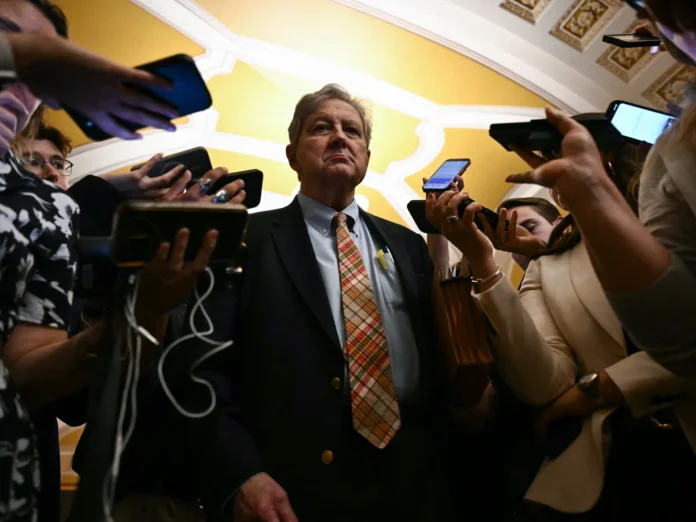
The Trump administration had signaled it was backing off on creating the $1.8 billion “anti-weaponization” fund announced by the Justice Department that could send money to allies of President Trump deemed to be “victims of lawfare and weaponization.” It came after a fierce and rare backlash from Senate Republicans, who threatened to team up with Democrats to block the fund. About half the Republican conference appeared ready to vote with Democrats to restrict or kill it, Sen. Ted Cruz, R-Texas, said.
On Tuesday, Acting Attorney General Todd Blanche testified that the DOJ would not move forward with plans for the fund, which was intended to compensate people who claimed to have been targeted by the “weaponization” of President Joe Biden‘s government. It was the first time that an official publicly confirmed the DOJ would scrap the fund entirely after backlash.
The U.S. Department of Justice had announced that, as part of a settlement agreement in Trump v. Internal Revenue Service, the Attorney General had established the fund to provide a systematic process to hear and redress claims of others who suffered weaponization and lawfare. The plaintiffs in the case — President Donald J. Trump, Donald J. Trump Jr., Eric Trump, and the Trump Organization — had filed suit against the Treasury and IRS following the leak of their tax returns. Per the settlement, plaintiffs would receive a formal apology but no monetary payment or damages of any kind.
Why It Matters
The episode is notable on multiple levels. It represents one of the most visible instances of Senate Republicans publicly breaking with the Trump administration on a domestic policy matter, signaling that the party’s deference to the White House has limits — particularly when perceived overreach involves directing federal funds to political allies. The speed with which opposition coalesced suggested that many Republican senators had private reservations about the fund from the moment it was announced.
The anti-weaponization fund concept was always likely to attract intense legal and political scrutiny. By grounding it in a tax return leak lawsuit settlement, the administration attempted to create a legal vehicle for a broader compensation mechanism. But critics on both sides of the aisle argued that allowing the Justice Department to unilaterally determine who qualifies as a victim of government weaponization — and to direct taxpayer dollars accordingly — crossed a clear line separating legitimate legal remedy from political patronage.
The Trump administration has repeatedly accused the Biden administration of the political weaponization of federal agencies, including the Justice Department. Biden officials have denied the allegations. At the same time, Trump has urged the DOJ to investigate his perceived foes, including former Fed Chair Jerome Powell, New York Attorney General Letitia James, and Sen. Adam Schiff, D-California. Those cases either did not result in charges or were dismissed.
The fund’s abandonment does not end the broader weaponization debate; it simply removes one instrument from the table. The administration retains significant tools through prosecutorial discretion and the appointment of loyal officials to key positions across the federal government.
Economic and Global Context
The ICE and Border Patrol funding bill that ultimately passed carries major fiscal significance. At $70 billion, it represents one of the largest single-year appropriations for immigration enforcement in American history. The legislation funds detention facilities, deportation operations, and border technology infrastructure through the remainder of Trump’s term, providing the operational foundation for the administration’s immigration agenda.
Republican opposition to the fund had stalled progress on the larger $70 billion funding package for immigration enforcement agencies, which Democrats are universally opposed to. Senate Majority Leader John Thune, R-South Dakota, had aimed to get the reconciliation package through the Senate before the Memorial Day holiday, but GOP senators emerged from a closed-door briefing with top Justice Department officials about the fund with more questions than answers.
The broader fiscal environment makes this bill significant beyond immigration policy. Congress has been on pace to pass the fewest bills in 50 years, meaning the successful passage of any major legislation represents a genuine governance achievement for Republican leadership in a fractured legislative environment. The fact that it required dropping the anti-weaponization fund to succeed underscores the difficulty of managing a narrow Senate majority with competing factions.
Implications
For the Republican Party, the outcome offers lessons about the limits of executive overreach in legislatively contested ground. Even senators who are broadly supportive of Trump’s agenda demonstrated that they will resist specific initiatives they view as legally or politically untenable when the pressure is organized and public.
For the Department of Justice, the episode leaves Acting Attorney General Blanche in a position of having publicly announced and then publicly retracted a major policy initiative within weeks. That pattern of announcement and reversal could complicate future DOJ credibility on policy rollouts, particularly on matters that attract adversarial legal challenge.
Republicans ultimately defeated multiple attempts by senators on both sides of the aisle to codify ending or changing the $1.8 billion settlement fund, meaning the Senate declined to formally prohibit the administration from attempting to revive a similar mechanism in the future. That leaves the door technically open, even as the practical political prospects for any revival appear limited for now.
Sources
“Senate votes to fund immigration enforcement without limits on Trump anti-weaponization fund”

