Story Highlights
- Trump announced Clayton’s nomination on Truth Social on June 11, praising him as among the most respected figures in the legal community
- The move came after Democrats blocked FISA renewal over Pulte’s appointment as acting DNI
- Democrats said the Clayton nomination was welcome but not sufficient — demanding Pulte be removed immediately
What Happened
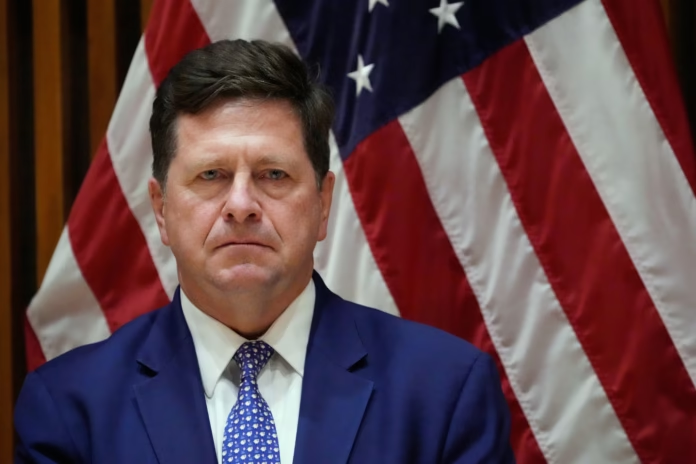
President Trump announced on Thursday evening via Truth Social that he intended to nominate Jay Clayton to serve as the next Director of National Intelligence, describing him as “very Highly Respected” and urging the Senate to confirm him “as soon as possible.” Clayton, 59, has been the U.S. attorney for the Southern District of New York since April 2025, and served as chairman of the Securities and Exchange Commission from 2017 to 2020 during Trump’s first term. Before his government service, Clayton was a senior partner at Sullivan and Cromwell, one of the country’s most prominent corporate law firms.
The announcement came directly in response to a rapidly escalating crisis in which House and Senate Democrats blocked the reauthorization of FISA Section 702 — a critical surveillance authority — citing their refusal to allow the program to be extended while Pulte remained in the DNI role. Pulte, who had led the Federal Housing Finance Agency and had no intelligence or military background, was appointed to the acting DNI position in early June after the departure of Tulsi Gabbard. Democrats argued his appointment was disqualifying and potentially dangerous to the integrity of the intelligence community.
Clayton’s profile is considerably more conventional than Pulte’s. He has maintained a visible public presence in support of the Trump administration since returning to government service in 2025, appearing on cable news to defend administration positions on free speech, election integrity, and financial regulation. His tenure as SEC chairman was generally regarded as effective by Wall Street, and he is seen as a legally credible figure whose nomination will be more defensible in a Senate confirmation hearing.
Democratic reaction to the Clayton announcement was measured but not immediately conciliatory. Senate Intelligence Committee ranking member Mark Warner acknowledged the nomination as potentially a “positive step” but made clear that Democrats’ core demand remained unchanged: Pulte had to be removed from the acting DNI role before Congress would agree to restore FISA Section 702 authorities. Senate Minority Leader Chuck Schumer stated flatly that Pulte “cannot be there, no ands, ifs, or buts.”
Senator Richard Blumenthal of Connecticut added that while Clayton seemed a reasonable selection, the president’s timing was damaging. “Literally waiting until now, when everyone has left town, and there’s no possibility of a path forward on FISA until next week,” Blumenthal said. Trump, asked about Pulte’s status earlier in the week, had said he tasked Pulte with executing “the immediate and needed downsizing of the office” — an indication Pulte remained in the role at least in a transitional capacity.
Why It Matters
The Director of National Intelligence oversees all seventeen components of the U.S. intelligence community, including the CIA, NSA, DIA, and the FBI’s national security divisions. The DNI receives and synthesizes the most sensitive intelligence the U.S. government collects, briefs the President daily, and coordinates the government’s response to foreign threats. The integrity and competence of whoever holds the position is not a matter of partisan preference — it is a national security prerequisite.
Trump’s initial appointment of Pulte to the role alarmed even some Republican national security veterans who viewed it as an example of the administration placing political loyalty above institutional competence. The intelligence community operates in an environment where credibility and professional expertise are essential to the trust of allied agencies, the cooperation of foreign liaison partners, and the confidence of analysts who risk their careers on the accuracy of their assessments.
Clayton’s nomination is an attempt to restore that credibility. His legal background — while not traditionally associated with intelligence — is at least defensible as a qualification for managing a large, complex organization with a significant legal dimension. His record at the SEC, which under his leadership significantly increased enforcement activity, suggests an executive willing to make difficult decisions and navigate entrenched bureaucracies.
The episode also highlights the degree to which Senate confirmation has become a genuine check on executive personnel decisions in the current political environment. The threat of Democratic obstruction — including over matters as consequential as national security surveillance — has forced the administration to recalibrate. How Republicans message that dynamic heading into the midterms will be closely watched.
Economic and Global Context
The DNI’s role in economic intelligence is often underappreciated. The intelligence community under the DNI’s coordination tracks foreign government economic espionage, monitors threats to U.S. financial infrastructure, and supports the Treasury Department’s sanctions enforcement activities. These functions have direct implications for American businesses operating in contested geopolitical environments, particularly in relation to China, Russia, and Iran.
Clayton’s Wall Street background may actually be an asset in the economic intelligence dimension of the DNI role. His familiarity with global financial markets, corporate structures, and regulatory frameworks — gained during his years at Sullivan and Cromwell and the SEC — could help bridge the gap between the intelligence community and the financial sector in ways that a career intelligence officer might not.
Allied intelligence services typically evaluate new DNI appointees closely. The United Kingdom’s GCHQ, Australia’s ASD, and Canada’s CSE all work in close partnership with NSA under Five Eyes arrangements that require deep institutional trust. A credible, legally sophisticated DNI who can manage those relationships professionally would be a reassuring signal to partners who have followed the Pulte controversy with concern.
The geopolitical timing of the transition is particularly sensitive given the potential Iran peace deal. The DNI’s office plays a central role in verifying arms control and diplomatic agreements. Clayton’s confirmation timeline — likely several weeks at minimum, possibly longer if Democrats slow-walk the hearings — means a period of leadership uncertainty at precisely the moment when intelligence verification of any Iran deal would be critical.
Implications
If confirmed by the Senate, Clayton would inherit an office significantly reduced from its post-9/11 peak. Former DNI Tulsi Gabbard oversaw a nearly 30% staff reduction at the director’s office before departing, and Trump assigned Pulte to continue downsizing. Clayton would need to determine what further restructuring serves legitimate efficiency goals and what cuts have damaged the office’s core functions.
The Senate confirmation process will be an opportunity for both parties to air their concerns about the intelligence community’s independence, the appropriate role of political appointees in intelligence functions, and the specific authorities the DNI exercises. Democrats who want to use the confirmation hearing as a vehicle to explore concerns about politicization of intelligence will have a ready forum. Republicans will frame Clayton’s credentials as evidence of responsible governance.
The Pulte chapter, even if it ends with his departure from the acting DNI role, will leave a lasting mark on how Congress approaches acting appointments to senior national security positions. Legislation establishing clearer guardrails on acting officials in intelligence leadership roles is likely to be proposed in coming months, with bipartisan appeal to lawmakers in both chambers who viewed the Pulte appointment as a warning sign.
For Trump, successfully navigating Clayton through confirmation would demonstrate that the administration can course-correct when faced with genuine institutional resistance. The alternative — a prolonged FISA lapse, an unresolved acting DNI situation, and continued Democratic obstruction — would compound an already challenging political environment ahead of the November midterms.
Sources

