Story Highlights
- President Donald Trump authorized a U.S. strike that killed Tren de Aragua leader Héctor Rusthenford Guerrero Flores in Venezuela.
- The operation was carried out by U.S. Southern Command with intelligence and security support from Venezuelan authorities.
- The administration now faces the larger task of dismantling the gang’s finances, regional cells and leadership structure.
What Happened
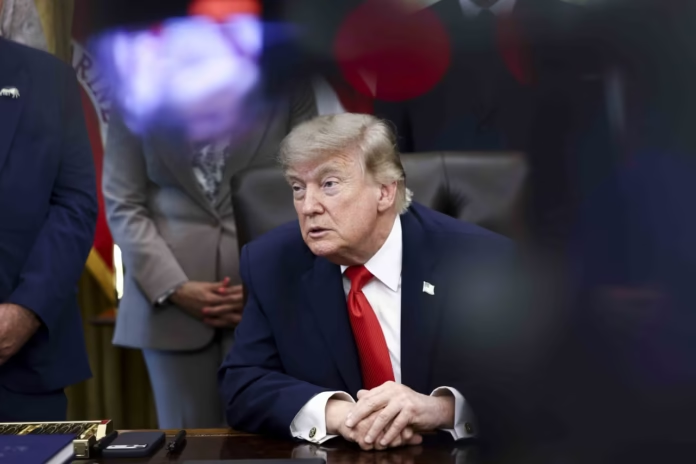
President Donald Trump announced that U.S. forces had killed Héctor Rusthenford Guerrero Flores, better known as Niño Guerrero, in a targeted operation inside Venezuela.
Guerrero was widely identified as the senior leader of Tren de Aragua, a Venezuelan criminal organization that expanded across Latin America and developed operations in the United States and Europe.
Trump said he personally directed U.S. Southern Command to carry out the strike and described the mission as a decisive action against one of the hemisphere’s most violent criminal organizations.
- The strike took place in Venezuela’s southeastern Bolívar state.
- Venezuelan authorities confirmed that the mission was jointly coordinated.
- American forces reportedly supplied intelligence and specialized technical support.
Defense Secretary Pete Hegseth said the target was a compound associated with Tren de Aragua.
Trump also released video footage appearing to show a projectile striking and destroying a building, although the government has not publicly released a complete operational assessment.
Venezuela’s communications ministry said Guerrero was killed during a combined operation involving clashes with members of the criminal network.
The cooperation marked an important development in U.S.–Venezuela relations after years of sanctions, political hostility and limited law-enforcement coordination.
Guerrero had been a fugitive since escaping from Tocorón prison in 2023, shortly before Venezuelan security forces retook the facility.
American prosecutors accused him of directing a network involved in extortion, drug trafficking, human smuggling, weapons offenses, money laundering and violent crimes across multiple countries.
Why It Matters
The operation gives Trump a significant national-security victory against an organization his administration designated as a foreign terrorist group.
The president has consistently argued that transnational gangs should be treated as more than ordinary criminal organizations because they operate across borders, control smuggling routes and threaten American communities.
Killing Guerrero removes the gang’s most visible senior leader and could temporarily disrupt communications, financing and decision-making.
- The strike may create confusion among competing regional commanders.
- Recovered intelligence could expose additional members and financial networks.
- The operation demonstrates that foreign territory may not provide safe haven when local governments cooperate.
The action also supports Trump’s broader argument that immigration enforcement, border security and organized crime are closely connected.
Tren de Aragua became a major focus of his 2024 campaign after members and alleged associates were linked to violent crimes and trafficking operations inside the United States.
Supporters will view the strike as evidence that the administration is following through on its promise to pursue gang leadership rather than limiting enforcement to lower-level arrests.
The neutral concern is that criminal organizations rarely collapse simply because one leader is removed.
Tren de Aragua has developed a decentralized structure, meaning local cells may continue operating even without direct control from Guerrero.
Political and Public Context
The strike reflects Trump’s expanding use of counterterrorism authorities against transnational criminal organizations.
The State Department’s decision to designate Tren de Aragua as a foreign terrorist organization gave federal agencies additional legal and financial tools to target the gang.
Trump has used those authorities to justify sanctions, prosecutions, deportations and closer security cooperation with governments across the region.
- Republicans are likely to present the strike as proof of stronger leadership against organized crime.
- Democrats may seek more information about the legal standards used to authorize lethal force.
- Congress could examine whether future operations require clearer reporting and oversight.
The mission also shows a pragmatic shift in Washington’s relationship with Venezuelan authorities.
Despite deep political disagreements, both governments share an interest in weakening a gang that has challenged state authority and profited from illegal mining, trafficking and extortion.
Trump’s supporters may argue that the cooperation demonstrates a results-focused foreign policy willing to work with difficult governments when American security interests are involved.
Critics may question whether closer cooperation could soften pressure over human rights, democratic governance or sanctions.
The White House will therefore need to distinguish limited security cooperation from a broader normalization of relations.
What Happens Next
The immediate priority will be determining who attempts to replace Guerrero and whether rival commanders compete for control.
American and regional intelligence agencies are expected to monitor communications, financial movements and gang activity for signs of succession or fragmentation.
Authorities may also use information recovered during the operation to pursue additional indictments, arrests and asset seizures.
- Watch for confirmation of Guerrero’s death through additional evidence.
- Monitor arrests of senior Tren de Aragua members and financiers.
- Follow sanctions targeting businesses linked to the gang.
- Track whether U.S.–Venezuela security cooperation expands.
The Treasury Department could intensify efforts to freeze accounts, cryptocurrency holdings and commercial fronts tied to the organization.
Federal prosecutors may also use the disruption to strengthen cases against members accused of operating inside the United States.
The operation could encourage other Latin American governments to share intelligence and conduct coordinated actions against Tren de Aragua cells.
For Trump, the strongest result would be evidence that the strike led to a sustained decline in the gang’s ability to traffic people, move money and direct violence.
If the organization quickly reorganizes, the administration may face pressure to conduct further operations or expand regional law-enforcement partnerships.
The strike removed a major target, but the administration’s broader success will be measured by whether it can dismantle the network Guerrero built.

