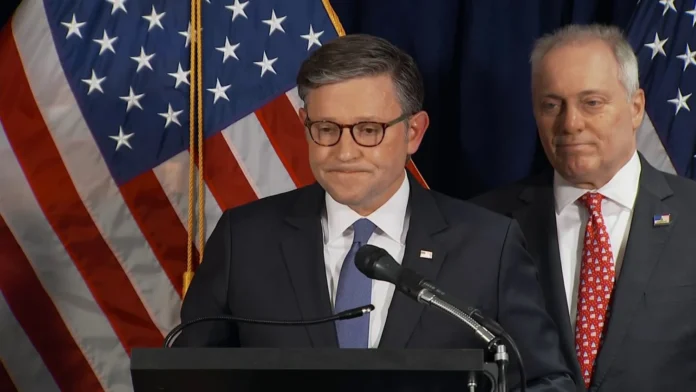
House Speaker Mike Johnson is preparing to move President Trump’s signature voter integrity legislation through the budget reconciliation process after the bill repeatedly stalled in the Senate, where it has failed to clear the 60-vote filibuster threshold. The renewed push comes after a small group of conservative hardliners briefly halted floor action to protest the bill’s delay, underscoring the growing urgency within the party to deliver on one of Trump’s top legislative priorities before the midterms. The maneuver represents a significant tactical shift in how Republicans hope to finally get the measure to the president’s desk.
Story Highlights
- Speaker Mike Johnson says the House will attempt to pass the SAVE America Act through the budget reconciliation process, which requires only a simple majority in the Senate
- The bill would require documentary proof of citizenship to register to vote and photo identification at the polls
- Trump has called for eliminating the Senate filibuster to pass the legislation, but GOP leaders say they lack the votes to do so
What Happened
House Speaker Mike Johnson announced plans to advance President Donald Trump’s signature election integrity legislation, the SAVE America Act, through the budget reconciliation process, a procedural pathway that would allow the bill to pass the Senate with a simple majority rather than the 60 votes typically required to overcome a filibuster. The announcement follows a tense standoff within the House Republican conference, during which Florida Representative Anna Paulina Luna led a small group of conservative hardliners in blocking a key procedural vote on unrelated legislation to protest the fact that Congress had not yet sent the bill to the president’s desk.
The Safeguard American Voter Eligibility Act, formally known as the SAVE America Act, would amend the National Voter Registration Act of 1993 to require individuals to present documentary proof of United States citizenship in order to register to vote, alongside a photo identification requirement at polling places. The bill passed the House in February on a near party-line vote, 218-213, with only Texas Democrat Henry Cuellar crossing party lines to support it. Despite that House passage and subsequent Senate floor debate beginning in March, the legislation has repeatedly failed to secure the 60 votes needed to overcome a Democratic filibuster.
Trump has been singularly focused on pressuring congressional Republicans to move the bill, going so far as to hold up a critical intelligence nomination and decline to sign a bipartisan housing package in an apparent effort to force action on his priority legislation. During a late-night Fourth of July speech on the National Mall celebrating the nation’s 250th anniversary, Trump again demanded passage, telling the crowd, “America is back, and we want to keep America great, and we will do so by approving the SAVE America Act.” He has also called on Senate Majority Leader John Thune to eliminate the filibuster entirely to secure passage, though Thune has said his caucus is “not even close” to having the votes for such a change.
Johnson has indicated he believes Trump will accept a narrower, “no-frills” version of the bill that strips out more contentious provisions previously floated by the president, including restrictions on transgender athletes in women’s sports and limits on transgender medical care for minors, neither of which were ever actually included in the underlying legislative text despite Trump’s public references to them. The stripped-down approach is seen as a pragmatic move to maximize the bill’s chances of surviving the reconciliation process, which has strict procedural rules limiting what provisions can be included.
Why It Matters
For Republicans, passage of the SAVE America Act represents one of the party’s most significant remaining legislative priorities ahead of the November midterm elections. Polling data cited by Republican lawmakers, including Senator Jim Banks of Indiana, indicates that more than 80 percent of Americans support voter identification requirements, giving the GOP confidence that the measure carries broad public support even amid fierce Democratic opposition.
The reconciliation strategy also reflects a broader pattern in which Republican leadership has increasingly turned to procedural workarounds to advance priority legislation in a closely divided Senate. If successful, the approach could offer a template for future GOP legislative pushes on other priorities that have similarly stalled due to the filibuster, while avoiding the more disruptive step of eliminating the procedural tool altogether.
For voters, the practical stakes of the legislation are significant. Proponents argue the bill would meaningfully reduce fraud and restore public confidence in the electoral process ahead of a consequential midterm cycle. Opponents, including most congressional Democrats, warn that the documentary proof-of-citizenship requirement could disenfranchise eligible voters who lack easy access to birth certificates or passports, particularly among lower-income and rural populations.
Economic and Global Context
While primarily a domestic policy matter, the SAVE America Act fight carries real budgetary implications tied to its path through reconciliation, a process specifically designed for legislation with direct fiscal effects. Election administration costs, including new documentation verification systems and voter roll maintenance requirements, would need to be absorbed by state and local governments, many of which have already raised concerns about unfunded federal mandates.
The bill’s mail-in ballot provisions, which would require in-person documentary proof of citizenship for mail voter registration applicants, could also have logistical effects on the eight states that currently conduct elections entirely by mail, along with the broader universe of election offices nationwide that have increasingly expanded mail voting access in recent election cycles.
Internationally, voter identification requirements remain common practice among many democracies, a point frequently raised by bill supporters. However, comparisons drawn by international observers note that most such systems pair identification requirements with free, widely accessible government-issued identification programs, a component not explicitly guaranteed under the current SAVE America Act framework.
Implications
In the coming weeks, expect the House to attempt formal action on the reconciliation approach, though the parliamentary rules governing reconciliation bills, particularly the Byrd Rule’s restrictions on non-budgetary provisions, could complicate efforts to include the full scope of Trump’s stated priorities. Whether the Senate parliamentarian ultimately deems the voter identification and citizenship provisions eligible for reconciliation treatment will be a critical procedural test.
For Senate Republicans, the reconciliation path offers a potential way around the united Democratic opposition that has stalled the bill for months, though it will require near-total unity within the GOP conference, including from moderates such as Alaska’s Lisa Murkowski, who has previously voted against advancing the measure.
For Democrats and voting rights organizations, the renewed push is likely to trigger intensified legal and political mobilization, including potential litigation should the bill ultimately become law. Organizations such as the Campaign Legal Center have already signaled they will continue opposing the legislation in all its forms, setting up what could become a significant legal battle heading into the 2026 midterms.
Sources

