Story Highlights
- The Texas State Board of Education approved a mandatory K-12 reading list including Bible passages on a 9-5 vote
- The list requires stories such as “David and Goliath” for elementary students and the Sermon on the Mount for middle schoolers
- The board separately approved a rewrite of social studies standards that eliminates a sixth-grade “World Cultures” course and expands lessons on communism
- Implementation will begin with elementary grades in 2030, affecting roughly 5.5 million Texas public school students
What Happened
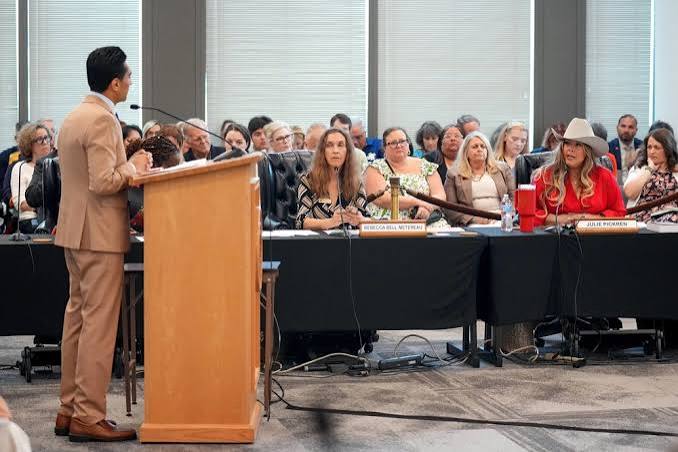
The Texas State Board of Education, controlled by Republican members, voted 9-5 on Friday to approve a mandatory statewide reading list for K-12 public schools that includes numerous Bible stories and passages alongside classic literary works. The list, which received preliminary approval in April, requires students at every grade level to read specific titles “in their entirety,” establishing what education experts describe as one of the first state-mandated literary canons of its kind in the nation. Board Chair Aaron Kinsey oversaw the vote following a contentious set of meetings in Austin that, at points, ran past 2 a.m. as members worked through proposed changes grade by grade.
Under the new requirements, elementary students as young as six years old will read picture-book versions of “David and Goliath” and “Daniel and the Lion’s Den,” while middle schoolers will study passages from the Sermon on the Mount in the New Testament, and high schoolers will read the story of Adam and Eve and the Parable of the Prodigal Son. The roughly 200-title list also includes secular works such as Charles Dickens’ “Great Expectations” and writings from authors including E.B. White, Kurt Vonnegut, and Elie Wiesel. The requirement goes well beyond a 2023 state law mandating that at least one board-approved literary work be taught at each grade level, and implementation will roll out on a staggered basis beginning with elementary grades in 2030.
At the same meeting, the board separately approved a rewrite of the state’s K-8 social studies curriculum, which eliminates a sixth-grade “World Cultures” course, deemphasizes global history and cultural diversity content, and significantly expands instruction on communism. Republican board member Brandon Hall called the combined changes a “generational opportunity,” stating, “We’re going to stop watering down American history.” Board member Tiffany Clark, a Christian Democrat representing parts of Dallas-Fort Worth, voiced opposition, arguing that “Bible lessons should be taught on Sundays” and noting that “not all of us believe the same,” pointing to varying translations and interpretations across Christian denominations.
The vote followed weeks of public testimony, with nearly 500 speakers addressing the board across multiple sessions, reflecting sharply divided views among parents, educators, and community members. Supporters, including Susan Perez, founder of the advocacy group Citizens for Education Reform, argued that “our nation was founded on Judeo-Christian values” and that Bible literacy is essential to understanding American history and Western literature. Critics, including Elva Mendoza of the progressive Texas Freedom Network, countered that the list “sends the message to children that one and only one religious text… is worthy of making this required reading list,” and raised concerns about both religious inclusivity and the diminished emphasis on diverse cultural perspectives in the revised social studies standards. The board postponed votes on remaining high school social studies courses to a future meeting, expected in September.
Why It Matters
The decision represents a significant escalation in a broader, sustained conservative push to expand religion’s role in American public education, building on a series of prior Texas measures including a 2023 law permitting schools to hire religious chaplains as counselors, a 2024 optional Bible-infused elementary curriculum, and a 2025 law requiring the Ten Commandments be displayed in every classroom, making Texas the largest state to do so. With Texas educating roughly one in ten public school students nationwide, the state’s curricular choices carry outsized influence over textbook publishers and instructional materials used well beyond its own borders.
Education policy experts note that Texas may be the first state to mandate a specific literary canon, rather than leaving text selection to local districts or individual teachers, a shift that Stanford University education professor Antero Garcia described as “a substantive reshaping” of what students learn throughout their public schooling. Garcia and other observers anticipate that other conservative-led states will study and potentially replicate the Texas approach, given the state’s historical influence on textbook content nationally due to the sheer scale of its purchasing power in the educational publishing market.
The accompanying social studies overhaul, which reduces emphasis on global cultures while expanding lessons specifically on communism, dovetails with a broader national Republican messaging effort, also reflected in President Trump’s recent remarks to the Faith and Freedom Coalition, to frame socialism and communism as urgent civic threats requiring direct educational attention. Critics argue this curricular emphasis reflects a politically motivated reframing of history education rather than a neutral expansion of civic knowledge, while supporters maintain it corrects what they describe as decades of insufficiently critical treatment of communist ideology in American schools.
Economic and Global Context
The financial stakes of Texas curriculum decisions are substantial given the state’s role as one of the largest textbook markets in the country. Texas previously had to spend $8.4 million correcting more than 4,200 errors found in its earlier “Bluebonnet Learning” Bible-infused elementary curriculum, illustrating both the scale of investment such initiatives require and the practical challenges of implementing large curricular changes across a state system serving millions of students.
The broader national context includes similar religious education initiatives gaining traction elsewhere; education officials in other states, including Oklahoma, have separately pursued Bible-mandate policies for public schools, suggesting Texas’s move may accelerate rather than originate a multi-state trend among Republican-controlled education systems. Publishers serving the national K-12 market will likely need to adapt offerings to accommodate both Texas’s new requirements and similar measures that may follow in other states, with implications for how religious and secular content gets balanced in instructional materials marketed nationally.
Legal scholars anticipate the mandate will likely face court challenges grounded in the First Amendment’s establishment clause, given the explicit requirement that all students engage with specifically Christian religious texts as a mandatory, rather than elective, component of public education. How courts ultimately resolve such challenges could have significant implications for similar religious curriculum efforts being considered or implemented in other states.
Implications
In the near term, the Texas board is expected to take up remaining high school social studies courses at its next scheduled meeting in September, with the possibility of an earlier special session if the chair determines one is warranted. Implementation planning for the K-12 reading list will continue ahead of the staggered 2030 rollout beginning with elementary grades.
For school districts and educators across Texas, the mandate removes a significant degree of local autonomy over literary curriculum decisions that have traditionally rested with districts, schools, or individual teachers, a shift that will require substantial professional development and instructional planning in the years before implementation begins.
For policymakers in other states, Texas’s action will likely serve as both a model and a test case, with national advocacy organizations on both sides of the debate closely monitoring implementation, legal challenges, and public reaction as they consider whether to pursue comparable measures in their own legislatures and state education boards.
Sources
“Texas education board approves Bible stories as required reading in public schools”

