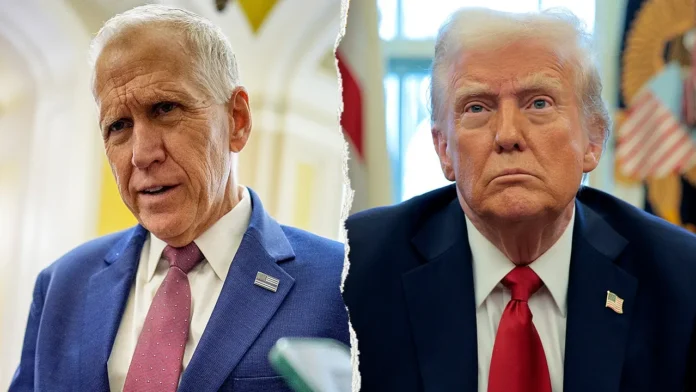
Senator Thom Tillis says President Trump’s top legislative priority, the SAVE America Act, has effectively died in the Senate, arguing there is no realistic path to implementing new voter ID and citizenship verification rules before November’s midterm elections. The blunt assessment from a sitting Republican exposes a widening rift within the GOP over election policy strategy just months before voters head to the polls. Tillis’s comments add to mounting signs that one of Trump’s signature legislative goals will not become law this cycle.
Story Highlights
- Senator Thom Tillis said the SAVE America Act is “dead” because there is not enough time to implement it before the November midterms
- The bill would require proof of citizenship to register to vote and photo ID to cast a ballot
- Tillis was one of four Republican senators who voted against attaching the bill to a budget reconciliation package
- The Senate parliamentarian ruled the bill ineligible for passage via reconciliation with a simple majority
What Happened
Senator Thom Tillis of North Carolina told the Raleigh-based News & Observer that the SAVE America Act, formally titled the Safeguard American Voter Eligibility Act, is functionally “dead” on Capitol Hill, arguing that even if Senate Republicans somehow secured the 60 votes needed to overcome a filibuster, there would be no realistic way to implement the law’s requirements across all 50 states before the November 3 general election. “Unless they do the work to get to the 60 votes, they know it’s dead, and so all this is theater,” Tillis said, repeating arguments he has made repeatedly in Washington urging Republican colleagues to shift focus to other legislative priorities.
The legislation would require individuals to prove citizenship when registering to vote and to present photo identification at polling places. Tillis, who previously implemented voter ID requirements as speaker of the North Carolina legislature, argued from firsthand experience that such changes require significant lead time and funding that Congress has not provided. “Let’s assume you only allow early voting in the month of October,” Tillis said. “Then do you honestly believe that we can have this thing up in 50 states? There’s no funding. There’s no specific implementation instructions.” He added that pushing the bill forward without addressing those logistical gaps risked undermining public confidence in the very elections it claims to protect.
Tillis was among four Senate Republicans who voted against an amendment sponsored by Senator Lindsey Graham that would have attached Trump’s preferred version of the SAVE America Act to a budget reconciliation package. The Senate parliamentarian separately ruled that the bill would enact substantial policy changes with only a tangential connection to federal spending, making it ineligible to pass via reconciliation with a simple majority rather than the 60 votes typically required to overcome a filibuster. Senator Bill Cassidy of Louisiana echoed similar skepticism in a separate appearance on CBS’s Face the Nation, saying he was uncertain of the president’s legislative priorities “beyond the SAVE Act,” while acknowledging that Louisiana’s own voter ID experience had been successful.
The bill has also been a source of friction between Trump and congressional Republicans more broadly. The president previously delayed a signing ceremony for a bipartisan housing bill, tying its progress to the SAVE Act’s passage, and has publicly dismissed the housing legislation as “a yawn” compared to what he calls the more urgent priority of voter ID reform. Speaker Johnson has indicated the House may attempt to pass the SAVE America Act again, potentially by repackaging it alongside the National Defense Authorization Act, though its prospects in the Senate remain effectively unchanged given the persistent lack of votes.
Why It Matters
Tillis’s public break with the White House on the SAVE Act reflects a broader dynamic within the Senate Republican conference, where a handful of members have shown willingness to publicly diverge from Trump’s stated legislative priorities, particularly on procedural questions involving the filibuster. Given that Tillis is retiring and has generally avoided direct criticism of the president, his blunt assessment carries added weight as a signal of genuine, rather than performative, opposition within the party.
The practical stakes of the bill’s failure are significant for how the 2026 midterms will be conducted. Voter identification and citizenship verification have been central themes of Trump’s public messaging around election integrity, and the bill’s effective demise removes a major legislative vehicle for those goals ahead of a consequential midterm cycle in which control of both chambers of Congress is at stake.
For election administrators across the country, the uncertainty surrounding the bill’s fate, even as the administration continues pushing for its passage, creates a difficult planning environment, particularly in states that would need to build new verification infrastructure with only a few months’ notice before ballots are cast.
The episode also illustrates the limits of presidential pressure on a closely divided Senate, where even a president’s top legislative priority can stall indefinitely when it lacks the votes to overcome a filibuster, regardless of how forcefully it is promoted publicly.
Economic and Global Context
Implementing new voter identification and citizenship verification systems nationwide would carry significant costs for state election offices, an issue Tillis specifically highlighted in noting that North Carolina’s own voter ID rollout took roughly a year to implement properly with adequate funding. Without a dedicated federal appropriation attached to the SAVE Act, states would likely bear much of that financial burden themselves, an unresolved question that has fueled skepticism among Republican governors and secretaries of state about the bill’s feasibility.
The legislative fight also intersects with a broader national debate over election administration that has intensified following recent Supreme Court rulings on mail-in ballot deadlines and voting rights, with Trump specifically citing a recent high-profile voting rights decision as new justification for pushing the SAVE Act forward on Truth Social.
Globally, election integrity measures similar to those proposed in the SAVE Act, including citizenship verification and photo identification requirements, are already standard practice in many democracies, a point supporters of the bill frequently cite, while critics note that implementation timelines and funding mechanisms in those countries typically involve years of advance preparation rather than the compressed timeline facing Congress this cycle.
Implications
In the near term, expect continued public friction between the White House and Senate Republicans over the bill’s prospects, particularly as Trump continues to describe its passage as a “national emergency” while key GOP senators like Tillis and Cassidy publicly acknowledge it lacks a viable path forward this year.
For Speaker Johnson and House Republicans, the pressure to demonstrate action on the issue may lead to further symbolic votes in the House, even without any realistic chance of Senate passage, a dynamic that risks being characterized by critics as political theater rather than substantive policymaking.
For voters and state election officials, the practical effect is that the 2026 midterms will almost certainly proceed under existing state election laws rather than any new federal voter ID or citizenship verification framework, leaving the broader fight over election administration rules to continue into the next Congress.
Sources
“Tillis: SAVE America Act is ‘dead’ as time has run out to implement new voting rules”

