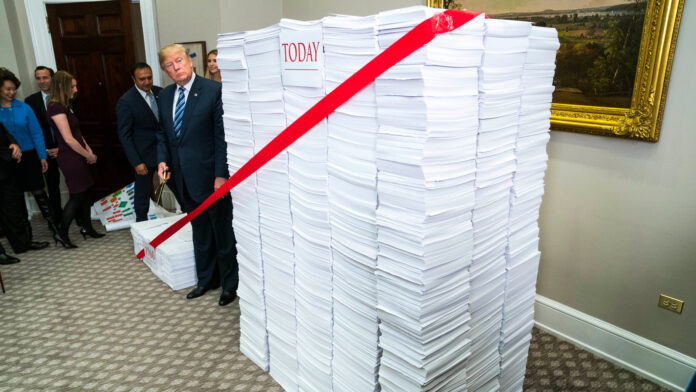
The Trump administration has issued fresh regulatory relief from Environmental Protection Agency restrictions, extending a deregulatory campaign that began earlier this year with the rescission of the landmark 2009 endangerment finding. The latest action grants critical facilities temporary exemptions from certain EPA compliance requirements in the name of national security and cost reduction. The move continues a pattern of aggressive rollback of Biden and Obama-era environmental rules that the administration says have driven up costs for American families and businesses.
Story Highlights
- The EPA issued new proclamations granting select critical facilities temporary relief from certain environmental compliance standards for national security purposes
- The action builds on February’s rescission of the 2009 Obama-era endangerment finding, which the administration calls the largest deregulatory action in American history
- The White House says prior deregulatory actions, including refrigerant rule reversals, have saved consumers and businesses over 1.3 trillion dollars
What Happened
The White House issued a new fact sheet detailing additional regulatory relief from Environmental Protection Agency restrictions, allowing certain critical facilities to comply with EPA standards that predate Biden-era rulemakings for a period of two years. The action represents the latest in a series of deregulatory proclamations the administration has pursued throughout 2026, building directly on what officials describe as the most consequential environmental policy reversal in American regulatory history.
The centerpiece of that broader campaign came in February, when President Trump and EPA Administrator Lee Zeldin announced the full rescission of the 2009 Obama-era endangerment finding, the scientific and legal determination that greenhouse gases pose a danger to public health and that has served as the foundational basis for nearly two decades of federal climate regulation under the Clean Air Act. Standing alongside Trump in the White House Roosevelt Room, Zeldin called the endangerment finding the “Holy Grail of the climate change religion” and declared its repeal the single largest deregulatory action in U.S. history, projecting savings to American taxpayers exceeding 1.3 trillion dollars.
The rescission eliminated federal greenhouse gas emission standards for motor vehicles and engines covering model years 2012 through 2027 and beyond, along with associated compliance, reporting and credit programs tied to the regulatory regime. The administration also eliminated the off-cycle credit tied to the automatic engine start-stop feature found in many modern vehicles, a feature Zeldin described as “almost universally despised” by consumers. White House officials projected the rollback would reduce new vehicle prices by an average of more than 2,400 dollars for popular light-duty cars, SUVs and trucks.
Since February, the administration has continued layering additional regulatory rollbacks onto that foundation. In May, Trump terminated Biden-era refrigerant regulations that had imposed compliance costs the White House says drove up prices for transporting and storing refrigerated goods, including food. Earlier in the year, EPA guidance affirmed farmers’ legal right to repair their own agricultural and non-road equipment, a change the administration estimated saves an average of 33,000 dollars per repair. December 2025 saw the administration reset Corporate Average Fuel Economy standards to levels officials say are achievable with conventional gasoline and diesel vehicles, reversing what the White House characterized as unrealistic Biden-era targets. The latest facility-specific exemptions extend this same deregulatory logic to industries the administration considers vital to national security.
Why It Matters
For American consumers, the administration frames its deregulatory campaign as a direct response to rising costs of living, arguing that vehicle price increases, refrigeration costs and agricultural equipment repair expenses were all driven higher by regulations imposed without commensurate environmental benefit. Supporters argue that the cumulative savings, which the administration pegs above 1.3 trillion dollars, translate into meaningful relief for household budgets strained by years of inflation.
For industry, particularly automakers, agricultural equipment manufacturers and refrigeration and food transport businesses, the rollbacks eliminate compliance burdens that companies have argued imposed substantial costs without corresponding market demand, especially given softer-than-anticipated consumer adoption of electric vehicles in recent years. Business groups have broadly welcomed the changes as restoring what they describe as consumer choice and manufacturing flexibility.
Critics, including environmental scientists and advocacy organizations, have raised significant concerns about the long-term implications of dismantling the legal foundation for federal climate regulation. Legal experts note the endangerment finding underpins nearly all federal authority to regulate emissions from vehicles, power plants and other pollution sources, meaning its rescission could have consequences extending well beyond the specific vehicle standards eliminated in February’s action, and the rollback is expected to face sustained legal challenges from environmental groups.
Economic and Global Context
The administration’s deregulatory push arrives amid a broader effort to lower costs for American consumers and businesses following a period of persistent inflation concerns. Administration officials have consistently framed environmental deregulation as a core component of their affordability agenda, positioning the endangerment finding rescission and subsequent rollbacks as directly responsive to household economic pressures rather than purely industry-driven policy shifts.
The auto industry in particular stands to see substantial changes in production planning, as manufacturers are no longer required to meet the federal emissions targets and reporting requirements that had shaped vehicle design and pricing strategies for over a decade. Industry analysts have noted that the removal of these standards could accelerate a shift away from electric vehicle production targets that automakers had previously built into long-term manufacturing plans under the prior regulatory framework.
Globally, the rollback places the United States increasingly at odds with international climate commitments and the regulatory trajectories of other major economies, including the European Union, which continue to pursue emissions reduction targets tied to international climate agreements. The divergence raises questions about the competitive dynamics facing American manufacturers in export markets that maintain stricter environmental standards for imported vehicles and industrial products.
Implications
In the near term, expect continued legal challenges from environmental organizations seeking to block or delay implementation of the various rollbacks, with the endangerment finding rescission representing the most consequential and heavily litigated of the administration’s actions. Courts will play a central role in determining how much of the deregulatory agenda survives judicial review in the coming months.
For businesses across the automotive, agricultural and refrigeration sectors, the rollbacks provide near-term operational and cost relief, though companies must also weigh the risk that successful legal challenges could reinstate some or all of the eliminated requirements, creating planning uncertainty around long-term investment decisions.
For voters heading into the November midterms, the administration’s deregulatory record is likely to feature prominently in campaign messaging, with Republicans emphasizing cost savings for consumers and Democrats highlighting environmental and public health concerns tied to the rollback of decades-old climate protections. The coming months will test whether the promised consumer savings materialize in visible, measurable ways that voters credit to the administration’s policy choices.
Sources

