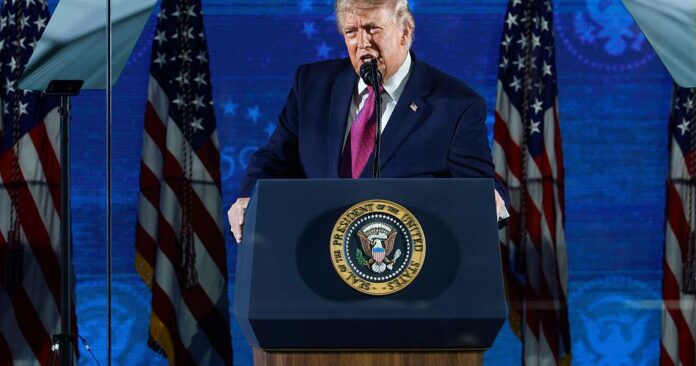
President Trump delivered a forceful rebuke of communism during a speech at Mount Rushmore on the eve of America’s 250th Independence Day, framing the nation’s founding ideals against what he described as a resurgent socialist movement within the Democratic Party. The address, delivered beneath the carved likenesses of four former presidents in Keystone, South Dakota, blended patriotic reflection on the nation’s history with sharp political messaging aimed at newly prominent democratic socialist candidates. The speech set the tone for a holiday weekend that doubled as both national celebration and a preview of Trump’s 2026 midterm messaging strategy.
Story Highlights
- President Trump delivered a roughly 30-minute speech at Mount Rushmore on July 3, calling communism “a mortal threat to American liberty” comparable to Pearl Harbor and 9/11.
- Trump declared “you can be a communist, or you can be a patriot. You cannot be both,” in remarks widely interpreted as targeting recently elected democratic socialist candidates.
- The speech marked Trump’s first appearance at the monument since 2020 and was billed by the White House as “inspiring” and “optimistic.”
- New York Mayor Zohran Mamdani delivered a competing Independence Day address the same day emphasizing America’s unfulfilled ideals without directly naming Trump.
What Happened
President Donald Trump delivered a wide-ranging speech at Mount Rushmore National Memorial in Keystone, South Dakota, on the evening of July 3, kicking off America’s 250th Independence Day weekend with remarks that combined patriotic tribute with pointed political messaging. Speaking beneath the granite likenesses of Presidents George Washington, Thomas Jefferson, Theodore Roosevelt, and Abraham Lincoln, Trump used the roughly 30-minute address to celebrate American exceptionalism while delivering what White House Press Secretary Karoline Leavitt had previewed as a “fierce rebuke” of communism. It marked Trump’s first appearance at the monument since 2020, and South Dakota Governor Larry Rhoden thanked the president for reviving Independence Day programming at the site.
The most striking portion of Trump’s remarks centered on what he characterized as a resurgent communist threat within American politics. “There is now a resurgence of the communist menace in our land, including from newcomers to our country who embrace ideas totally opposed to our way of life and our great success,” Trump told the crowd. He went further, declaring communism “a mortal threat to American liberty” and asserting it represented “the greatest threat to our country, including World War I, World War II, Pearl Harbor or even 9/11.” Trump did not name specific political figures directly, though he has repeatedly used similar rhetoric in recent weeks to describe democratic socialist candidates who won prominent primary races in New York.
Trump framed the choice facing Americans in stark, binary terms. “You can be loyal to Karl Marx, or you can be loyal to America. You can be a communist, or you can be a patriot. You cannot be both,” he said, describing communism as having “no respect for law, justice, principle, tradition, or your God-given rights” and stating it had caused more death and destruction than any political system in history, citing a figure of 100 million deaths attributed to communist governments over the past century. He also briefly addressed ongoing developments in the Middle East, referencing the recent conflict with Iran and stating that Iranian leadership was eager to formalize a settlement following the hostilities.
The speech was delivered under challenging weather conditions, with organizers issuing two separate shelter-in-place orders earlier in the day due to lightning strikes and hail near the monument. Despite the disruptions, Trump proceeded with his remarks as planned before departing for Washington, where he was scheduled to deliver a second address the following evening as part of the “Salute to America 250″ celebration on the National Mall. Notably, the speech occurred against a broader political backdrop in which New York Mayor Zohran Mamdani, a self-identified democratic socialist, delivered his own Independence Day remarks the same day, framing America as a nation still working toward the fulfillment of its founding ideals without directly naming Trump, though observers noted his remarks appeared to respond indirectly to the president’s rhetoric.
Why It Matters
Trump’s decision to deliver explicitly political, partisan messaging at a national monument historically associated with unifying, apolitical presidential rhetoric represents a notable departure from past Independence Day traditions observed by predecessors of both parties. Previous presidents delivering remarks at similarly significant national commemorations have generally sought to emphasize shared national identity rather than draw sharp partisan distinctions, and Trump’s approach reflects his broader strategy of using patriotic and historical occasions as vehicles for direct engagement with his political base ahead of a consequential midterm election cycle.
The specific focus on communism and democratic socialism carries clear strategic messaging value for Republicans heading into November. With multiple democratic socialist candidates having secured high-profile primary victories in recent months, Trump’s rhetoric provides a unifying theme for Republican midterm messaging, framing the choice facing voters in stark ideological terms rather than around specific policy disputes. This approach mirrors messaging strategies employed during previous election cycles when Republicans have sought to nationalize contests around broader ideological contrasts rather than localized concerns.
The speech’s timing and content also carry symbolic weight given the venue’s historical association with four presidents widely regarded as embodying different eras of American constitutional and national development. By explicitly invoking these historical figures alongside a warning about contemporary ideological threats, Trump sought to position his own political moment within a broader narrative of American historical continuity and struggle against external and internal threats to constitutional governance, a framing likely to resonate strongly with his core supporters while drawing sharp criticism from opponents who view the comparison as historically overreaching.
Economic and Global Context
Trump’s rhetorical emphasis on countering socialism and communism domestically occurs alongside continued economic messaging challenges for Republicans heading into the midterms. Polling conducted around the same period showed only 36 percent of Americans approving of Trump’s handling of cost-of-living issues, suggesting that abstract ideological messaging about communism may need to be paired with more concrete economic arguments to fully address voter concerns about affordability, a dynamic Democrats have already begun exploiting in their own midterm messaging strategy.
The speech’s brief reference to Iran occurred amid delicate, ongoing negotiations between the United States and Iranian officials regarding a proposed interim peace agreement following recent military hostilities in the region. Trump’s characterization of Iranian leadership as eager to formalize a settlement reflects the administration’s broader diplomatic posture, though Iranian officials have simultaneously issued their own public statements warning of potential consequences should the agreement’s terms not be fully honored by the United States and Israel.
Internationally, Trump’s sweeping characterization of communism as history’s greatest threat to American security, ranking it above events including Pearl Harbor and the September 11 attacks, is likely to draw scrutiny from historians and foreign policy analysts who may view the comparison as rhetorically significant but historically contestable, particularly given the complex and varied nature of America’s historical relationships with nominally communist and socialist governments across different eras of the twentieth and twenty-first centuries.
Implications
For Republican midterm strategy, Trump’s Mount Rushmore address establishes a clear ideological framework that GOP candidates are likely to echo in their own campaigns, emphasizing contrasts with democratic socialist and progressive Democratic candidates rather than focusing exclusively on traditional economic or policy-based critiques.
For Democrats, particularly progressive and democratic socialist candidates who have gained prominence in recent primary contests, Trump’s rhetoric provides both a challenge and a potential opportunity, forcing these candidates to directly address ideological characterizations while also potentially energizing their base supporters who view such attacks as validating their political relevance on the national stage.
For voters assessing the tone of American political discourse heading into a consequential midterm cycle, the speech represents a continuation of an increasingly polarized rhetorical environment surrounding national commemorative occasions, raising broader questions about whether such events can continue to serve their traditional function as moments of shared national reflection above partisan politics.
Sources

