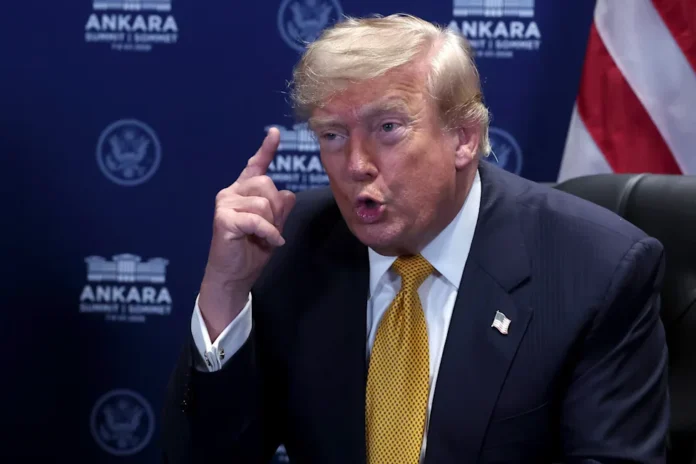
President Donald Trump said Friday that the ceasefire between the United States and Iran is “over,” even as he confirmed that diplomatic talks between the two countries would continue. The declaration comes after days of renewed military strikes triggered by Iranian attacks on commercial vessels in the Strait of Hormuz, a critical global oil corridor. The volatile standoff threatens to unravel a fragile memorandum of understanding reached between Washington and Tehran just weeks earlier.
Story Highlights
- Trump said in a Truth Social post that the U.S. has agreed to continue talks with Iran but reiterated that “the Cease Fire is OVER.”
- The renewed hostilities followed Iranian attacks on multiple commercial ships in the Strait of Hormuz, prompting American strikes on roughly 170 Iranian targets since Tuesday.
- Commercial shipping traffic through the strait, which normally carries about 20 percent of the world’s oil, remains severely depressed.
What Happened
The latest flare-up began after Iran targeted several commercial vessels transiting the Strait of Hormuz, a narrow waterway separating Iran from Oman that serves as one of the world’s most important oil shipping routes. Tehran has argued it has a right to control passage through and charge fees on ships crossing sections of the strait, a claim the United States rejects. In response to the attacks on shipping, American forces launched a series of strikes on Iranian targets, with U.S. Central Command reporting it had hit roughly 90 targets in a single day earlier in the week and close to 170 since the exchanges began.
Iran retaliated with strikes on U.S.-aligned Gulf states, including Qatar, Bahrain, Kuwait, and Jordan, triggering air-defense alerts across the region. Jordan’s military said it intercepted eight Iranian missiles, while Kuwait’s Defense Ministry reported shooting down two ballistic missiles and thirteen drones. Iranian state media reported explosions across multiple cities in southern Iran, and Tehran’s Foreign Ministry condemned the American strikes as targeting civilian infrastructure, including railway bridges.
Speaking to reporters and in a Truth Social post Friday, President Trump said the ceasefire established under the June memorandum of understanding was no longer in effect, though he confirmed the two sides had agreed to keep talking. “The Islamic Republic of Iran has asked us to continue ‘talks.’ We have agreed to do so,” Trump wrote. “But the United States has stated to them, in no uncertain terms, that the Cease Fire is OVER!” Iran’s Foreign Ministry spokesperson later disputed that new negotiations had been formally requested, though Iranian state television confirmed Tehran had accepted a visit from a Qatari mediation delegation.
Iran’s chief negotiator, parliament speaker Mohammad Bagher Ghalibaf, said Tehran remains “distrustful of the Americans” and is prepared for “all-out defense” if Washington breaks the agreement further, while also signaling openness to continued diplomacy. No new American strikes were reported Thursday night into Friday, and mediators including Qatar and Oman have been working to de-escalate tensions and restore safe passage through the strait, a step U.S. officials say is a prerequisite for any broader nuclear negotiations to resume.
Why It Matters
The Strait of Hormuz dispute strikes at one of the most economically sensitive chokepoints in the global energy system, and any sustained disruption carries the potential to affect gasoline and energy prices for American consumers well beyond the Middle East. The June memorandum of understanding had been billed as a critical step toward ending a war that began in February, and its unraveling raises the prospect of a prolonged, unresolved conflict without a clear diplomatic off-ramp.
For the Trump administration, the situation presents a delicate balancing act. Continued military strikes carry escalation risks with a regional power that has demonstrated willingness to target U.S. allies directly, while a failure to secure safe passage through the strait undermines the administration’s stated objective of restoring stability to global shipping lanes. Officials have said Iran must publicly commit to safe passage before nuclear talks can meaningfully proceed, tying the shipping dispute directly to the broader diplomatic track.
Domestically, the war carries political risk for Trump and congressional Republicans ahead of the midterms. Extended military engagement in the Middle East has historically proven unpopular with American voters, and continued instability could become a liability in competitive House and Senate races this fall, even as the administration frames its strikes as necessary responses to Iranian aggression.
For Gulf allies including Qatar, Bahrain, Kuwait, and Jordan, the direct targeting by Iranian forces underscores their exposure as hosts to American military infrastructure. Their willingness to continue supporting U.S. operations, and their own diplomatic efforts to mediate a de-escalation, will likely shape how quickly the situation can stabilize.
Economic and Global Context
Oil markets have responded sharply to the renewed hostilities. Prices surged more than six percent on initial reports that the ceasefire had collapsed, reflecting the strait’s outsized importance to global energy supply. With roughly 20 percent of the world’s oil historically transiting the waterway, even a partial and temporary disruption sends ripples through global markets, and further escalation could sustain upward pressure on fuel prices in the United States and abroad.
Commercial shipping data underscore the scale of disruption. According to MarineTraffic figures cited by U.S. officials, only about 15 commercial vessels transited the strait in a recent 24-hour period, a fraction of typical traffic, with roughly 20 ships reported crossing on a subsequent day. Shipping lines have increasingly rerouted vessels to avoid both the Strait of Hormuz and the Red Sea, adding time and cost to global trade routes and straining supply chains for goods dependent on Gulf shipping lanes.
The broader war has had cascading effects on regional economies. Flights in and out of the Middle East were disrupted for extended periods earlier in the conflict, and Dubai International Airport, one of the world’s busiest hubs, was forced to temporarily halt operations after drone strikes damaged its facilities. China has also moved to restrict exports of helium, a critical input for semiconductor manufacturing, citing supply pressures tied to the broader instability, illustrating how the conflict’s effects have rippled into unrelated global industries.
NATO allies, meeting at a summit in Ankara, Turkey, reaffirmed their commitment to freedom of navigation in the strait and called on Iran to respect international shipping norms, while reiterating that Iran must never be permitted to obtain a nuclear weapon. The alliance’s declaration reflects broader international concern that the conflict, now in its fifth month, has yet to produce a durable resolution despite periodic ceasefires and negotiating windows.
Implications
In the near term, much depends on whether Iran issues the public declaration U.S. officials say they are seeking, affirming that the Strait of Hormuz is open and that commercial vessels can transit safely without fear of attack. Senior U.S. officials have said that without such a declaration, the two sides will “never” move on to substantive negotiations over Iran’s nuclear program, making that step a critical near-term marker to watch.
For global markets, continued volatility in oil prices is likely until a clearer resolution emerges, with energy traders closely monitoring both diplomatic signals and shipping data for signs of stabilization. Businesses reliant on Gulf shipping routes may continue to face elevated costs and delivery delays as rerouting persists.
Diplomatically, the involvement of Qatar and Oman as mediators suggests both Washington and Tehran retain some appetite for a negotiated outcome despite the public rhetoric declaring the ceasefire dead. Analysts caution, however, that any renewed talks may yield limited near-term results given the erosion of trust between the two sides after repeated cycles of strikes and retaliation.
For the Trump administration, sustaining domestic and allied support for its approach will likely require demonstrating tangible progress, whether through a restored ceasefire, secured shipping lanes, or movement toward a final nuclear agreement, particularly as the political costs of an open-ended conflict continue to accumulate ahead of November’s elections.
Sources
“Mediators work to de-escalate US-Iran tensions and revive talks”

