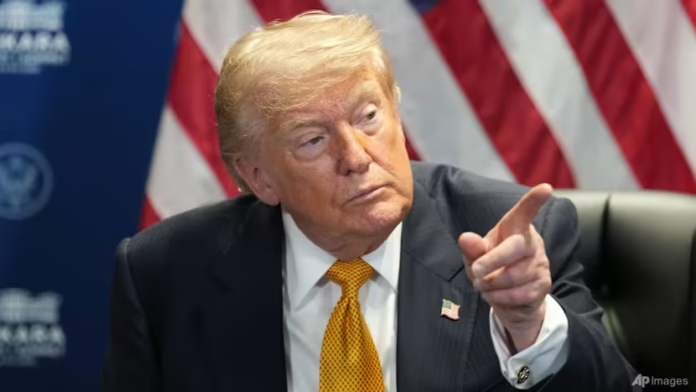
President Donald Trump fired the last three sitting members of the U.S. Election Assistance Commission this week, leaving the only federal agency dedicated solely to election administration without any commissioners just four months before the 2026 midterms. The move follows a recent Supreme Court ruling expanding presidential authority to remove leaders of independent agencies. Democrats and voting-rights advocates have condemned the dismissals as a power grab, while the White House says it is acting to safeguard election integrity.
Story Highlights
- Democratic commissioners Thomas Hicks and Benjamin Hovland were terminated by email; Republican commissioner Christy McCormick was asked to resign.
- The commission, evenly split by law between two Republicans and two Democrats, now has zero sitting members and lacks a quorum to conduct official business.
- The firings follow the Supreme Court’s Trump v. Slaughter decision, which gave presidents broader power to remove leaders of independent regulatory agencies.
What Happened
The White House ousted all three remaining commissioners of the Election Assistance Commission on Thursday, according to multiple people familiar with the terminations. Thomas Hicks and Benjamin Hovland, the panel’s two Democratic members, each received a brief termination email from White House aide Morgan DeWitt Snow around 4 p.m. Eastern time. The email read, in part, that the recipient’s position “is terminated effective immediately.” Christy McCormick, the sole remaining Republican commissioner, was contacted by phone and asked to resign rather than be formally fired.
Hovland learned of his termination while traveling in Missouri, where he was visiting a local election office and an early voting location to review new measures protecting election workers. He told reporters the commission has functioned as a clearinghouse for best practices among state and local election officials, helping jurisdictions with limited resources run elections more effectively. “It feels much more like a death-of-1,000-cuts situation than there’s one particular thing that you’re concerned about,” Hovland said, describing the broader erosion of election infrastructure support under the current administration.
The Election Assistance Commission was created by Congress in 2002 through the Help America Vote Act, in the aftermath of the disputed 2000 presidential election. Its four-member board, evenly split between the parties by design, oversees the federal testing and certification program for voting systems, maintains the national mail voter registration form, and provides technical assistance to state election officials. A fourth commissioner, Republican Don Palmer, had already resigned in April, leaving the panel with three members before Thursday’s dismissals emptied it entirely.
A White House official confirmed the terminations and said replacements would eventually be nominated, though any new commissioners would require Senate confirmation, a process that is rarely fast. The official cited the Supreme Court’s recent Trump v. Slaughter decision as legal justification, saying the “President, and head of the Executive Branch, reserves the right to remove individuals that may not be totally aligned with the important task of securing America’s elections.” The administration framed the move as part of a broader effort to combat fraud and strengthen election infrastructure ahead of November.
Why It Matters
The Election Assistance Commission’s paralysis arrives at a particularly sensitive moment, with control of Congress at stake in the midterms and state election officials already stretched thin. Without a quorum, the commission cannot take formal action on certifying voting systems, updating the Voluntary Voting System Guidelines that many states rely on before purchasing new equipment, or issuing guidance that helps standardize election administration nationwide. Advocacy groups warn that leaving the agency dormant during an active election cycle could compound existing strains on local election offices.
Democratic lawmakers have characterized the firings in stark terms. Senate Minority Leader Chuck Schumer called the move a “brazen attempt to seize control of our elections before a single vote is cast,” while Senator Mark Warner of Virginia said it “should concern every American, regardless of party.” Nevada Secretary of State Cisco Aguilar, who chairs the Democratic Association of Secretaries of State, warned that the burden of filling the gap would once again fall on state election officials.
Even some Republicans have expressed unease. Representative Mike Lawler of New York, who faces a competitive re-election race, said he “would not have done it at this moment, heading into the midterms,” reflecting concern among vulnerable House Republicans that the optics of dismantling a bipartisan election agency could carry political risk in swing districts.
The legal underpinning for the firings remains contested. The Supreme Court’s ruling in Trump v. Slaughter addressed removal power over agencies like the Federal Trade Commission but left unresolved whether that same logic extends to bipartisan election bodies specifically designed with statutory party-balance requirements. That ambiguity could set up further litigation testing the limits of presidential authority over independent commissions.
Economic and Global Context
While the Election Assistance Commission does not have direct economic functions, its disruption carries indirect costs for state and local governments that rely on federal guidance and voting-system certification to make equipment purchasing decisions. Many states condition purchases of new voting machines on federal certification through the commission’s accredited testing laboratories; a prolonged lapse in commission operations could delay procurement decisions or force states to rely on outdated guidance as they prepare for the midterms.
The commission has faced quorum problems before. For years following its creation, vacancies left it unable to perform major functions, contributing to delays in updating voting-system standards that persisted until the Senate confirmed a full slate of new commissioners in 2019. That prior period of dysfunction offers a rough historical parallel, though officials note the current situation differs in that all commissioners were removed simultaneously by presidential action rather than through the more gradual process of expiring terms and resignations.
Internationally, the United States’ handling of election administration has drawn scrutiny given the country’s decentralized system, in which most election rules are set at the state and local level. The Election Assistance Commission has served as one of the few unifying federal touchpoints for standardizing practices across thousands of local jurisdictions. Its incapacitation removes that coordinating function at a moment when foreign election-security concerns and domestic disputes over voting procedures remain heightened.
There is no direct market impact tied to the commission’s status, but the episode adds to a broader pattern this year of the administration testing the boundaries of executive removal power across multiple independent agencies, a trend that legal analysts say could have lasting implications for how regulatory bodies function across sectors including finance and telecommunications.
Implications
The most immediate practical question is how quickly the White House will nominate replacement commissioners and whether the Senate will move to confirm them before the midterms. Given the chamber’s calendar and the contentious nature of election-related nominations, confirmation before November is far from guaranteed, meaning the commission could remain without a quorum through the entirety of the 2026 election cycle.
State election officials, who have already begun preparing for November, will likely need to navigate certification and guidance gaps without federal support from the commission in the interim. Secretaries of state from both parties may face pressure to coordinate informally to fill some of that void, as several already indicated they expect to do.
Congressional Democrats are expected to pursue oversight hearings and potentially legislative or legal action challenging the firings, though any such effort would face a difficult path in a Republican-controlled Congress. Litigation testing the reach of Trump v. Slaughter as applied to bipartisan, statutorily balanced commissions is a plausible next step and could take months to resolve, likely extending well past the midterms themselves.
For voters, the practical effect may be less visible than the political fallout, since most day-to-day election administration occurs at the state and county level. Still, the loss of federal coordination and technical support arrives at a moment when public trust in election administration remains a persistent and politically charged issue nationwide.
Sources
“Trump ousts remaining members of the Election Assistance Commission ahead of midterms”

