Story Highlights
Trump directed nominee Jay Clayton not to appear at his own confirmation hearing this week
Trump tied the delay to unrelated demands involving a U.S. attorney nomination and his voter ID legislation
Senate Majority Leader John Thune said he had not received clarity from the White House on next steps
What Happened
President Donald Trump moved to delay the confirmation process for his own nominee to lead the intelligence community this week, directing federal prosecutor Jay Clayton not to appear at a scheduled Senate Intelligence Committee hearing just hours before it was set to begin. In an early morning Truth Social post, Trump said he was “cancelling” the hearing and would not allow it to proceed until the Senate confirmed Jamie McDonald, his pick to replace Clayton as U.S. Attorney for the Southern District of New York.
The reversal caught Senate Republicans off guard, particularly Senator Tom Cotton of Arkansas, the Intelligence Committee chairman and a close Trump ally, who initially indicated the hearing would proceed regardless of the president’s social media post. Cotton stated that the committee would move forward “unless the president directs him not to appear or withdraws his nomination.” Within two hours, Trump escalated the situation by directly instructing Clayton not to attend, forcing Cotton to publicly reverse course and postpone the hearing, calling the development “regrettable” while still praising Clayton as “a patriot and a highly qualified nominee.”
Trump’s Truth Social post also linked the delay to his long-stalled SAVE America Act, a voter identification and proof-of-citizenship bill that has repeatedly failed to advance in the Senate due to unanimous Democratic opposition and defections from several Republican senators, including Susan Collins, Lisa Murkowski, and Mitch McConnell. Trump wrote that he would not approve renewal of a separate, already-expired intelligence surveillance authority unless it was paired with passage of his voting legislation, further complicating an already tangled legislative situation.
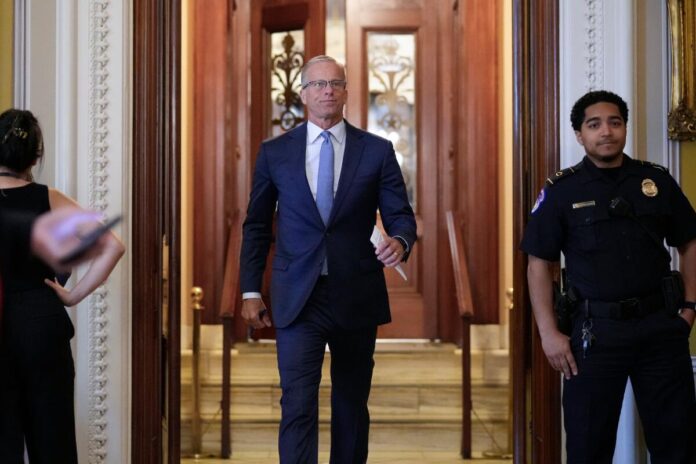
Senate Majority Leader John Thune, appearing visibly uncertain when questioned by reporters, said he had not received clarity from the White House about how to proceed. “I can only do what I can do here,” Thune said. “We’re the Article I branch. The president, this is his nominee, and so obviously he made a decision not to move forward at the moment, and we’ll see what comes next.” Senator Todd Young of Indiana, a member of the Intelligence Committee, expressed regret over the delay while acknowledging it remained within the president’s prerogative as the nominating authority.
Why It Matters
The episode represents one of the more striking examples this year of a sitting president disrupting his own administration’s personnel priorities to extract leverage on an unrelated legislative goal, even at the cost of delaying the confirmation of a nominee he has repeatedly praised as highly qualified. For Senate Republicans already managing a difficult midterm landscape, the unpredictability surrounding Trump’s demands complicates their ability to present a unified, functioning governing agenda to voters.
The dispute also leaves the broader intelligence community in a state of prolonged uncertainty regarding its permanent leadership, since the delay means Bill Pulte, a controversial figure with no intelligence background, will continue serving in an acting capacity for an indefinite period. Several Senate Republicans, including Thune, have previously stated they do not want a “weaponized DNI,” reflecting discomfort within the party’s own ranks about the situation Trump’s latest demand has prolonged.
For Republican senators up for reelection in competitive states, episodes like this one create a difficult balancing act between demonstrating loyalty to a president who remains popular with the base and avoiding association with governing dysfunction that Democrats are likely to highlight heading into November. The pattern of public confusion, reversed statements, and unclear White House guidance does little to support the message of effective one-party governance that Republican leaders have sought to project.
The dispute additionally underscores the practical costs of linking unrelated legislative and personnel priorities together, a strategy that has become increasingly common but that risks tangling multiple Republican objectives, in this case national security leadership, a U.S. attorney appointment, and a marquee voter identification bill, into a single unresolved standoff.
Economic and Global Context
The continued absence of permanent leadership at the helm of the intelligence community carries implications beyond domestic politics, particularly given that the position oversees coordination across eighteen federal intelligence agencies responsible for both foreign and domestic threat assessment. International partners who coordinate with U.S. intelligence services rely on stable counterpart leadership, and prolonged uncertainty can complicate routine information-sharing arrangements.
The SAVE America Act, which Trump is using as leverage in this dispute, has been a central but largely unsuccessful priority throughout the current Congress, having failed multiple times to overcome the Senate’s 60-vote cloture threshold due to unified Democratic opposition and a handful of Republican defections concerned about ballot access implications.
The broader pattern of friction between Trump and Senate Republicans this year, including previous standoffs over a controversial Justice Department settlement fund and other nominations, has been described by GOP aides as creating a cumulative drag on the party’s ability to execute a coherent legislative strategy heading into a midterm cycle where Republicans are defending narrow majorities in both chambers.
Implications
For the Senate, the path forward depends entirely on guidance from the White House that, as of this week, had not been provided to GOP leadership, leaving Cotton’s committee unable to reschedule Clayton’s hearing or offer senators a timeline for resolution.
For Clayton, the delay leaves his own confirmation prospects in limbo despite broad bipartisan acknowledgment of his qualifications, illustrating how individual nominees can become collateral in broader political disputes unrelated to their own credentials.
For Republican leadership heading into the midterms, continued episodes of this kind risk reinforcing a narrative of internal disorganization at a moment when the party needs to demonstrate effective governance to maintain its congressional majorities in November.
Sources
Senate postpones confirmation hearing for intel chief after Trump’s call to delay

