Story Highlights
- President Trump declared on Tuesday that Iran has “fully and completely agreed” to future nuclear inspections
- Iran’s Foreign Ministry spokesperson told state media there are no scheduled IAEA visits and “no protocol exists in this regard”
- Vice President Vance said on Monday that IAEA inspectors were expected to resume their work in Iran as early as this week
What Happened
President Donald Trump on Tuesday insisted Iran has “fully and completely agreed” to future inspections of its nuclear facilities as negotiators work toward a final peace deal. The declaration came after Trump landed in Pennsylvania and spoke to reporters, pushing back directly against statements coming out of Tehran.
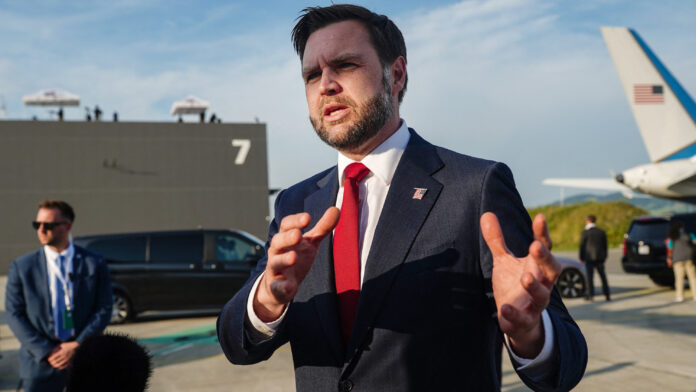
Vice President JD Vance echoed the positive assessment of mediators following the first round of high-level negotiations in Switzerland. Washington and Tehran had “laid a very good foundation for a successful final deal,” Vance said Monday. He said Iran had agreed to allow the United Nations watchdog, the International Atomic Energy Agency, to examine Iranian nuclear sites bombed by the United States last year.
However, Iranian Foreign Ministry spokesperson Esmail Baghaei told the state-run Fars News Agency there are no plans to allow inspectors into Iran and that no meeting has been scheduled with IAEA Director-General Rafael Grossi. “No protocol exists in this regard,” he told state media.
Secretary of State Marco Rubio is visiting the Persian Gulf region to “make sure that their views are taken into account” as the United States moves forward on negotiations with Iran. “We’re really here to hear from them more than we are to talk,” Rubio told reporters on the tarmac in Abu Dhabi, saying he wants to hear about economic and security concerns.
When asked about Iranian officials contradicting the administration’s account, Trump remained firm. “They’re wrong, they’re wrong, they know they’re wrong,” Trump told reporters. “They told us inside, and we have it down 100%. And if they were right, I’d cancel the meetings right now.” He declined to provide a timeline for when inspectors would be on the ground, saying only “at the appropriate time.”
Why It Matters
The credibility gap between Washington and Tehran represents one of the most consequential variables in determining whether a durable peace agreement can be achieved. Nuclear inspections are not a peripheral detail — they are the core mechanism by which the international community can verify whether Iran is genuinely abandoning its weapons-grade enrichment capability. Without access, any agreement lacks enforcement substance.
Vance acknowledged the ambiguity, saying: “We’re going to see what they actually let the inspectors do once they’re in the country. That’s going to continually be a part of our negotiation.” He added: “My point is not that I trust or distrust anybody. My point is that I trust actions.” That framing — results over promises — suggests the administration is aware that verification will be an ongoing battle, not a settled matter.
Nuclear policy experts have warned the deal could leave dangerous gaps. Andrea Stricker, deputy director of the Foundation for Defense of Democracies’ Nonproliferation Program, told Fox News Digital that any credible agreement must begin with recovering and safeguarding Iran’s enriched uranium stockpile, and not allowing Tehran to keep control of the material while it is diluted inside the country.
The stakes extend beyond diplomacy. If Iran is perceived to be stalling or misleading U.S. negotiators, political pressure from hawkish lawmakers and allied governments — particularly Israel — could quickly undermine the peace process entirely. Congressional Republicans in favor of a firm deal have indicated that inspections with unrestricted access are a non-negotiable element.
Economic and Global Context
The Treasury confirmed it was waiving all existing U.S. sanctions on the production, delivery, and sale of crude oil and petrochemical products of Iranian origin through August 21, 2026. The lifting of the sanctions will give Iran a huge financial boost while it continues negotiating with the U.S. to reclaim its roughly $100 billion in frozen financial assets.
Oil markets have watched the U.S.-Iran negotiations closely since the 2026 war disrupted shipping traffic through the Strait of Hormuz, one of the world’s most critical energy transit points. Any resolution that reopens the strait fully and reduces Iranian sanctions could meaningfully increase global crude supply and place downward pressure on oil prices — a priority for Trump, who has pointed to energy costs as central to his economic agenda.
Gulf Arab states have an acute stake in the outcome. Rubio’s visit to the UAE, Kuwait, and Bahrain underscored how deeply America’s partners in the region are watching the talks. Those governments fear an Iran emboldened by a weak nuclear deal that lacks enforceable inspection rights — a concern that also resonates in Riyadh and Tel Aviv. European allies have their own interests in a verifiable agreement, given that Iranian enrichment levels reached near-weapons grade before the 2026 war began.
Implications
The contradictory public statements from Washington and Tehran will test whether the diplomatic process can withstand early turbulence. Negotiators on both sides will be under intense pressure to clarify what, precisely, was agreed to in Switzerland before the situation deteriorates into mutual recriminations. A breakdown in messaging this early in the process risks hardening public opinion on both sides against compromise.
For the Trump administration, the inspections question is also a domestic political matter. Republicans who backed the war expect the administration to secure binding, verified commitments from Iran — not a rerun of the Obama-era framework, which many conservatives viewed as porous and easily circumvented by Tehran. The president will need to demonstrate that this deal is fundamentally different.
The reported U.S.-Iran memorandum of understanding identifies on-site downblending — diluting enriched uranium so it is less usable for a nuclear weapon — under IAEA supervision as the minimum acceptable method for dealing with Iran’s nuclear material. A still-to-be-negotiated process will determine the final fate of Tehran’s enriched uranium stockpile. That unresolved detail leaves the agreement’s most critical component open to further dispute.
The coming days will reveal whether the administration’s confidence is justified. IAEA inspectors have not had access to Iran’s bombed enrichment sites since the 2026 war began. If they do gain access this week, as Vance predicted, it will validate the administration’s account. If Tehran continues to block entry, the entire foundation of the Switzerland talks will face a serious credibility crisis.

