Story Highlights
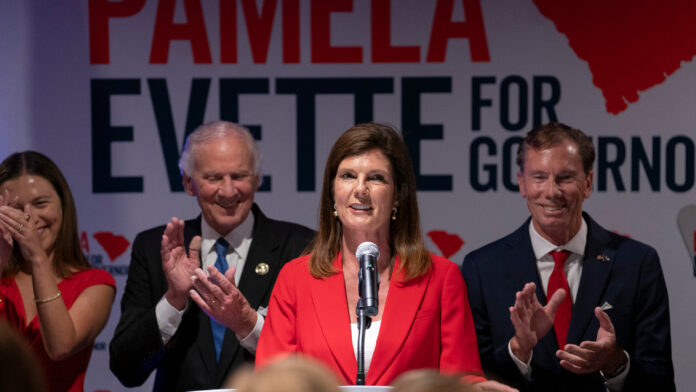
- Trump initially endorsed Lieutenant Governor Pamela Evette but has since extended a co-endorsement to include Attorney General Alan Wilson ahead of the June 23 runoff
- Evette led the six-candidate field with just under 30 percent support in the June 9 primary, with Wilson trailing closely at 26 percent
- Representative Nancy Mace, who clashed with Trump after championing release of the Epstein files, finished out of contention and has endorsed Wilson
What Happened
South Carolina’s Republican primary for governor opened as a wide-open contest following Governor Henry McMaster’s term-limited departure, drawing a crowded field that included Lieutenant Governor Pamela Evette, Attorney General Alan Wilson, Representatives Nancy Mace and Ralph Norman, and businessman Rom Reddy. Trump issued a late endorsement of Evette ahead of the June 9 primary, calling her a “good friend, fighter, and WINNER” during early voting, an endorsement that echoed support she also received from outgoing Governor McMaster. Trump’s endorsement notably included a suggestion that McMaster’s son could serve as Evette’s running mate, a comment that drew criticism from her rivals, who characterized it as evidence of a backroom arrangement.
Neither Evette nor Wilson secured the majority needed to avoid a runoff in the June 9 primary, with Evette taking just under 30 percent support and Wilson following closely behind at 26 percent. The result eliminated Mace, a congresswoman whose relationship with Trump had deteriorated significantly after she joined a bipartisan push to force the release of Justice Department files related to Jeffrey Epstein. Mace, who had once positioned herself as a Trump loyalist following her initial criticism of him after the January 6, 2021, Capitol attack, conceded on primary night and immediately endorsed Wilson, telling supporters she wanted “a law and order governor.”
According to reporting from the Post and Courier, Trump personally called Evette on primary night to pledge he would do “whatever it takes” to ensure her victory in the runoff, signaling at the time a continued exclusive commitment to her candidacy. However, Trump’s subsequent public posture shifted toward a co-endorsement encompassing both Evette and Wilson as the runoff approached, according to Wikipedia’s tracking of the race’s endorsement history, a notable departure from his typical pattern of backing a single candidate decisively in contested primaries.
The runoff campaign has featured a pre-runoff debate hosted by the South Carolina Republican Party on June 16, with both candidates working to consolidate support from the eliminated primary candidates. Wilson, who has served as attorney general since 2010 and gained national recognition for his office’s prosecution of the Alex Murdaugh double murder case, has emphasized his experience and law enforcement background, while Evette has continued to draw a contrast with what her campaign describes as a “career politician” opponent.
Why It Matters
Trump’s shift toward a dual endorsement represents an unusual departure from his characteristic approach to Republican primaries, where his backing has typically been presented as exclusive and decisive. The move suggests either genuine uncertainty within Trump’s political operation about which candidate is better positioned to win the runoff and ultimately the general election, or a calculated effort to avoid the kind of high-profile setback Trump experienced in Georgia’s gubernatorial primary, where his sole endorsement of Burt Jones ended in defeat against a well-funded challenger.
For South Carolina Republicans, the race carries significance beyond the immediate gubernatorial contest because the state traditionally holds early influence in shaping national Republican politics, including its role as a first-in-the-South presidential primary state. Whoever wins the nomination and subsequent general election will play an outsized role in shaping the contours of South Carolina’s political landscape heading into the 2028 presidential cycle, when the state’s primary will again draw national attention.
The contest also reflects internal Republican tensions over the Epstein files controversy that have rippled through multiple races this cycle. Mace’s primary defeat, following her vocal advocacy for file disclosure, and her subsequent endorsement of Wilson rather than the Trump-aligned Evette, illustrates how that issue has created durable fault lines within the party that extend beyond the original congressional disputes into down-ballot state races.
For Republican voters in South Carolina, the choice between Evette and Wilson ultimately centers on competing visions of executive experience, with Evette emphasizing her business background and gubernatorial readiness gained through her lieutenant governor role, while Wilson leans on his extensive prosecutorial record and longer tenure in elected statewide office, providing a genuine ideological and experiential choice within a broadly conservative field.
Economic and Global Context
South Carolina’s economy, anchored by a substantial manufacturing base including major automotive and aerospace operations, along with a growing technology and life sciences sector, makes the governor’s office consequential for the state’s economic development trajectory and ongoing efforts to attract additional industrial investment. Both Evette and Wilson have campaigned on continuing the state’s aggressive approach to economic recruitment that has characterized recent Republican administrations.
The race occurs against the backdrop of failed efforts earlier this year to redraw South Carolina’s congressional map to eliminate the state’s sole Democratic-held seat, held by longtime Representative Jim Clyburn. The Republican-controlled state Senate rejected that Trump-backed redistricting push, a decision that drew contrast with more aggressive redistricting moves in neighboring states like Tennessee and Louisiana, suggesting a degree of institutional caution among South Carolina Republicans that may also be reflected in the relatively competitive and contested nature of the gubernatorial primary itself.
Nationally, South Carolina’s gubernatorial race is being watched as one of several contests this cycle testing whether Trump’s continued political dominance within the party can withstand genuinely competitive primary fields, particularly in deep-red states where the eventual Republican nominee faces minimal general election risk regardless of which candidate prevails in the primary.
Implications
The immediate outcome of Tuesday’s runoff will determine the Republican nominee heading into a general election against the eventual Democratic nominee, in a state where Democrats have not won a gubernatorial election since 1998, making the Republican primary effectively determinative of the state’s next governor barring a significant electoral surprise.
For Trump’s broader endorsement strategy, the South Carolina co-endorsement approach may signal a more cautious posture in future contested primaries, particularly following the high-profile loss in Georgia, as the political operation weighs the risks of exclusive endorsements in races with genuine uncertainty against the value of decisive intervention in races where Trump’s preferred candidate holds a clearer advantage.
For the losing candidate in Tuesday’s runoff, whether Evette or Wilson, the defeat would mark a significant setback for a statewide political career, while the winner will need to quickly pivot toward general election positioning and fundraising with limited time before the November contest.
For national Republican strategists, the South Carolina race will offer additional data on how the party’s primary electorate weighs competing claims to MAGA alignment when Trump’s own endorsement signal becomes less than fully decisive, informing how the party approaches candidate recruitment and endorsement strategy in future open-seat gubernatorial races across other competitive states.
Sources

