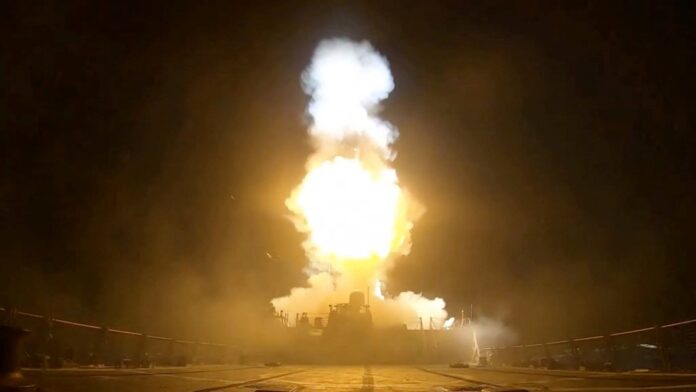
President Trump ordered a third round of U.S. military strikes against Iran this week after the Islamic Revolutionary Guard Corps attacked a commercial vessel transiting the Strait of Hormuz, further shattering an already fragile ceasefire between Washington and Tehran. The strikes, which hit roughly 140 Iranian targets, came as mediators in Oman pushed for renewed diplomacy even as both sides continued exchanging fire. The escalation threatens global oil shipping routes and raises fresh questions about the durability of the June ceasefire agreement.
Story Highlights
- U.S. forces struck approximately 140 Iranian military targets early Sunday, the third round of strikes in a single week
- The strikes followed an Iranian attack on the Cyprus-flagged container ship M/V GFS Galaxy, leaving one crew member missing
- Iran declared the Strait of Hormuz closed “until further notice” after the exchange
- Trump warned that “1000 Missiles are Locked and Loaded” while diplomatic talks continued in Oman
What Happened
The latest escalation began when Iran’s Islamic Revolutionary Guard Corps attacked the Cyprus-flagged container ship M/V GFS Galaxy as it transited the Strait of Hormuz, leaving a civilian crew member missing and causing an onboard fire that left the vessel unable to continue its voyage. U.S. Central Command, known as CENTCOM, characterized the attack as a blatant violation of the memorandum of understanding signed in June, which had called for an end to hostilities, the lifting of a U.S. naval blockade on Iran, and the reopening of the strait to commercial traffic.
In response, CENTCOM said American forces launched strikes beginning at 7:15 p.m. Eastern time Saturday, hitting approximately 140 Iranian military targets including missile and drone storage sites, naval assets, ammunition depots, communication networks, and coastal surveillance installations. CENTCOM stated the operation was carried out “at the direction of the Commander in Chief,” and Defense Secretary Pete Hegseth posted on social media that “Iran made a poor choice. Now they pay.” The strikes marked the third such operation against Iran within a single week, following earlier rounds on July 7 and July 9 that together hit roughly 170 additional targets.
Iran’s response was swift. The IRGC declared the Strait of Hormuz closed “until further notice” and said it had fired warning shots at a vessel attempting to use what it called an unauthorized route through the waterway. Iranian state media accused unnamed foreign powers of interference by encouraging vessels to test the closure. A senior adviser to Iran’s supreme leader, Mohsen Rezaee, said the strait was “more important than dozens of atomic bombs” and vowed the country would protect it regardless of consequences.
Trump escalated his own rhetoric over the weekend, warning in a Friday night Truth Social post that “1000 Missiles are Locked and Loaded” and aimed at Iran. He separately told the New York Post that he had left standing orders for U.S. forces to strike Iran “at levels that they’ve never seen before” should the regime attempt to assassinate him, a threat he said Iranian officials had privately raised. U.S. officials told CBS News that Iranian officials had separately signaled they viewed the ship attacks as a mistake carried out by a “rogue faction” of hardliners within the IRGC seeking to undermine ongoing negotiations.
Amid the strikes, diplomatic efforts continued in Muscat, where Iranian Foreign Minister Abbas Araghchi met with his Omani counterpart to discuss a tentative Omani proposal for managing traffic through the strait via two separately controlled routes. A senior American delegation, including Vice President JD Vance, Secretary of State Marco Rubio, and special envoy Steve Witkoff, was also dispatched to the region for parallel talks, though U.S. officials maintained that substantive negotiations could not proceed until safe passage through the strait was assured.
Why It Matters
The renewed strikes represent one of the most serious tests yet of the June ceasefire, raising the prospect that the conflict between the United States and Iran could escalate into a more sustained and open-ended military engagement rather than the contained campaign officials initially described. Trump’s own public statements, including his declaration that the ceasefire is “over,” suggest the administration may be shifting toward a more prolonged posture of military pressure rather than a return to the negotiating table.
For American service members and regional allies, the escalation carries direct security implications. Iran has already retaliated against U.S. military installations in Kuwait and Bahrain, and continued strikes raise the risk of American or allied casualties in a conflict that has already drawn in neighboring Gulf states. Qatar reported that debris from intercepted missiles injured three people, including a child, illustrating how quickly the conflict’s effects have spread beyond the two primary combatants.
The dispute over the Strait of Hormuz carries outsized economic significance given that a substantial share of global oil shipments passes through the waterway daily. Iran’s repeated closures and attacks on commercial vessels have already disrupted shipping patterns, and further escalation threatens broader global energy markets and supply chains that remain sensitive to instability in the region.
Domestically, the conflict is likely to remain a significant point of political debate, with questions about congressional authorization for continued military action, the scope of the president’s war powers, and the potential for American casualties all likely to intensify as the strikes continue without a clear resolution in sight.
Economic and Global Context
The Strait of Hormuz remains one of the world’s most critical energy chokepoints, and repeated attacks on commercial shipping have already caused measurable disruptions to vessel traffic through the waterway. Analysts have noted that any sustained closure or continued attacks could push global oil prices higher and increase shipping insurance costs for vessels transiting the region, effects that would likely ripple through fuel prices in the United States and allied nations.
The current round of hostilities follows the U.S. decision to revoke a sanctions waiver on Iranian oil sales that had been part of the original June ceasefire framework, after Iran attacked three commercial vessels earlier in the month. That decision, combined with the reinstated naval blockade Trump ordered on Iranian ports, has significantly tightened economic pressure on Tehran even as military confrontation continues.
Internationally, the conflict has drawn condemnation from several Gulf states after Iran launched retaliatory strikes against Jordan, the United Arab Emirates, Bahrain, Oman, and Kuwait in addition to direct strikes on U.S. positions. Qatar issued a formal condemnation of the attacks, underscoring how the conflict has expanded well beyond a bilateral U.S.-Iran confrontation into a broader regional crisis involving multiple American allies.
Diplomatic mediation efforts led by Oman and Qatar continue in parallel with the military escalation, reflecting the complex dual-track nature of the crisis, in which active combat operations proceed alongside genuine, if strained, efforts to reach a durable arrangement for managing the strait and de-escalating broader hostilities.
Implications
In the immediate term, the outcome of ongoing talks in Muscat between Iranian and Omani officials, along with the parallel American diplomatic delegation, will determine whether the current cycle of strikes and retaliation can be interrupted before further escalation occurs. The proposed dual-route framework for managing strait traffic represents one potential off-ramp, though its viability remains uncertain given the pace of recent hostilities.
For global markets, continued instability in the strait is likely to keep energy prices elevated and could prompt further volatility in shipping and insurance sectors tied to Middle Eastern trade routes, with downstream effects on consumer fuel prices in the United States and other major economies.
For congressional policymakers, the scale and duration of the current military campaign may prompt renewed debate over war powers authorization, particularly if strikes continue without a clear endpoint or if American casualties occur in the conflict’s expanding regional footprint.
For the Trump administration, the coming days will test whether continued military pressure can produce a genuine de-escalation or whether the conflict will continue expanding, with the president’s own rhetoric suggesting a willingness to sustain and even intensify operations should Iran fail to comply with the terms of the original memorandum of understanding.
Sources

